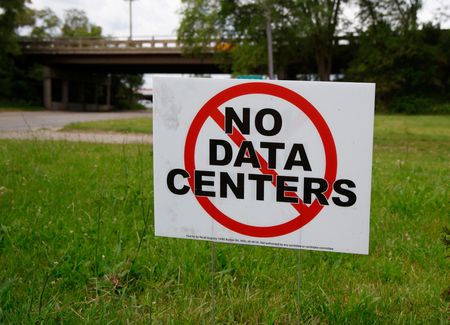

Opponents of the booming data center industry are taking their frustration to the streets this Saturday, with demonstrations planned at more than 125 sites across the country in what organizers are calling the first nationwide coordinated effort to push back against the rapid growth of artificial intelligence infrastructure.
The effort is being led by a grassroots organization known as HumansFirst, which was co-founded by a former leader of the modern-day Tea Party movement. The co-founder has drawn comparisons between the growing data center opposition and that right-wing populist wave that rose up in 2009 to fight what it viewed as government overreach and excessive taxes.
HumansFirst says protesters are rallying against what they describe as an “unaccountable” expansion of data centers and an “unacceptable infringement on our liberty.”
The backlash has been building at the local level, with towns and counties leading the charge against data center projects that have sometimes been approved by local officials who signed non-disclosure agreements with developers — often over the objections of residents and without meaningful regulatory review. Now state and national politicians are scrambling to respond to growing voter anger over concerns including higher electricity costs, the strain on water supplies, and environmental pollution.
Opposition to data centers has become one of the rare issues bringing together Americans of different political beliefs. A Reuters/Ipsos poll conducted in June found that only about one-third of Americans approve of the current pace of data center construction in the U.S. Even fewer — just 14% — said they would welcome a data center being built in their own community to support AI projects for major tech companies including Meta, Alphabet, Amazon, Microsoft, and Elon Musk’s xAI.
The Data Center Coalition, which represents and lobbies on behalf of the industry, did not respond to requests for comment on the planned protests. The group has previously stated that data centers are committed to being good neighbors in the communities where they are located.
HumansFirst co-founder Amy Kremer acknowledged the Tea Party comparison but was clear that anger over data centers crosses party lines.
“They just woke up one day and found out they’re going to have this monstrosity in their community, and they don’t want it,” Kremer said. She also predicted that data centers will become a defining issue heading into November’s midterm elections and the 2028 presidential race.
Kremer has taken aim at Republicans for giving Big Tech a “free pass,” but she and fellow organizers have also said they don’t back policies like moratoriums on data center approvals — such as the one adopted in the Democratic state of New York. Instead, organizers say they want more transparency in the development process, stronger protections for natural resources and environmental health, community benefits like well-paying union jobs, and real accountability for developers who fail to keep their promises.
As of Friday evening, Texas — a Republican stronghold and a hotspot for data center development — was on pace to have the highest number of protests with 16. Georgia had 11, while California, Florida, and Pennsylvania each had 7 planned demonstrations.
Eva Cardona, 31, a first-time activist who describes herself as a “political nomad,” is organizing one of the Texas protests. “I’ve been hearing about unregulated AI and the rapid growth was alarming me. I wanted to do something more hands-on than just your standard Facebook post,” she said.
In California’s Imperial County, located in the desert, left-leaning activist Ivan DelSol, 54, is helping lead a protest against a proposed data center that could draw as much as 260 million gallons of water per year from the Colorado River. “It’s dystopian that you would use this much fresh water for AI,” DelSol said.
Water usage is frequently cited as a top concern among data center opponents, particularly in regions already dealing with water scarcity. The data center industry, however, argues that its water consumption is not as significant as that of other industries.