
KYIV, Ukraine — When nuclear disaster struck the Chernobyl power plant on April 26, 1986, Associated Press photographer Efrem Lukatsky was living in Kyiv, just two hours away from the catastrophe. Over the past four decades, he has documented the exclusion zone dozens of times, capturing the haunting legacy of a disaster that continues to impact Ukraine today.
The catastrophe didn’t begin with official announcements — it started with workplace rumors.
Soviet authorities made no immediate public statement about the nuclear accident in 1986. Information spread only through hushed conversations between coworkers.
Lukatsky was working as a specialized underwater welder in his late twenties, traveling to offshore platforms and secret military installations throughout the Soviet Union for a Kyiv research institute.
Public discussion of the Chernobyl incident remained forbidden, though anxiety was mounting. Many people, including Lukatsky, experienced strange symptoms — a metallic flavor in their mouths and throat irritation that no one could explain.
Two days passed before officials made their first minimal acknowledgment — confirming only that an incident had taken place. Citizens whispered about emergency responders being airlifted to Moscow medical facilities.
Government operations proceeded as if nothing had occurred.
Citizens secretly listened to foreign radio broadcasts each evening — an activity still considered dangerous during that era — seeking information their government refused to share. These reports revealed that radioactive contamination had drifted beyond Soviet territory. International specialists recommended sealing windows, using protective masks, and administering iodine to children. Lukatsky heeded this guidance, daily placing iodine drops on sugar cubes to shield his thyroid from radiation absorption.
Living with his family in Kyiv, a neighbor alerted Lukatsky about radioactive particles in the air. He later witnessed her police officer husband removing his uniform in their building’s hallway and sealing the clothing in bags before entering their home.
A nuclear scientist friend contacted Lukatsky, strongly advising him to permanently relocate from Kyiv. Some residents evacuated their children to distant areas. Lukatsky chose to remain because his parents lived there and it was his hometown.
Using an old military radiation detector, Lukatsky tested everything around him — his living space, clothing, and neighborhood streets. The measurements were disturbing. Playground readings soared well beyond safe levels. His home showed even higher contamination. He used adhesive tape to remove radioactive particles from his garments.
Despite the nuclear emergency, Kyiv’s traditional May Day celebration proceeded as scheduled five days after the explosion. Thousands participated in the parade, including many children. Lukatsky marched past a statue honoring Soviet founder Vladimir Lenin while carrying a banner celebrating the government.
The city subsequently hosted a bicycle competition with spectators gathering along the route as though conditions were normal. While officials insisted everything was safe, residents already suspected otherwise.
Following the accident, endless convoys of buses transported thousands of displaced residents from Pripyat, the community where nuclear plant employees resided, into Kyiv.
Lukatsky remembers their expressions — worried yet composed. Authorities told them their departure would last only several days. They abandoned their residences, possessions, and animals who perished waiting for owners who never came back.
Soviet leader Mikhail Gorbachev finally spoke to the nation three weeks following the catastrophe, offering no justification for the communication delay or complete disclosure of events.
In fall 1986, Lukatsky made his initial journey to what became Chernobyl’s exclusion zone — a 2,600-square-kilometer area — first as part of his scientific institute’s team, then later photographing for the Soviet publication Ogonyok.
Empty residential buildings stood alongside educational facilities, recreational centers, and commercial establishments that appeared recently vacated.
Most memorable were the emergency workers sent to manage the crisis. Firefighters had pulled water hoses through debris, attempting to extinguish flames that water couldn’t stop. Tens of thousands of cleanup workers, called liquidators, arrived to extract contaminated earth and encase the damaged reactor in concrete. Military personnel removed radioactive wreckage from the plant’s rooftop, facing potentially fatal exposure within minutes.
Coal miners played a crucial role. To prevent radioactive material from contaminating groundwater, they excavated tunnels underneath the facility through darkness and extreme heat, frequently working in minimal clothing.
Protective equipment — suits, boots, and masks — felt insufficient. Before departing, workers underwent inspection and decontamination procedures, as though this could reverse any radiation exposure. After each visit, Lukatsky sealed his clothing in containers and disposed of footwear and outerwear.
Authorities maintained strict information control. Photographers were required to surrender their film following each assignment.
However, reality was already emerging. Kyiv residents began speaking more freely. Initial protests started small and cautious but expanded into larger demonstrations demanding transparency — gatherings that eventually became the foundation of Ukraine’s independence movement.
This marked the beginning of Lukatsky’s journalism career. His photographs appeared in an amateur exhibition and were published internationally. He feared possible arrest.
By that time, the Soviet system was experiencing significant pressure.
After the USSR’s dissolution in 1991 and Ukraine’s independence, Lukatsky returned to the exclusion zone repeatedly, often accompanying scientists, law enforcement, and firefighters. The Associated Press hired him in 1989.
Another enduring memory involved people waiting for medical screenings. He photographed elderly and young residents standing patiently for examinations to detect illness signs.
Thirty plant employees and firefighters died immediately from severe radiation poisoning. Subsequently, thousands more died from radiation-related diseases. Six media professionals who documented the initial response all later died from illness.
Pripyat became suspended in time. At the medical facility where initial victims received treatment, radiation remained at dangerous levels.
Nearby sat an enormous equipment cemetery: Emergency vehicles, buses, trucks, military transports, and helicopters used during cleanup were abandoned due to extreme contamination. Photographers worked rapidly to limit exposure while documenting these machines.
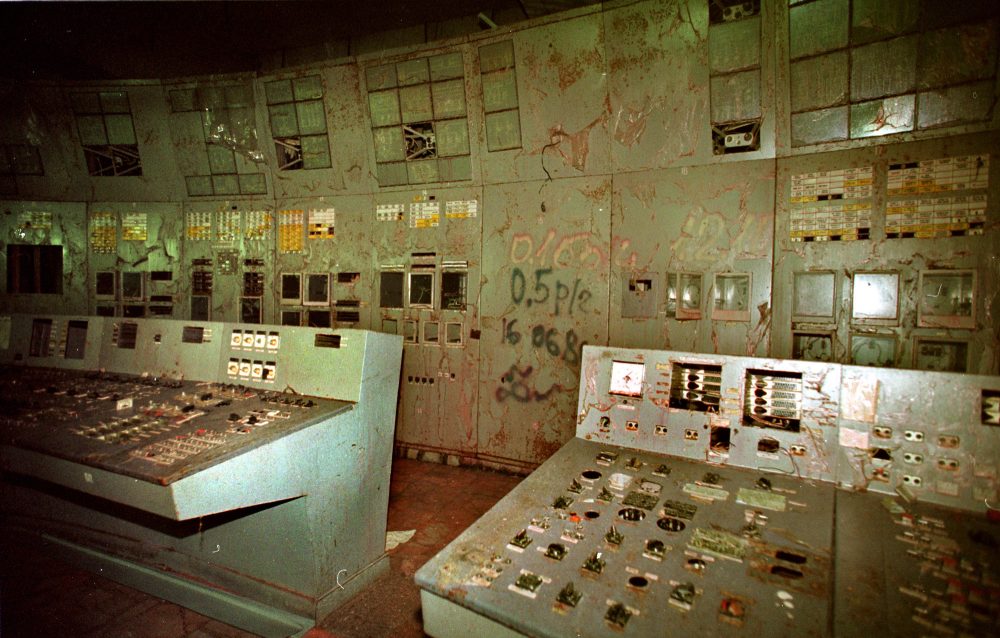
Within the power facility, thick dust particles floated in the air, visible in the light. Workers moved swiftly but cautiously to the control center, where a routine test on Reactor No. 4 went catastrophically wrong at 1:23 a.m. on April 26, 1986, causing two explosions. Many control panel buttons were missing — removed as mementos.
As teams ventured deeper into the plant, radiation measurements increased, forcing them to retreat. Some boundaries cannot be crossed.
Over time, the original reactor covering deteriorated, creating openings where radiation escaped. In 2019, engineers installed a massive arch-shaped containment structure designed to last for generations. The situation appeared finally stabilized.
Russia’s 2022 invasion of Ukraine brought troops into the exclusion zone as they advanced toward Kyiv. Soldiers created defensive positions in contaminated ground, disturbing long-buried materials. Three years later, a Russian drone attack damaged the protective structure. While no radiation escaped, the incident demonstrated that dangers persist.
In the absence of human habitation, the contaminated exclusion zone has experienced unexpected environmental recovery. Forests have expanded. Animal populations have grown. Rare species now inhabit areas once synonymous with catastrophe.
While Pripyat remains frozen in time, it’s no longer completely deserted as wildlife moves through the abandoned city.
After four decades, perhaps the clearest lesson is this: Lives were devastated, and truth was concealed for years. Yet when left undisturbed, nature persists — even at Chernobyl.