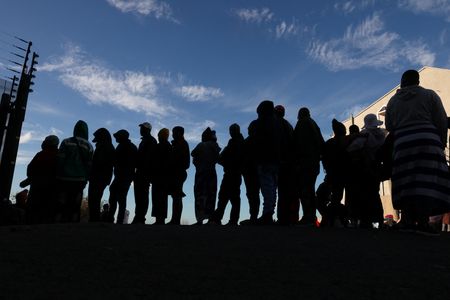

DURBAN, South Africa — Long lines of Malawian migrants gathered at a temporary processing camp in the South African city of Durban this week, while hundreds of Zimbabweans spent nights sleeping on the sidewalk outside their country’s consulate in Cape Town — all hoping to escape before planned anti-immigrant protests erupt into violence.
Ebrahim Moosa, 37, stood in a winding queue alongside his wife, some carrying babies on their backs, waiting to board a bus bound for Malawi. “We are scared because you never know what people are planning to do to you. It’s not right to wait and see what will happen,” he said.
South Africa has experienced a surge of xenophobic protests and sometimes deadly attacks in recent weeks, forcing many foreign nationals to flee their homes or be driven out by mobs. Anti-immigrant groups have set June 30 as a deadline for all undocumented migrants to leave the country, and several cities are preparing for potential unrest. The government has urged citizens not to take immigration enforcement into their own hands.
“We are appealing to all those who will be marching to respect the police,” said Phumelele Makoba, the acting police commissioner for KwaZulu-Natal province, considered one of the likely flashpoints for violence.
Law enforcement officials have pledged a major deployment across the country to keep the peace. President Cyril Ramaphosa stated Thursday: “Our security forces are ready.”
The primary organization behind the protests, March and March, has publicly stated it is not calling for violence — but has also said it will not be held responsible for any harm that occurs on June 30.
Neighboring countries including Malawi, Zimbabwe, and Mozambique have been working to bring their citizens home by bus, but have struggled to meet the overwhelming demand.
Mozambican national Antonio Njive, who had been doing odd jobs in South Africa since 2019, fled on June 1 after his home was burned down during a wave of violence that killed five of his fellow Mozambicans. Speaking by phone from Chibuto, Mozambique, he said: “I left home without clothes. Everything was burned.” Njive, along with his wife and 6-year-old daughter, were among hundreds of Mozambican citizens repatriated by bus.
Outside the Zimbabwean consulate in Cape Town, Amina Chiwoko, 30, described the desperate scene. “We are sleeping outside waiting for buses. Everyone just wants to go home,” she said.
For some, however, going home is not an option. Leanne Sefu, 25, is an asylum seeker from the Democratic Republic of Congo who arrived in South Africa at just three years old. “The entire world knows that there’s a war in Congo, so me going back, it feels like going back to death,” she said.
After being attacked at the nail salon where she worked in Durban and forced out of her home, Sefu is now camped outside the Home Affairs office. Sitting on a mattress on the pavement alongside dozens of others, she expressed hope that the government would step in. “What I’m hoping is that maybe the government can help us find a shelter. From yesterday we’ve been hearing people are being attacked and they’re coming here,” she said. “There’s no safety here.”
Xenophobic violence is a long-standing problem in South Africa, where some citizens blame immigrants — largely from other African nations — for crime, unemployment, and overcrowded public services. President Ramaphosa has cautioned against making foreigners scapegoats, attributing the country’s deep social and economic inequalities primarily to the legacy of apartheid. Despite years of sluggish economic growth, South Africa still holds the largest economy on the continent and continues to attract workers from neighboring countries.