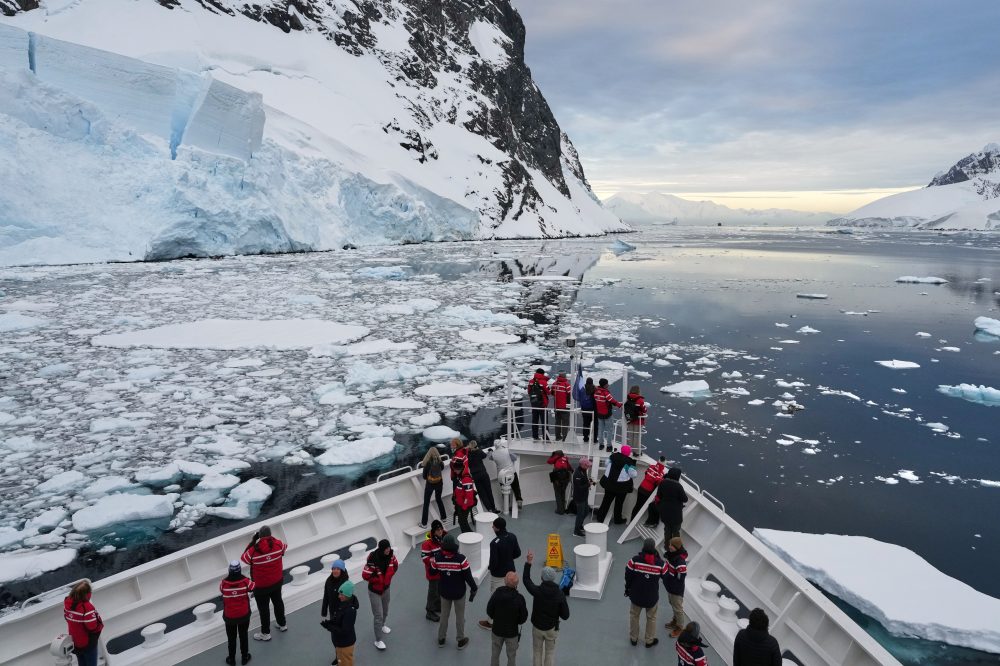

BRUSSELS (AP) — The world’s most remote continent is experiencing an unprecedented surge in visitors as travelers rush to witness Antarctica’s pristine wilderness before climate change potentially transforms it forever. However, this dramatic increase in tourism is raising serious concerns among researchers and environmental advocates about potential contamination, disease outbreaks, and ecological harm.
Though visitor numbers remain relatively modest due to expensive costs and lengthy travel times, the rapid growth rate has prompted warnings from the scientific community.
Recent attention has focused on this trend following a fatal hantavirus outbreak that occurred on the Dutch vessel MV Hondius during an extended polar expedition.
The majority of Antarctic expeditions visit the Antarctic Peninsula, recognized as among the globe’s most rapidly warming regions. NASA data shows that between 2002 and 2020, approximately 149 billion metric tons of Antarctic ice disappeared annually.
A typical journey involves sailing southward from Argentina to Antarctica before traveling northward along Africa’s coastline — the identical path followed by the cruise vessel MV Hondius.
“The sites you will see in Antarctica are extremely unique and not replicable anywhere else on the planet — the whales, the seals, the penguins, the icebergs — it’s all really stunning and it makes a huge impression on people,” said Claire Christian, executive director of the environmental group Antarctic and Southern Ocean Coalition.
Data from the International Association of Antarctica Tour Operators reveals that in 2024, more than 80,000 visitors actually set foot on the ice-covered landmass, while an additional 36,000 observed the scenery from aboard vessels.
The International Union of Concerned Scientists calculates that Antarctic tourism has expanded by ten times over the previous three decades.
These figures may climb even higher in the coming decade as expenses decrease with additional ice-resistant vessels entering service and technological improvements, according to Hanne Nielsen, a senior lecturer of Antarctic law at the University of Tasmania. Her university colleagues project that annual visitor numbers could increase three or four times to exceed 400,000 within that timeframe.
Nielsen explained that some travelers participate in “last chance tourism,” understanding that the melting environment is undergoing rapid transformation.
Authorities have not reported any contamination evidence related to the MV Hondius incident.
Nevertheless, migrating bird populations have transported avian influenza from South America to Antarctica in recent years, the U.S. Centers for Disease Control and Prevention reports.
This disease outbreak led the International Association of Antarctica Tour Operators and other organizations to strengthen regulations governing tourist behavior and sanitation practices to safeguard visitors from contamination. To preserve the delicate ecosystem from invasive organisms both large and microscopic, tourists receive instructions to maintain distance from wildlife and avoid ground contact except with their feet.
“There are rules that people are bound by when they’re heading south,” Nielsen explained, drawing from her experience as a former guide on five expeditions. Staff and passengers employ vacuum cleaners, disinfecting agents, and brushes to thoroughly clean footwear and gear, removing insects, feathers, seeds, and dirt that may harbor microorganisms.
“Between the tongues and the laces of the boots you can find a lot of things,” she noted.
Cruise vessels have experienced outbreaks of illnesses such as norovirus, which can rapidly spread within a ship’s confined environment. In 2020, a COVID-19 outbreak aboard the Diamond Princess transformed the cruise liner into a breeding ground for the then-unknown virus.
Hantavirus typically spreads through inhalation of contaminated rodent waste particles.
The World Health Organization announced Tuesday that MV Hondius departed from Ushuaia, Argentina, on April 1 and traveled to Antarctica and multiple remote islands.
WHO officials are examining potential person-to-person transmission aboard the cruise vessel, stated Dr. Maria Van Kerkhove, WHO’s director of epidemic and pandemic preparedness. Authorities believe the initial infected individual likely acquired the virus prior to embarkation, she explained, and officials have been informed that no rats are present on the ship.
The Antarctic Treaty governs Antarctica, establishing the region in 1959 as a scientific sanctuary designated solely for peaceful activities. Subsequent regulations “aim to ensure that all visits, regardless of location, do not adversely impact the Antarctic environment or its scientific and aesthetic values,” the treaty’s secretariat states.
Tourism companies and research organizations voluntarily follow biosecurity protocols and provide environmental impact evaluations for Antarctic activities.
Christian pointed out that the treaty was created when tourist numbers were significantly smaller.
“Activity needs to be regulated appropriately, as you would with any of the world’s sensitive and precious ecological sites,” Christian stated from Hiroshima, Japan, where she was attending an Antarctic Treaty Consultative Meeting. At the gathering, she planned to support efforts to enhance protections for Antarctica’s penguins, whales, seabirds, seals and krill — small organisms that form the foundation of the food web.
Currently, the appeal of the frozen wilderness continues attracting travelers.
“You can put a footprint in Antarctica and it’s still there 50 years later,” Christian observed.