
Officials in Egypt have put on display a remarkable plaster wall from King Tutankhamun’s burial chamber and opened two newly restored ancient tombs in Luxor that showcase scenes from daily life and burial customs from the New Kingdom era.
The plaster wall, which sealed the famous pharaoh’s tomb, represents an extraordinary piece of history that cannot be found anywhere else, according to Abdelghaffar Wagdy, director-general of Luxor Antiquities. He explained that this uniqueness stems from the fact that nearly all pharaonic burial sites were robbed throughout history.
“Therefore, it is a one-of-a-kind artifact — the only one currently on display more than 100 years after the discovery of Tutankhamun’s Tomb,” Wagdy stated during the Luxor exhibition. “It is the only surviving artifact of Tutankhamun that the world had never seen before. Recently, an Egyptian team reconstructed it.”
The Egyptian Ministry of Tourism and Antiquities describes the original plaster barrier as one of the most significant elements connected to the sealing of the tomb that British archaeologist Howard Carter uncovered in 1922.
Making its public debut at the Luxor Museum, the wall served to protect the burial chamber entrances and featured official markings that represented funeral ceremonies and governmental authority related to the monarch’s interment, the ministry noted.
According to Wagdy, the barrier displays seals from Tutankhamun along with markings from cemetery guardians who were responsible for safeguarding the tombs and preventing robbery.
The western side of the Nile River at Luxor houses the Valley of the Kings, where rulers and aristocrats from the New Kingdom period were laid to rest in chambers carved from stone.
Tutankhamun, commonly called King Tut, was among the numerous New Kingdom pharaohs interred in this location. His 14th-century B.C. burial site and complete contents were discovered in 1922.
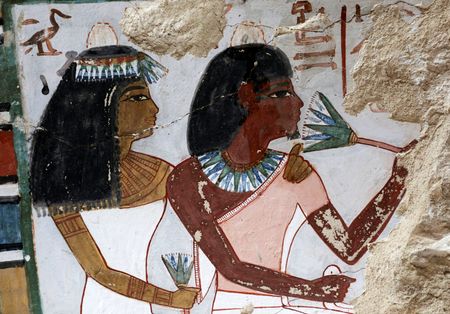
The newly opened burial chambers belong to Rabuya and his son Samut from the 18th Dynasty, which marked the beginning of the New Kingdom dynasties. Both men worked as doorkeepers for the deity Amun, the ministry reported.
“Today we are inaugurating two very important tombs that were discovered by chance in 2015,” announced Hisham El-Leithy, secretary-general of Egypt’s Supreme Council of Antiquities.
The burial chambers feature depictions of various activities such as farming, harvesting, craftsmanship, bread making, pottery creation, and wine production.