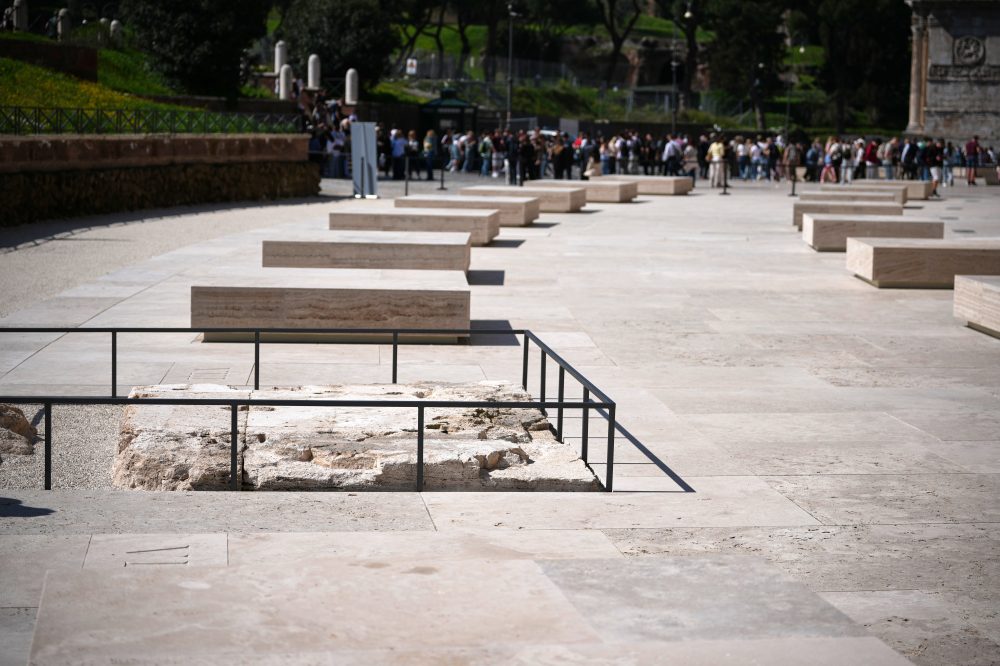

ROME — Italy’s most famous ancient landmark has received a stunning makeover that brings visitors closer to experiencing what Romans saw two millennia ago.
The Colosseum’s exterior plaza has been transformed through a restoration project that uses authentic travertine marble to mark the exact locations where massive columns once towered 164 feet into the sky. These same quarries supplied building materials to ancient Roman architects.
The arena continues to mesmerize people from around the globe, drawing 9 million tourists in 2025 and maintaining its status as Italy’s top visitor destination. Centuries ago, crowds of Romans gathered in this same space to witness gladiator combat and battles with wild beasts.
The renovation concentrated on the curved plaza area where ancient spectators once congregated beneath two grand arcade structures supported by towering marble pillars. These waiting areas allowed people to queue before entering the arena to find their designated seats.
Natural disasters and ground instability caused these magnificent archways to crumble over many centuries. However, visitors today can rest on substantial travertine blocks positioned precisely where the original supports once stood, while examining replicas of Roman numerals that once guided spectators to their seating areas.
Italian architect Stefano Boeri, who created the plaza design, explained the project’s vision: “These blocks of travertine marble are placed, located exactly where the pillars, the original pillars were based. The idea we had was to give back to the public the perception of the proportion of the arcades and the proportion of the vaults of the arches that were used to enter in the center of the Colosseum.”
The surrounding area had deteriorated significantly, becoming cluttered with rubble fragments and overgrown vegetation.
Workers excavated approximately three feet down to reach the original travertine pavement that once covered the entrance zone. Archaeological discoveries during the dig included ancient coins, sculptural pieces, animal remains, and a golden ring. Further excavation revealed Emperor Commodus’s private underground tunnel, which allowed him to access the Colosseum without encountering ordinary citizens. This hidden passageway opened for public tours last year.
The restoration team obtained fresh travertine slabs from identical quarries that supplied ancient Roman builders. These same stone sources continue providing materials for contemporary religious structures, financial institutions, cultural venues, government facilities, and residential properties.
Fabrizio Mariotti, whose family business Mariotti Carlo has specialized in travertine craftsmanship for four generations in Tivoli, expressed his enthusiasm while seated on one of the new stone pieces: “From the beginning we understood only one thing and that was that we wanted to be involved. For a family like ours that has been working with travertine for four generations, working at the Colosseum, which is the symbol not only of Rome but also of this material, is so important.”
Rome recently inaugurated two additional subway stations this year, including one located deep beneath the Colosseum, completing a multi-billion euro transit expansion. Officials confirmed that funding for the Colosseum’s perimeter restoration came from compensatory money allocated for the metro construction project.