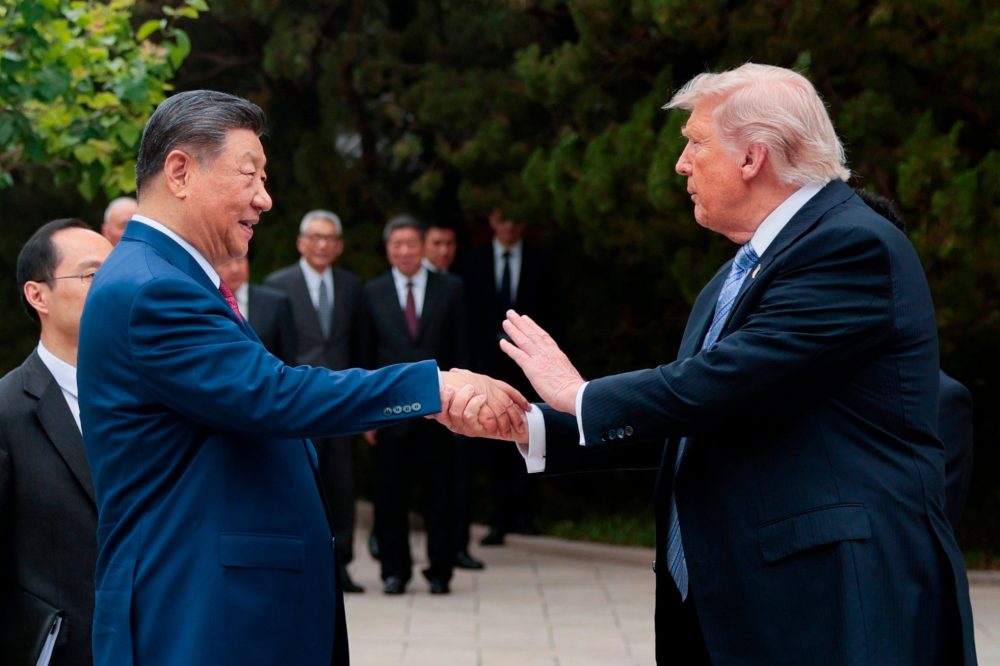

BEIJING (AP) — Chinese leader Xi Jinping recently conducted consecutive diplomatic meetings with U.S. President Donald Trump and Russian President Vladimir Putin, which appeared similar on the surface with formal ceremonies at Beijing’s Tiananmen Square, enthusiastic welcomes from children waving flags, and military honor guards with gleaming weapons. However, these visits highlighted the contrasting nature of China’s relationships with both nations.
Trump’s visit focused on stabilizing relations between the United States and China, whereas Putin’s trip aimed at strengthening the strategic alliance between Russia and China.
Xi provided ceremonial treatment during Trump’s stay, featuring an exclusive visit to Zhongnanhai, the former royal gardens that currently house China’s government headquarters. Beijing recognized that Trump appreciated prominent demonstrations of respect, according to George Chen, partner for Greater China practice for The Asia Group. “Xi knows this is what Trump values: being treated like a VIP, respected in front of the cameras.”
Regarding Putin, Chen noted that Xi focused on meaningful discussions. “Reaffirming the friendship treaty, signing new energy deals, and re-emphasizing their ‘no limits’ partnership,” he explained.
The visits differed in duration: the U.S. president remained in China for three days, compared to Putin’s two-day stay.
Both leaders received ceremonial welcomes at Tiananmen Square featuring honor guards, military bands, and children displaying Chinese and respective national flags.
Each leader also conducted private discussions with Xi at the Great Hall of the People, located adjacent to the square.
However, Trump’s visit did not feature a public ceremony for signing agreements, while Putin and Xi observed the formal signing of bilateral accords and memorandums of understanding.
Trump received an exclusive visit to the Temple of Heaven and toured the royal gardens of Zhongnanhai.
Putin alternatively spent considerable time with Xi within the Great Hall of the People, where both leaders viewed a photographic display showcasing China-Russia relations before sharing tea.
This marked Trump’s second presidential visit to China. For Putin, this represented his 25th trip to the nation.
The primary difference between both summits lay in their communication approaches.
During Trump’s visit, Xi emphasized maintaining relatively stable relations following months of conflict and trade disputes between the world’s largest economies. He encouraged the U.S. president to view China as an ally rather than an adversary, with both leaders committing to pursue what they termed “a constructive China-U.S. relationship of strategic stability.”
With Putin, Xi aimed to strengthen and expand a long-established partnership that holds strategic and economic significance for both nations.
While the U.S. and China continue working to stabilize their commercial relationships, Moscow and Beijing confirmed their status as crucial partners. Putin identified the “driving force” of their relationship as the energy industry, especially oil and natural gas.
Both sides executed over 40 cooperation agreements spanning trade, technology, and media collaboration. The leaders also endorsed a joint statement characterizing Russia and China as “important centers of power in a multipolar world.”
Trump and Xi, in comparison, did not endorse a joint statement or witness any agreement signings during the visit. Only after the U.S. president departed Beijing did both countries reveal details of several arrangements, with Washington announcing that China committed to purchasing U.S. agricultural goods at an annual rate of $17 billion and acquiring 200 Boeing aircraft.
“China and Russia reached more agreements, and with China and the U.S., what are the agreements? Even that is not very clear,” stated Claus Soong, an analyst at the Mercator Institute for China Studies in Berlin.
However, Lyle Morris, senior fellow on Chinese national security and foreign policy at Asia Society Policy Institute’s Center for China Analysis, noted the most unexpected outcome from the Xi-Putin meetings was the apparent absence of a formal agreement for the Power of Siberia 2 gas pipeline project, which would transport gas from Russia to China via Mongolia.
“This is a huge setback for Russia and Putin,” he stated.
Moscow shares Beijing’s position on Taiwan, the island democracy that China considers its territory. Meanwhile, the U.S. maintains a deliberately unclear position on the island while serving as its primary unofficial supporter and weapons supplier.
Xi informed Trump that Taiwan represents the most critical issue in bilateral relations and cautioned that mismanaging U.S. connections with the self-governing island could result in conflict between both countries.
Trump avoided public discussion of Taiwan during his visit. However, while returning to the United States, he characterized weapons sales to Taiwan as a “very good negotiating chip” with China, remarks that created concern on the island that Beijing claims as its territory.
With Putin, no disagreement appeared regarding this matter.
In the joint statement signed by Xi and Putin, Russia restated its opposition to Taiwanese independence “in any form” and expressed support for what it characterized as China’s efforts to protect its sovereignty and achieve “national unification.”
According to the Chinese Foreign Ministry, both parties also expressed concerns about what they described as “accelerated remilitarization” of Japan, amid tense China-Japan relations regarding Taiwan.