
WASHINGTON — Federal law enforcement is gearing up for what officials describe as one of the most demanding security operations ever staged in the nation’s capital, as Washington prepares to host massive celebrations marking 250 years of American independence.
The security challenge is compounded by a recent surge in politically motivated violence — including several incidents near the White House — and the presence of a sitting president who both enjoys large public gatherings and has been the target of multiple assassination attempts.
“It comes as no surprise to you that D.C. on a normal day is a target-rich environment,” said Darren B. Cox, assistant director in charge of the FBI’s Washington Field Office, during a recent press conference outlining the security plans. “We are prepared for any threats.”
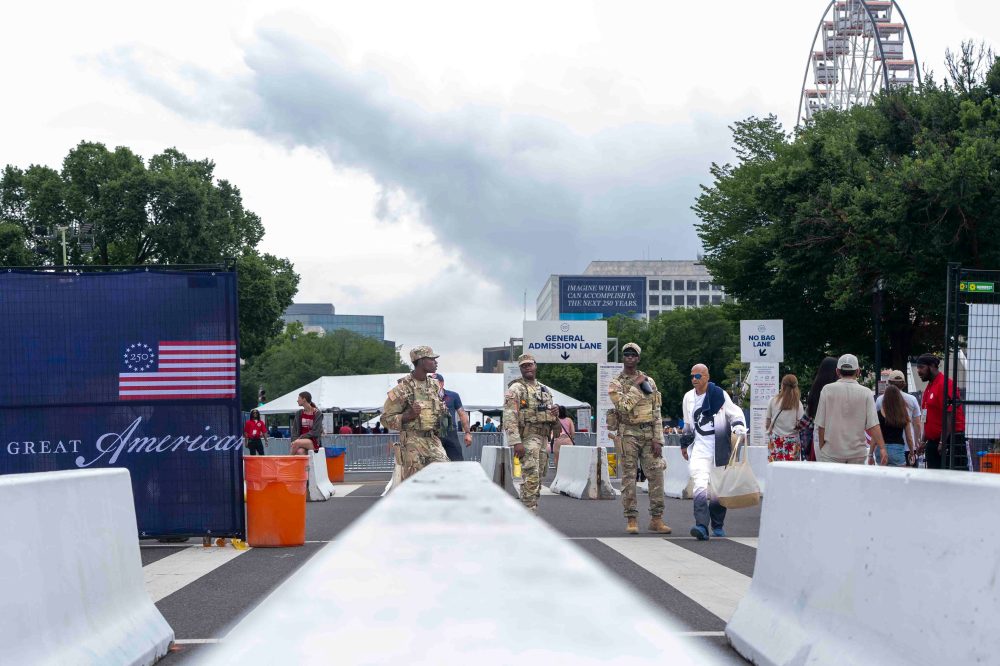
Officials expect hundreds of thousands of visitors to pour into Washington over the coming weeks for the anniversary festivities. They will be met by thousands of law enforcement officers and agents, 5,000 National Guard troops, and an array of military-style vehicles and equipment rarely seen on American streets.
The biggest crowds are anticipated on July 4th, when several events will take place at the same time, including the Great American State Fair — a showcase featuring all 50 states spread across the National Mall. The traditional fireworks display that evening has been designated a National Security Special Event by the Department of Homeland Security for the first time, giving it the highest level of federal security coordination available.
For those planning to attend, that designation means strict identification checks, lengthy lines, and walk-through magnetometers — a process similar to airport security. Snipers are also expected to be stationed at certain events.
Flights at Ronald Reagan Washington National Airport, located just across the Potomac River from the city, will be suspended from noon on July 4th through the following day — a longer halt than in previous years due to the scale of the celebrations. Additional flight disruptions are possible if other America 250 events involve aerial flyovers or parachute demonstrations.
Multiple agencies are coordinating the security effort, including the FBI, Secret Service, U.S. Capitol Police, U.S. Park Police, and the D.C. National Guard. At an earlier press conference this month, officials displayed some of the equipment that could be deployed, such as BearCat armored SWAT vehicles, Mine-Resistant Ambush Protected vehicles — known as MRAPs — along with communication vans and FBI diving boats.
“Our protective model is meant to adjust to any type of direct or indirect threats that we come across,” said Tara McLeese, special agent in charge of the Secret Service’s Washington Field Office. “I can assure you that we have no lack of imagination as to the potential threats out there.”
Brig. Gen. Leland Blanchard II, interim commander of the D.C. National Guard, noted that planning has been ongoing for months and has included rehearsals. He said Guard members will continue performing the duties they have carried out over the past ten months as part of a deployment President Donald Trump says is aimed at reducing crime in the city. Those duties include traffic management, crowd control, and emergency response around the events.
President Trump, who has already participated in several lead-up events — including last week’s kickoff rally launching the Great American State Fair — posted on Truth Social that he plans to hold a rally on the National Mall on July 4th.
At a Monday press conference, Cox repeated that “at this time we are not tracking any credible threats related to the July 4th event, but we always remain vigilant.”
The celebrations are unfolding against a backdrop of heightened political tension. One man, Cole Tomas Allen, has been charged with attempting to assassinate the president after he rushed past security at the White House Correspondents’ Association dinner in April. Allen has pleaded not guilty. In the weeks that followed, two separate individuals fired at Secret Service officers near the White House on two different occasions. More recently, the FBI announced it had disrupted a planned attack targeting Trump’s UFC cage-fighting event at the White House, with several suspects arrested in connection with that plot.
Security around the National Mall was already being stepped up before the festivities officially began, after Trump — without offering evidence — claimed vandals had damaged the Reflecting Pool, which he said he had recently renovated.
Matt Dallek, a political scientist at George Washington University who studies extremism, said Trump presents a unique challenge for security planners because he is “both an accelerant and a target of political violence.”
Some observers are drawing comparisons to the nation’s 1976 bicentennial celebration. At that time, the country was still reeling from Watergate and the Vietnam War, and there had been two assassination attempts against then-President Gerald Ford in the ten months before the celebration.
“There was a lot of sourness in the country in ’76, a lot of cynicism about the direction of the country,” Dallek said. He noted that both Ford and his Democratic opponent Jimmy Carter recognized the danger posed by political divisions and “were looking to bring down the level of vitriol.”
Angelyn Spaulding Flowers, a professor of Homeland Security and Administration of Justice at the University of the District of Columbia, described the current security presence as unprecedented for Washington, pointing to the extended and open-ended National Guard deployment that has kept additional security patrols in the city for months.