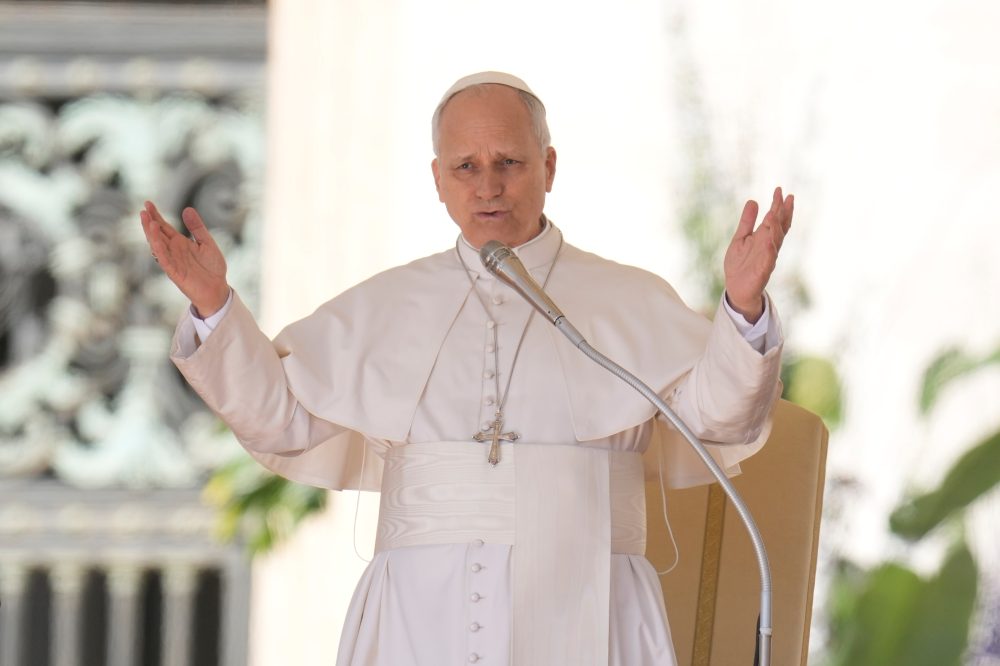

President Trump has faced criticism from many quarters during his political career — opposition party leaders, fellow Republicans, television hosts, and street demonstrators. However, during his current term, his most prominent American critic resides not within U.S. borders but in Vatican City.
This marks an extraordinary moment in history, as the nation’s first pope openly challenges the American commander-in-chief regarding the Iranian conflict, where a tentative ceasefire was established this week. This development followed Pope Leo XIV’s statement that Trump’s aggressive stance was “truly unacceptable.”
The dynamic between Washington and the Vatican has never before centered on two Americans — a 79-year-old leader from Queens and a 70-year-old religious figure from Chicago. Despite sharing generational ties and certain cultural backgrounds, they demonstrate remarkably different philosophies in wielding their considerable influence. This unique relationship carries potential consequences for both parties.
“They’re two white guy boomers but they could not be any more different in their life experiences, in their values, in the way they have chosen to live those values,” said theology professor Natalia Imperatori-Lee of Fordham University. “This is a very stark contrast, and I think an inflection point for American Christianity.”
Catholic Church scholars stress that Leo’s war opposition stems from longstanding religious doctrine rather than contemporary political calculations.
“For the last five centuries, the church has been involved in a project of helping develop strong international norms,” including the Geneva Conventions in recent centuries, said Catholic University professor William Barbieri. “It is a very long-standing tradition rooted in Scripture and theology and philosophy.”
Meanwhile, the current administration, which maintains strong connections with conservative evangelical Protestant leadership, has asserted divine support for Trump’s Iranian military campaign.
Defense Secretary Pete Hegseth encouraged Americans to seek victory through prayer “in the name of Jesus Christ.” When questioned about divine approval for the conflict, Trump responded, “I do, because God is good — because God is good and God wants to see people taken care of.”
The Rev. Franklin Graham, son of iconic Baptist evangelist Billy Graham, said of Trump that God “raised him up for such a time as this.” Graham also prayed for triumph so Iranians can “be set free from these Islamic lunatics.”
Leo responded during his Palm Sunday address that God “does not listen to the prayers of those who wage war, but rejects them.” He cited an Old Testament verse from Isaiah, stating that “even though you make many prayers, I will not listen — your hands are full of blood.”
Though disagreements between pontiffs and presidents occur regularly, direct papal criticism of American leadership remains extremely uncommon. Leo subsequently mentioned Trump by name and expressed hope the president would pursue “an off-ramp” in Iran.
More forceful condemnation emerged after Trump threatened extensive attacks on Iranian energy facilities and infrastructure, posting on social media that “an entire civilization will die tonight.” Leo characterized this as a “threat against the entire people of Iran” and declared it “truly unacceptable.”
Imperatori-Lee noted that Leo’s targeted criticism differs from the church’s typical broader critiques of political and social frameworks. For instance, Pope Francis encouraged American bishops to protect migrants without specifically referencing Trump or his removal policies. Leo has also previously advocated for compassionate migrant treatment.
“Popes have critiqued unfettered capitalism before, very robustly. The popes have critiqued the Industrial Revolution, right? Things that the U.S. has been at the forefront of,” Imperatori-Lee said, “but it’s never been this specific and localized.”
She explained that Leo’s statements carry weight among Americans — both Catholic and non-Catholic — because he speaks English natively.
“There’s no question about his inflection and meaning,” she said. “It removes any ambiguities.”
Trump praised Leo’s papal election last May as a “great honor” for America, though he hasn’t addressed the recent criticisms. The White House declined to comment when contacted.
“What Pope Leo and Donald Trump have in common is they both lived through the post-war polarization,” including the political upheaval of the Civil Rights Movement and Vietnam War, said Steven Millies, a professor at Chicago’s Catholic Theological Union, one of the pope’s alma maters.
Millies observed that Leo subscribes to The New York Times, enjoys the “Wordle” puzzle, follows American sports, and maintains regular contact with his brothers, including one who strongly supports Trump.
“In some ways he’s just like us,” Millies said, someone “who understands where our domestic political crisis came from,” unlike the Argentinian Francis, “who did not fully understand the peculiarities of the United States” despite offering indirect criticism.
Barbieri emphasized that Leo’s American understanding doesn’t alter a frequently overlooked aspect of Catholicism and papal authority. “The Catholic Church doesn’t neatly fit into either right or left boxes as they’re understood in U.S. politics,” he said.
Leo conducted most of his pre-papal work, including his entire tenure as bishop and cardinal, beyond American borders.
He received his education in Rome studying canon law within the church hierarchy. He served as bishop in impoverished, rural areas of Peru. He directed the Augustinian order and worked as Francis’ advisor for bishop recommendations worldwide.
Imperatori-Lee explained that this international experience provided him direct insight into how Washington’s economic and military strategies — including support for Latin American dictators — have harmed less powerful countries and their populations.
These diverse experiences positioned then-Cardinal Robert Prevost as an ideal papal candidate despite the College of Cardinals’ historical wariness toward America and its global dominance. Millies suggested that Trump and his team, including Vice President JD Vance, a Catholic convert, may not grasp these nuances.
“This is an administration that seems to think only in terms of transactional politics — who’s for us and who’s against us,” he said.
Washington-Vatican relations have deteriorated to the point where reports of a supposedly tense meeting between Pentagon and Catholic Church representatives created alarm in both capitals.
According to The Free Press report, a Trump administration official allegedly warned the church in January against opposing American military power.
The U.S. Embassy to the Holy See dismissed the report, posting on social media that “deliberate misrepresentation of these routine meetings sows unfounded division and misunderstanding.”
Millies questioned whether papal or bishop statements can influence individual Catholics. Trump will likely see declining Catholic support as his overall popularity drops, Millies suggested, though not necessarily because Leo’s followers are following church teaching.
“Partisan preferences always trump the religious commitments,” Millies said, describing a “disconnect” between church leadership and many congregants who seek guidance from other sources, including politicians, when forming their faith and political perspectives.
“The icon of Catholicism in American politics now is JD Vance, and it’s more about winning an argument,” he said. “It’s a very different emphasis, but it’s one that may suit the Trump administration very well.”