
Alabama residents are heading back to the ballot box Tuesday for a primary runoff election that will lock in party nominees for an open U.S. Senate seat and several other races where no candidate captured a majority of votes during the May 19 primary.
The winners of Tuesday’s runoffs will advance to compete in the general election this fall, when candidates across the heavily Republican state will face off for a full slate of state and federal offices.
It’s worth noting that primaries for four of Alabama’s seven congressional districts were pushed back from May 19 to an August 11 special primary — a consequence of a U.S. Supreme Court ruling that led Republicans in several southern states to scrap their existing congressional district maps.
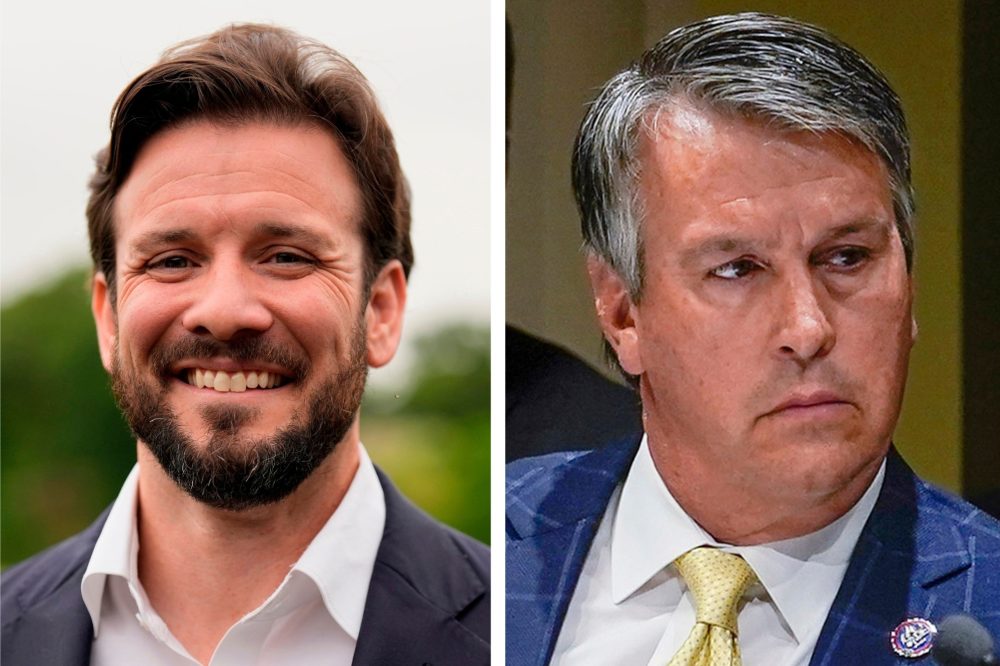
On the Republican side, the race for U.S. Senate comes down to Barry Moore and Jared Hudson, who are competing for the right to replace U.S. Sen. Tommy Tuberville. Tuberville chose to run for governor rather than seek another Senate term. Moore, a third-term congressman who represents Alabama’s 1st Congressional District, carries the endorsement of President Donald Trump. His opponent, Hudson, is a former Navy SEAL who runs a security and weapons training company and founded a nonprofit dedicated to fighting human trafficking.
Moore finished first in the May primary with roughly 39% of the vote, while Hudson came in second with about 26%. State Attorney General Steve Marshall finished a close third at around 25%.
Moore’s strongest showing came from his home turf in the 1st Congressional District in southern Alabama, near the Florida border and the Gulf Coast. He also claimed pluralities across a large portion of central Alabama, including the Montgomery area, with narrower margins in the northern and northeastern parts of the state near the Tennessee and Georgia borders.
Hudson performed best in Jefferson County — the state’s most populous county and home to Birmingham — where he secured about 45% of the vote and built a 19-percentage-point lead. Expanding on that advantage will be essential to his runoff chances.
Moore holds an edge heading into the runoff in Madison County, the second-largest county in the state and home to Huntsville — a city nicknamed Rocket City for its NASA presence. Moore pulled in about 34% of the vote there in May, while Hudson placed third with roughly 22%.
Trump’s backing is expected to be a significant factor for Moore in a state where Trump received two out of every three votes against Democrat Kamala Harris in the 2024 presidential race. Trump-endorsed candidates have an almost flawless record at the polls, though his pick for Iowa governor did fall short earlier in June.
Democrats are also settling their U.S. Senate nomination Tuesday. The two candidates are Dakarai Larriett — a former corporate executive, aromatherapy pet care entrepreneur and policing reform advocate — and Everett Wess, an attorney and former Midfield Municipal Court Judge. Wess led the Democratic primary field with about 40% of the vote, followed by Larriett at approximately 29%.
Additional Republican runoffs are taking place for lieutenant governor, attorney general, agriculture commissioner and other state positions. A Democratic runoff is also being held in the 5th Congressional District, which held its primary back in May. The 1st, 2nd, 6th and 7th Congressional Districts will hold their primaries in the August 11 special election.
Polls across Alabama close at 7 p.m. Central Time, which is 8 p.m. Eastern Time. The Associated Press will report results and declare winners in runoffs for U.S. Senate, U.S. House, lieutenant governor, attorney general, agriculture commissioner, state Public Service Commission, state Board of Education, and both chambers of the state legislature.
Under Alabama’s election rules, voters who participated in a partisan primary on May 19 can only vote in the runoff for the same party. Democratic primary voters cannot cross over to vote in the Republican runoff, and vice versa. However, registered voters who sat out the May 19 primary are free to participate in either party’s runoff Tuesday.
As of Thursday, Alabama had approximately 3.8 million registered voters on the books.
During the May 19 primary, around 482,000 people voted in the Republican Senate race, about 474,000 participated in the Republican lieutenant governor primary, and roughly 340,000 cast ballots in the Democratic Senate primary.
Looking at historical trends, the last Republican Senate primary runoffs were held in 2022 and 2020. In 2022, total votes dropped from about 647,000 in the primary to around 402,000 in the runoff — falling from 18% to 11% of registered voters. In 2020, when Tuberville first appeared on the ballot, turnout slipped from roughly 718,000 in the primary to about 551,000 in the runoff, representing a drop from 20% to 15% of registered voters.
Alabama is one of the few states in the country that does not offer any form of in-person early voting, meaning the vast majority of residents cast their ballots on Election Day. In the 2024 primaries, mail voting was minimal — about 4% of Democratic primary voters and just 1% of Republican primary voters used absentee ballots.
Vote reporting practices differ by county. Most counties tend to release absentee ballot results in their first update, sometimes alongside Election Day totals. During the May 19 Republican Senate primary, the AP first reported results at 8:28 p.m. Eastern Time — just 28 minutes after polls closed — with the final update of the night coming at 12:54 a.m. Eastern Time, at which point more than 99.9% of votes had been counted.
The AP does not make projections and will only call a race when it is mathematically clear that a trailing candidate cannot catch up. If a race remains uncalled, the AP will continue monitoring and reporting on significant developments — such as a candidate conceding or claiming victory — while making clear that no official winner has been declared.
Alabama law includes an automatic recount provision, but the state attorney general issued an opinion in 2010 stating that it does not apply to primary elections.
As of Tuesday, 56 days remain until the special congressional primaries on August 11, and 140 days until the November 3 midterm elections.