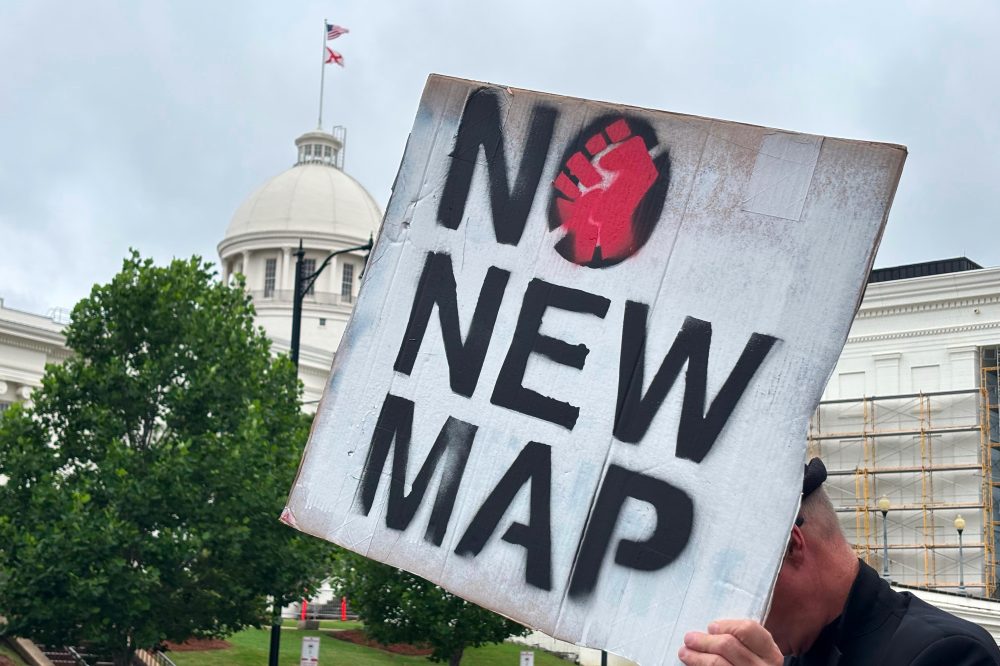

A federal court issued a temporary order on Tuesday halting Alabama’s attempt to implement new congressional district boundaries that would potentially benefit Republican candidates in November’s midterm elections.
The three-judge panel overseeing the state’s ongoing redistricting litigation granted a preliminary injunction stopping Alabama from adopting the revised map. The decision mandates that the state maintain the existing court-mandated districts used in the 2024 congressional elections.
Legal representatives for Black voters in the redistricting lawsuit had requested the preliminary injunction, contending that the same judicial panel determined in 2023 that Alabama’s proposed map deliberately discriminated against Black voters. The attorneys also maintained that Alabama was generating confusion by attempting to alter district boundaries during an active election cycle.
The decision represents a setback for state Republicans seeking to implement a map for November’s midterm contests that would provide the GOP an opportunity to regain the seat currently occupied by Democratic U.S. Rep. Shomari Figures. The state retains the option to challenge the decision before the U.S. Supreme Court.
This court decision marks the most recent chapter in the complex legal and political developments following a U.S. Supreme Court decision that eliminated a Black-majority district in Louisiana and diminished the federal Voting Rights Act. The Supreme Court’s ruling has prompted Republicans across multiple Southern states, including Alabama, to pursue efforts to reconfigure voting districts containing substantial minority populations that have historically elected Democrats.
The redistricting activities represent part of a wider effort by President Donald Trump to maintain Republicans’ narrow House majority in November’s elections.
Additional states have also contemplated modifications to their primary election schedules to accommodate congressional redistricting following the U.S. Supreme Court’s Voting Rights Act decision. Louisiana rescheduled its congressional primaries from May 16 to later in the summer, with Republican Gov. Jeff Landry making the change to allow state legislators time to evaluate a new U.S. House map eliminating a majority-Black district.
In South Carolina, the Republican-controlled legislature examined a proposal to invalidate votes from its June 9 congressional primary and conduct a new August primary using modified districts that could enhance Republicans’ prospects of securing an additional seat.
Tennessee also acted swiftly to establish new U.S. House districts following the Supreme Court’s decision by dividing a Black-majority district centered in Memphis that had elected the state’s sole Democratic representative. The revised map provides Republicans the possibility of capturing all nine state seats. Tennessee temporarily reopened its candidate qualification period for August congressional primaries as part of the plan, permitting new candidates to join races while allowing existing candidates to change districts or withdraw.
Following Trump’s initial call for Texas to redraw its U.S. House districts last summer, approximately six Republican-controlled states have adopted new voting districts, although some continue to face legal challenges. Democrats responded with new districts in California and anticipate gaining a seat through new court-imposed districts in Utah.