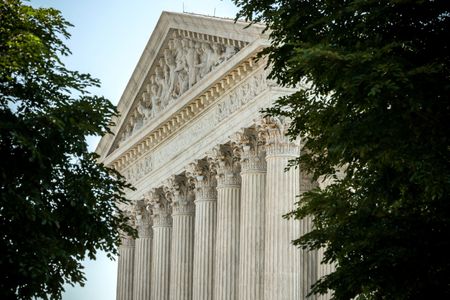

Alabama state officials have petitioned the U.S. Supreme Court to permit the use of a congressional district map that would eliminate one of two districts where Black voters hold a majority or near-majority, as Republicans work to maintain congressional control heading into November’s midterm elections.
The appeal comes after a federal court on Tuesday prohibited the state’s most recent attempt to implement a redrawn map designed to convert a U.S. House seat currently occupied by a Black Democratic representative into a Republican-held district.
Democratic candidates typically receive strong support from Black voters, while Republicans are working to protect slim majorities in both chambers of Congress during the upcoming midterm elections.
State Republicans are requesting that the Supreme Court overturn Tuesday’s judicial prohibition issued by a three-judge federal panel, which determined that the Republican-supported map deliberately discriminated against Black voters and cannot be implemented for the 2026 elections.
This decision represents the most recent chapter in an intense wave of congressional redistricting occurring throughout the South, as Republican-controlled states rush to capitalize on an April Supreme Court ruling that significantly diminished the Voting Rights Act, the landmark 1965 legislation designed to prevent voting discrimination.
Legal battles over Alabama’s congressional boundaries have bounced back and forth between the Supreme Court and the federal three-judge panel over recent years.
State Republican lawmakers are attempting to reinstate a map they enacted in 2023 that the same three-judge panel had previously ruled discriminatory. This map would reduce the number of districts where Black voters constitute a majority or near-majority from two down to one among the state’s seven U.S. House seats. Approximately one-quarter of Alabama’s population is Black.
On May 11, the Supreme Court approved the state’s petition to remove the lower court’s earlier decision preventing Alabama from implementing the map.
In their dissenting opinion, the three liberal justices indicated that the three-judge panel retained the authority to reinstate its judicial prohibition against Alabama Republicans’ preferred map. Tuesday’s lower court decision did precisely that, leading to Alabama officials’ new Supreme Court filing.