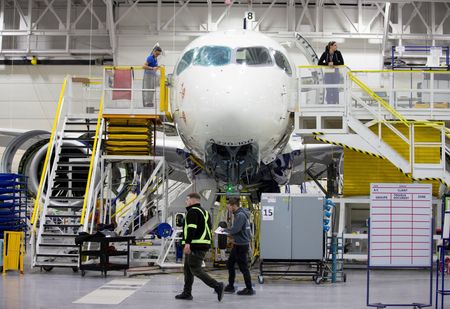

Aircraft manufacturer Airbus finds itself uncertain about timing for the debut of an expanded A220 aircraft following tepid interest from major leasing firms and ongoing discussions about flight range and capabilities, according to six industry insiders.
The company had previously generated excitement among potential customers earlier this year by suggesting a possible announcement during this summer’s Farnborough Airshow, but has since backed away from those expectations.
A high-ranking Airbus official indicated that an announcement at Farnborough, scheduled for late July, was now “not probable,” though the company hasn’t completely eliminated the possibility of a 2024 launch.
“We are studying all the options; no decisions have been made,” an Airbus spokesperson stated.
An expanded A220 model would allow Airbus to rework agreements with suppliers and reduce manufacturing expenses, potentially helping the company address losses from the program it acquired for one dollar in 2018 after Canada’s Bombardier faced financial difficulties.
The A220 program continues to operate at a loss and has been dropping orders to Brazilian competitor Embraer.
Industry insiders report that Airbus has been promoting a relatively minor enhancement described as a “simple stretch” that wouldn’t increase maximum takeoff weight or require expensive Pratt & Whitney engine improvements.
The aircraft would accommodate approximately 180 passengers, an increase from the current 160-passenger capacity, resulting in roughly 10% lower per-seat costs but reduced flight range, according to two individuals with knowledge of the project.
Not all carriers are willing to sacrifice range, which limits the number of potential buyers. Airlines meeting in Brazil for an IATA conference this weekend also remain concerned about reliability issues with current Pratt & Whitney engines.
“Airlines are possibly sold on the economics, but not necessarily the performance,” aviation analyst Rob Morris commented.
RTX, Pratt & Whitney’s parent company, chose not to provide comment.
Airbus displayed greater optimism in January, informing financial professionals at the Airlines Economics conference in Dublin that 2026 would represent a “big year” for the A220, sources reported.
Five months later, prospective customers indicate they haven’t received the detailed information typically expected when an aircraft launch is imminent.
“One of the questions we’ll have to examine is the range of the aircraft,” Air Canada’s chief operations officer Mark Nasr shared with Reuters this week.
The urgency to develop something new also diminished when AirAsia committed to purchasing 150 units of the current model.
“It remains a matter of when … rather than if, but it’s not now,” Airbus CEO Guillaume Faury informed reporters in April, discussing the larger A220’s launch timeline.
Airbus is additionally evaluating potential effects on sales of its crucial A320neo narrow-body series, which is positioned slightly above the proposed A220-500 in terms of size, two sources familiar with the situation revealed.
Leasing companies also express concern about negatively affecting A320neo values.
“Lessors are so exposed to the A320 that the last thing they need is a new anything; the less disruption the better off they all are,” a senior industry source explained.
Aviation analyst Morris suggested this shouldn’t postpone the project indefinitely.
“The A320 lessors should be okay: the market for the plane has sufficient liquidity and a strong customer base,” he noted.