
WASHINGTON — While Americans feel the financial sting of the Iran conflict every time they fill up their tanks, certain economic factors are helping cushion the blow to the nation’s economy — at least temporarily — including substantial tax refunds and a surge in artificial intelligence investments.
Economic data released Thursday revealed that inflation climbed at its steepest rate in nearly three years last month, while U.S. economic expansion remained stable and unemployment claims dropped this week.
The Federal Reserve’s preferred inflation measurement — the Commerce Department’s Personal Consumption Expenditures price index — jumped 0.7% between February and March, with a 3.5% increase compared to the previous year. This annual increase marked the largest since May 2023.
The driving force behind this surge was clear: Gas prices skyrocketed 21% from February to March following Iran’s response to U.S. and Israeli military actions by shutting down the Strait of Hormuz, creating what experts call the most significant oil supply disruption in recorded history.
The data also revealed that price increases outpaced American earnings — including wages, business profits, and government assistance — for the consecutive second month in March.
Thursday’s Commerce Department report showed that U.S. gross domestic product — measuring the nation’s total goods and services output — maintained a steady 2% annual growth rate during the first quarter, falling short of economist predictions but improving from the disappointing 0.5% growth in the final quarter of 2025. The October-December period saw the 43-day federal government shutdown reduce growth by more than a full percentage point.
Corporate investment is experiencing a dramatic upswing due to the artificial intelligence revolution. Business investment, excluding housing, jumped 10.4% in the first quarter, marking the largest increase in almost three years.
Consumer spending, which represents 70% of American economic activity, grew at a 1.6% annual rate from January through March. Americans benefited from substantial tax refunds resulting from President Donald Trump’s 2025 tax legislation.
However, this economic support may be short-lived. Michael Pearce, Oxford Economics’ chief U.S. economist, explained the situation: “Rising tax refunds were outpacing the increased burden of gasoline spending two to one in March and most of April.” He added, “With tax refund season winding down and gas prices still climbing, the hit to consumer spending will become more evident from May.”
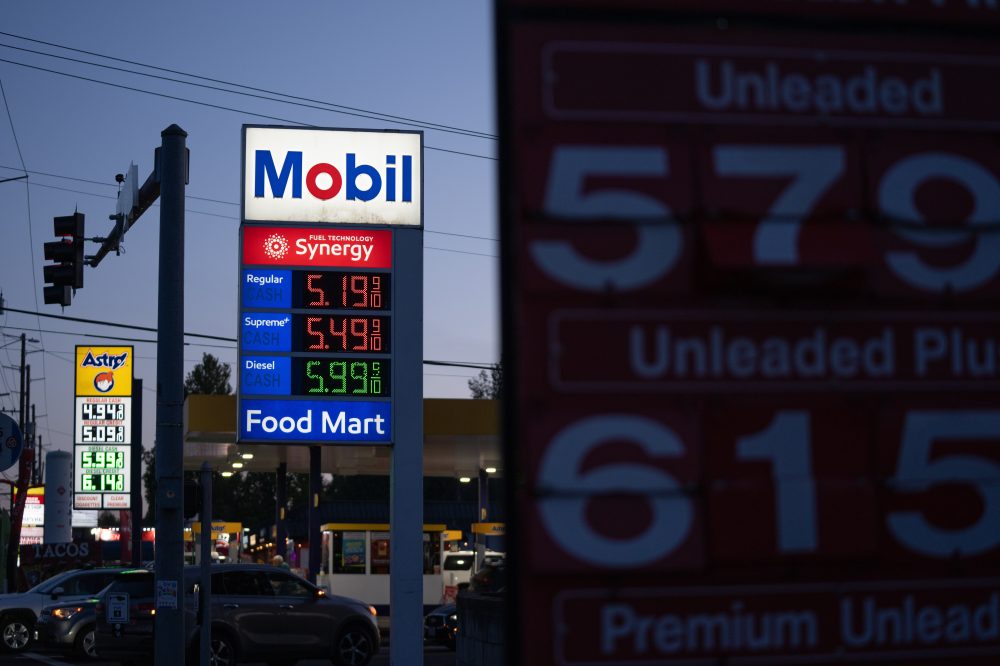
Regular gasoline prices increased by another 7 cents overnight, reaching $4.30 per gallon. This compares to $3.18 on the same date last year. Gasoline prices have reached new multi-year peaks for three consecutive days.
As consumers allocate more money toward fuel costs, they’re expected to reduce spending on other products and services. Economists anticipate this shift will negatively impact GDP. Joe Brusuelas, RSM’s chief economist at the tax and advisory company, has revised his U.S. economic growth projection for this year downward to 1.7% from his earlier estimate of 2.4%.
“A year that was set to benefit from tail winds associated with a large tax cut and boom in artificial intelligence-led investment has been partially derailed by the impact of what as of today is an adverse and growing supply shock caused by the war in Iran,” Brusuelas explained. “Unfortunately, war and the supply shock that ensued has altered the probable growth path this year.”
The combination of increasing prices and potential economic growth threats has created a challenging situation for the Federal Reserve and other central banks worldwide. They must decide whether to reduce interest rates to support their economies or maintain current rates — or even consider increases — to address inflation concerns.
Currently, they’re maintaining their positions. The Bank of England maintained its primary interest rate at 3.75% Thursday while suggesting potential future increases as officials evaluate the war’s economic consequences. Similarly, the Federal Reserve, Bank of Japan, and European Central Bank have all chosen to keep rates unchanged while monitoring the conflict’s economic effects.
Despite these challenges, American workers maintain strong job security. The Labor Department reported Thursday that unemployment benefit applications — an indicator of layoffs — dropped last week to their lowest point in over five decades.
While companies aren’t releasing workers, they’re also not actively hiring. Last year’s job growth was the weakest outside of a recession since 2002. This year has shown inconsistent patterns — strong performance in January (160,000 new positions) and March (178,000) but weakness in February when employers eliminated 133,000 jobs.
Economic experts describe a “no-hire, no-fire” environment that prevents young job seekers from entering the employment market. Simultaneously, concerns are mounting that artificial intelligence is eliminating entry-level positions.