
Former chemical industry sites across northeastern England are experiencing an unexpected renaissance as property owners position their land for the artificial intelligence revolution sweeping through Britain’s real estate market.
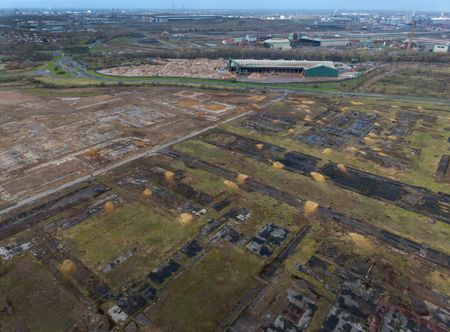
The Wilton International site in Teesside exemplifies this transformation. Once home to a thriving petrochemical industry, the location now boasts the essential ingredients for modern AI infrastructure: existing power plants, water access, and electrical grid connectivity.
Sembcorp UK, the site’s primary owner, is collaborating with data center developer Digital Reef to attract major technology companies to establish operations at the location, which sits in one of Britain’s most economically challenged regions.
“We’re trying to develop something quite quickly, and bring jobs and industry and investment back,” explained Mike Patrick, CEO of Sembcorp UK, a division of Singapore-based Sembcorp Industries.
This transformation reflects a nationwide trend. Property owners, speculative investors, developers, and even agricultural landowners are repositioning their holdings to benefit from the massive investments technology giants are making in AI infrastructure.
Construction analytics firm Barbour ABI reports that 119 data center proposals have been filed across diverse locations, including abandoned automotive plants, former paint manufacturing facilities, closed hotels, and shopping centers near Heathrow Airport.
The momentum accelerated following a high-profile banquet where King Charles hosted Donald Trump and technology executives during the U.S. president’s visit. Companies including Google, Microsoft, and Nvidia subsequently announced multi-billion-dollar commitments to Britain’s digital infrastructure development.
“The demand that’s come through in the last couple of years – really because of AI – has exploded,” observed Andrew Groves from real estate consultancy Bidwells. “Speculators and promoters have obviously seen it as an opportunity to make greater returns.”
Unlike financial services data centers that require proximity to urban centers for speed, AI facilities primarily need processing power, allowing them to operate from more remote and affordable locations away from London’s premium property markets.
This geographic flexibility has created opportunities for industrial sites far from the capital and sparked interest among rural property owners seeking alternatives to traditional farming income.
The Wilton site represents what industry professionals call “powered land” – property equipped with either independent power generation capabilities or existing high-voltage grid connections, or both.
“Wilton is almost uniquely placed in that it already has a large grid connection and on-site power assets,” noted Peter Ireton, Sembcorp UK’s Business Development Director. “We think we can attract a large off-taker.”
However, many properties aspiring to host data centers lack adequate power infrastructure, creating an unprecedented surge in grid connection applications. Combined with necessary transmission system upgrades, this demand has extended waiting periods for new connections to 12-15 years.
Britain’s energy department reported a 460% increase in connection requests during the first half of 2025. Applications for high-voltage network access reached 96 gigawatts of capacity, with an additional 29 GW requested for local network connections.
To put this in perspective, Britain’s total generation capacity is approximately 72 GW, while peak demand last year was just under 46 GW.
The National Energy System Operator identified 140 data centers in the primary queue in March, representing roughly 50 GW of capacity. Officials indicated that speculative activity is driving demand far beyond network capabilities, delaying legitimate projects and hampering the energy transition.
Some applications come from landowners lacking power infrastructure, planning approval, or identified end users. These “zombie projects” are creating bottlenecks in the system.
“You’ve been seeing an awful lot of people speculating, spending time trying to get power onto a site,” said Tom Glover, head of data centers for EMEA at U.S. real estate company JLL.
Recognizing these challenges, NESO introduced reforms in March to filter out speculative applications and prioritize strategic sectors, including data centers. A similar initiative last year targeting clean energy projects reduced those applications by half.
Real estate brokers report that land with suitable power supply for data centers has always commanded premium prices, but AI demand and grid congestion have driven values even higher recently.
According to British real estate firm Savills, London industrial land typically sells for between 4.5 and 6 million pounds per acre. For data center-suitable properties, prices jump to 8-15 million pounds per acre, according to Savills and other industry sources.
Similar trends are occurring in the United States. A March report by real estate adviser Colliers found powered land selling for up to 2.5 times more than other industrial property, with multiples exceeding three times in northern Virginia and northern California.
Some developers have employed creative solutions to secure power access in Britain. The developer behind a site north of London purchased by U.S. data center operator Equinix partnered with a group holding an allocated connection for battery storage, then converted it to a demand connection suitable for data center use.
“Acquiring a development that has outline planning and a confirmed grid connection just effectively removes the risk,” explained James Tyler, UK managing director at Equinix.
The company plans to invest 3.9 billion pounds ($5.3 billion) in the development – its largest investment outside the United States. Construction is scheduled to begin in early 2027, with operations starting in 2031.
Even guaranteed connection dates don’t always provide certainty. Dawn Childs, president of data center developer Pure DC, described how their London project’s connection offer was delayed approximately two years ago, with about one-third of the promised power pushed back more than a decade.
Data compiled by DC Byte for Reuters reveals Britain is lagging behind competing data center markets. Of 61 British projects tracked since late 2022, only 7% are under construction or completed.
In contrast, 46% of German projects monitored by DC Byte are under construction or finished, compared to 40% in France and 24% in the United States.
This performance gap poses challenges for the government, businesses, and major technology companies, all viewing large-scale data centers as crucial for economic modernization and establishing Britain as an AI superpower.
Grid connection delays aren’t the only obstacle. Britain also maintains some of the world’s highest industrial electricity rates.
OpenAI, creator of ChatGPT, recently suspended plans for a large data center in northeastern England, approximately 50 miles from Wilton, citing concerns about elevated energy costs and regulatory issues.
Despite these challenges, industry consensus maintains that AI demand remains genuine, creating substantial opportunities for sites offering power, planning approval, and suitable land.
This outlook could benefit Wilton, which maintains an existing 240 MW grid connection and on-site generation assets including gas, biomass, and waste-to-energy facilities.
Sembcorp anticipates integrating nearby solar and wind power into Wilton’s energy mix as data center development progresses, ultimately reaching 1 GW capacity. Digital Reef founder Piers Slater estimates achieving this goal would require approximately 15 billion pounds invested over eight to ten years.
The partners describe discussions with potential data center operators as encouraging.
“Obviously there’s a lot of talk, is it a dot com? Is it a bubble?” Slater reflected. “But what we’re seeing is the adoption of AI – and it’s happening.”