
BUTHA-BUTHE, Lesotho — When people picture Africa, skiing rarely comes to mind — but for thousands of winter sports fans across southern Africa, a small mountain kingdom has quietly become the region’s top snow destination.
Lesotho, a landlocked nation entirely surrounded by South Africa, sits at remarkably high elevation, making it the coldest country on the African continent. In the highlands, temperatures regularly drop to minus 8 degrees Celsius — around 18 degrees Fahrenheit — during the June through August winter months.
Tucked into the northern Maluti Mountains at an elevation of roughly 3,200 meters (10,499 feet) above sea level, the Afriski Mountain Resort holds a unique distinction: it is Lesotho’s only fully functioning ski resort and the sole ski resort in all of sub-Saharan Africa.
The snow-draped mountain scenery provides an ideal setting for skiing, with slopes stretching across 17 hectares — about 42 acres, or roughly the equivalent of 24 standard soccer fields. The resort, which first opened its doors 25 years ago, is located about 80 kilometers (50 miles) from the nearest major town of Butha-Buthe, reachable by a short car or bus trip.
Tourism accounted for roughly 7% of Lesotho’s annual GDP of approximately $2.6 billion last year. The World Bank has identified Lesotho as one of the world’s poorest nations, making the revenue generated by Afriski especially valuable to the local economy. The resort’s artificial snow machines ensure operations continue throughout the Southern Hemisphere’s entire winter season, regardless of natural snowfall.
U.S. President Donald Trump drew attention to the country in 2025 when he joked that Lesotho was a place “nobody has ever heard of.” Yet just a year before those remarks, the kingdom — home to 2.3 million people — marked 200 years since the founding of the Basotho nation and celebrated 58 years of independence from British rule.
Situated entirely at or above 1,000 meters (3,280 feet) above sea level, Lesotho receives significant snowfall each year, and skiing has been steadily growing in popularity — transforming from a niche activity once closely tied to North America and the European Alps into something increasingly embraced across southern Africa.
Most visitors cross into Lesotho by road from South Africa, though international travelers can also arrive by air at the capital city of Maseru.
Afriski’s CEO, Theo Ferreira, says nearly 70% of the resort’s guests come from South Africa, with the remaining visitors largely from Lesotho itself or elsewhere in the southern African region. The resort currently employs 227 full-time and seasonal workers, the vast majority of whom are Lesotho nationals. Around 30 South Africans also work at the resort, primarily as ski instructors, Ferreira noted.
The resort can house up to 420 overnight guests on-site, and during peak periods, the towns of Butha-Buthe and Mohlokong nearby can provide additional lodging options. The busiest single day this year brought in more than 1,400 visitors, while the 2025 record reached over 1,600 people — counting both day-trippers and those staying overnight or longer, according to Ferreira.
Because natural snowfall can be unpredictable, the resort depends heavily on artificial snow production to keep the slopes skiable throughout the winter.
Afriski has played a meaningful role in establishing ski tourism as a new draw in southern Africa, a region already well known for its wildlife and dramatic coastlines along both the Indian and Atlantic Oceans.
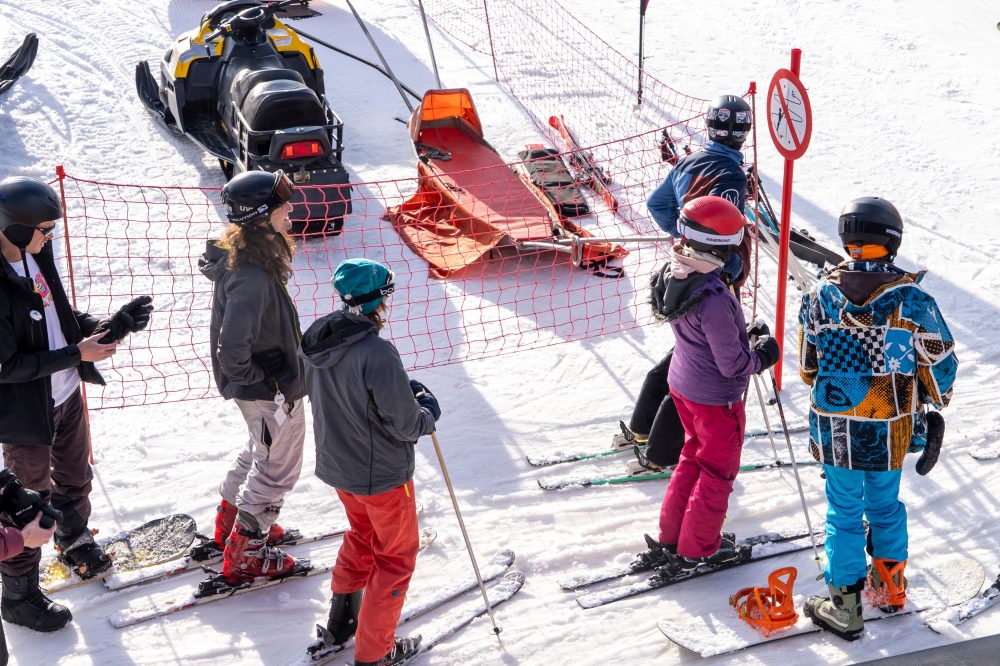
For many guests, a visit to Afriski marks their very first time on skis — learning through repeated falls, dusting themselves off, and trying again until that first smooth, uninterrupted run down the slope finally happens.
Janko Smits, a student visiting from Cape Town, South Africa, called it “an amazing slope to learn on.”
“At the start it was a little discouraging because you fall, and you fall hard,” he said. “But the people here, they gave me one lesson and after an hour, honestly, I felt confident.”
Thato Ramaphoko, a first-time visitor from Pretoria, South Africa’s capital, reflected on the surprising contrast of the experience. “When you think of the African continent, you don’t think of snow. You think about … the sun and the Sahara (Desert),” he said. “But that you can actually go to all that and also come here and it also snows at the same time, it is just mind-blowing, so I just had to see it for myself.”
Beyond the slopes, visitors can enjoy a taste of local culture through traditional sausage rolls and Maluti Lager, a beer brewed right in Lesotho. And for those looking to bring something home, the vibrant Basotho blanket — featuring bold colors and distinctive patterns — serves as a popular keepsake, with those same designs creatively woven into local ski jackets and other gear.