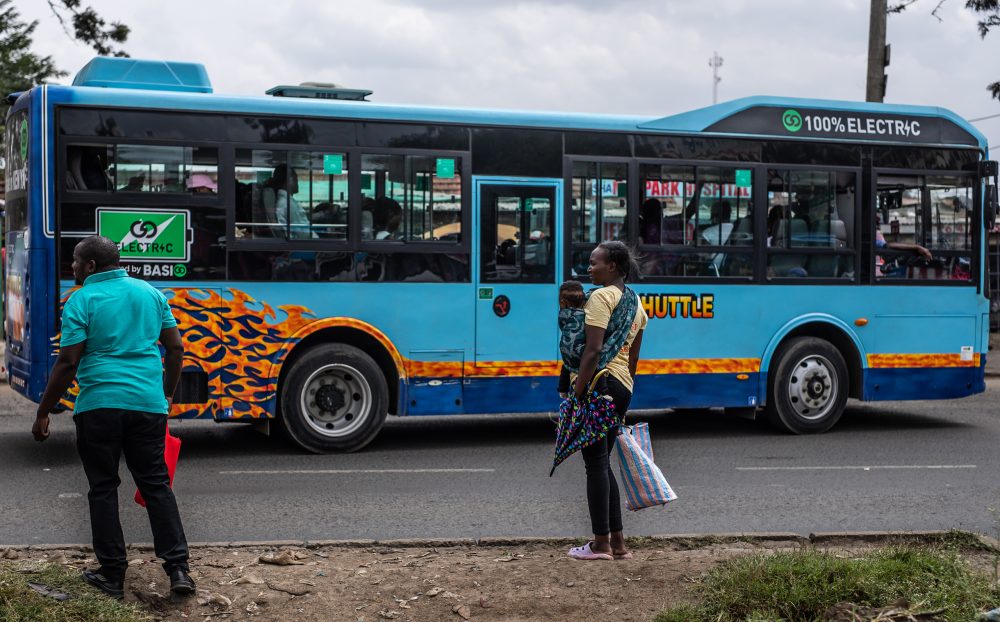

NAIROBI, Kenya (AP) — Transportation companies across Africa are starting to build electric passenger vans and taxis within their own borders, utilizing component kits from Chinese manufacturers along with creative payment plans to expand electric public transit throughout the region.
Lagos-based Saglev has started putting together 18-passenger electric vans using component packages from Chinese car manufacturer Dongfeng Motor Corp. The Nigerian company expects to produce as many as 2,500 vehicles annually, with plans to eventually build 17 different electric models for Nigeria and neighboring West African countries.
“This is a major step in Nigeria’s transition toward clean, fossil-free transportation,” said Saglev’s CEO Olu Falaye. He described the van as Nigeria’s first domestically assembled electric vehicle designed for mass transportation, marking a first for sub-Saharan Africa as well.
“This feat is a clear signal that electric mobility in Nigeria is practical, scalable and ready for adoption,” Falaye said.
The company represents a partnership between Nigeria’s Stallion Group, a prominent automotive distributor, and Chinese car maker Sokon Motor. Saglev also intends to build solar-powered charging facilities to address power reliability issues that pose a significant obstacle to electric vehicle adoption across parts of Africa.
Kenya is pursuing a comparable strategy, where Chinese-supported Rideence Africa recently finalized a $2.46 million agreement with Mombasa’s Associated Vehicle Assemblers (AVA) to start local production of electric taxis and small buses using kits from China’s Jiangsu Joylong Automobile and Beijing Henrey Automobile Technology.
“We are now moving decisively from operator to manufacturer,” said Rideence Africa’s managing director, Minnan Yu. “Our aim is to build a Kenya-rooted new-energy mobility company serving Africa.”
These two major African economies are spearheading local electric vehicle production as nations work to lower fuel expenses, decrease pollution, and develop their own manufacturing industries.
“This partnership delivers Kenya’s first dedicated electric vehicle assembly line, demonstrating clearly that Kenya has the capacity and capability to assemble EVs locally at scale,” AVA Managing Director Matt Lloyd said.
Small electric vans and buses serve as the backbone of African public transportation, where Japanese vehicles like Toyota Hiace and Nissan vans currently dominate streets, transporting both passengers and cargo.
Charging an electric vehicle costs approximately $3 for distances up to 200 kilometers (123 miles), while gasoline expenses for the same distance exceed $15.
“The assembly of electric vans is emerging as a strong market segment,” said Dennis Wakaba, the secretary-general of the Electric Mobility Association of Kenya. “Earlier, the cost of electric vans was high, putting off operators. But as local assembly scales up, these costs have dropped, attracting more orders.”
Kenya operates one of Africa’s most dynamic electric transportation markets, featuring startup companies that build buses and vans for public transit and ride-sharing services. Ethiopia and South Africa have also joined this market, with Ethiopia’s Belayneh Kinde Group (BKG) producing approximately 150 small buses monthly using Chinese parts.
To improve electric vehicle affordability, companies such as Rideence offer pay-per-use and rent-to-own programs that eliminate large upfront costs for operators. The company rents its taxis to drivers for roughly $18 daily.
BasiGo-Kenya Vehicle Manufacturer, which is also expanding into electric van assembly, asks operators to make a down payment followed by approximately 20 U.S. cents per kilometer (32 cents per mile) of driving.
This strategy aligns with the financial circumstances of African transport operators, who face limited credit access and rarely have funds to buy new vehicles outright.
“These innovative financing models mitigate risks for both assembler and operators, helping put vehicles on the road faster. With these, we expect to see more e-vans taking a larger share of the African transport systems,” Wakaba said.
However, Africa currently has only about 30,000 electric vehicles compared to millions powered by gasoline and diesel, according to recent data from the Africa Mobility Alliance. The continent produced just 1.1 million vehicles total last year, with 90% manufactured in Morocco and South Africa.