
ITTEFAQ, Afghanistan — The screams lasted for several minutes after the earth began to shake. Then, devastating silence.
Mohibullah Niazi, a local resident who assisted with rescue operations, reported Saturday that eight victims who perished near Kabul during Friday evening’s 5.8 magnitude earthquake were members of a refugee family who had recently come back from Iran.
A single survivor remains: a 3-year-old boy named Aarash, who sustained injuries and is currently receiving treatment at a Kabul hospital.
Deputy government spokesman Hamdullah Fitrat announced Saturday that the earthquake’s total fatality count has reached 12, with four additional people wounded. According to Fitrat, the disaster destroyed five residences and caused substantial damage to 33 others, impacting 40 families across Kabul, Panjshir, Logar, Nangarhar, Laghman and Nuristan provinces.
The Afghanistan Disaster Management Authority reported a lower death count of nine. Officials have not explained the difference in these figures.
The affected family represents part of the massive wave of Afghan refugees who have recently come home from Iran and Pakistan, following both nations’ 2023 enforcement campaigns targeting foreign residents, especially Afghans.
The family had been in the area for just 15 days, residing in a tent on property adjacent to Niazi’s residence. The family patriarch, Najibullah, approximately 50 years old, “had no other shelter,” Niazi explained. “He was a very poor person.”
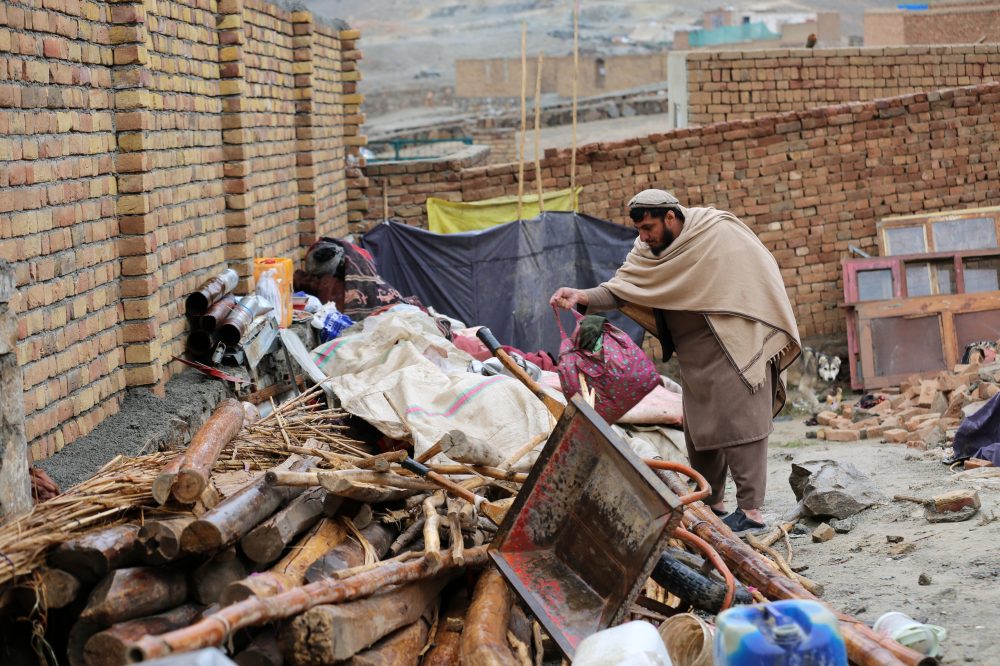
Their temporary shelter was positioned against a barrier wall that divided the land from Niazi’s property, which sat on elevated terrain in Ittefaq village on Kabul’s eastern edges.
Recent days of intense rainfall, which have caused fatal flooding throughout Afghanistan, had saturated the soil. During the earthquake, the barrier wall gave way and crushed the family beneath it.
“My daughter shouted to me that a wall had fallen on them. The whole family ran, but there were so many big rocks,” Niazi recalled Saturday while standing at the disaster site. “We tried our best.”
By Saturday morning, only debris piles of bricks and mud remained, alongside blankets, kitchen items and other personal effects recovered from the wreckage and gathered together.
“For about three minutes, I could hear the voices of these people,” Niazi stated. “But we couldn’t do anything. There were two or three of us, but this was not the work of three people.”
Community members quickly arrived to assist, using shovels and bare hands to dig through mud and debris. They contacted the nearby Taliban police station, which dispatched rescue teams and emergency vehicles.
Young Aarash was extracted alive but wounded and immediately transported for medical care. Health Ministry spokesperson Sharafat Zaman, who visited the child Saturday, confirmed he is being treated for serious head trauma.
For the remaining family members — the parents, four daughters between ages 12 and 23, and two sons — rescue came too late. Workers could only retrieve their remains.
Niazi revealed he had previously welcomed the family into his home for one evening. On Friday, merely 30 minutes before the earthquake occurred, he had extended another invitation, offering his guest room as protection from the harsh weather and cold. “But they did not come with me,” he said.
The Friday evening tremor originated in the Hindu Kush mountains, approximately 150 kilometers (90 miles) east of Kunduz city in the north, based on data from the Euro-Mediterranean Seismological Center and U.S. Geological Survey. This location sits roughly 290 kilometers (180 miles) northeast of the capital.
Afghanistan sits within an extremely earthquake-prone region, with seismic events claiming thousands of lives in recent years.
This past August, a 6.0 magnitude earthquake struck a remote mountainous area in eastern Afghanistan, resulting in over 2,200 deaths. Kunar province experienced the highest casualties, where residents typically inhabit wooden and mud-brick structures along steep valley slopes.
In November, a 6.3 earthquake hit Samangan province in northern Afghanistan, claiming at least 27 lives and injuring more than 950 people. The disaster also harmed historic landmarks, including Afghanistan’s renowned Blue Mosque in Mazar-e-Sharif and the Bagh-e-Jahan Nama Palace in Khulm.
On October 7, 2023, a 6.3 earthquake accompanied by powerful aftershocks in western Afghanistan resulted in thousands of fatalities.