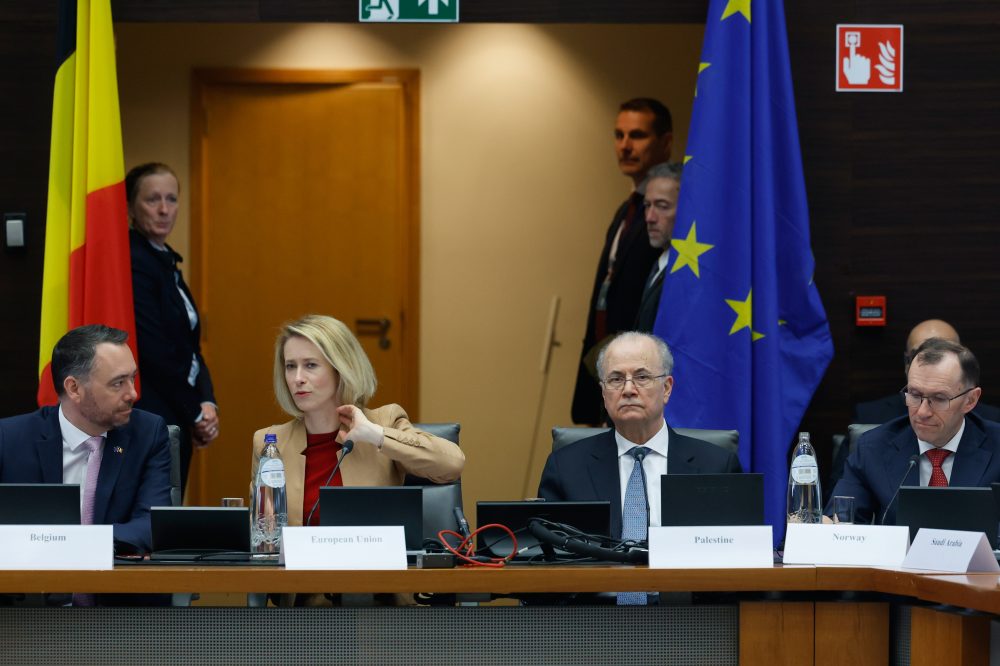

BRUSSELS — Representatives from over 60 countries convened in Brussels Monday to meet with Palestinian Prime Minister Mohamed Mustafa regarding stability, security, and sustainable peace efforts in Israel, Gaza, and the West Bank. The international gathering takes place while global focus remains concentrated on ongoing Middle Eastern conflicts involving Iran and Lebanon.
Belgian Foreign Minister Maxime Prévot, who co-hosted the conference alongside EU top diplomat Kaja Kallas, expressed concerns that continued violence in the West Bank and ongoing destruction in Gaza are making prospects for a two-state solution increasingly challenging.
“We observe without naivety that the two-state solution is being made more difficult by the day,” Prévot stated. “But Belgium and many European and Arab partners continue to believe that this remains the only realistic path to a lasting peace, for Israelis, for Palestinians and for the stability of the entire region.”
The European Union serves as the primary financial supporter of the Palestinian Authority, led by 90-year-old President Mahmoud Abbas, who has governed from Ramallah for the past twenty years. While the EU has chosen not to participate directly in President Donald Trump’s Board of Peace initiative, favoring UN multilateral approaches and international legal frameworks, the organization seeks to maintain its diplomatic influence in the strategically important Mediterranean region.
European anger over Gaza’s humanitarian crisis has prompted numerous EU officials to criticize Israel’s military actions and apply pressure to Prime Minister Benjamin Netanyahu’s administration. Following the recent removal of Hungary’s long-serving Prime Minister Viktor Orbán, a Netanyahu ally, the bloc may now have sufficient political backing for stronger measures such as targeted sanctions against Israeli settlers or partial suspension of Israeli relations.
West Bank Palestinians report that Israel has exploited the Iran conflict to strengthen its territorial control, with increased settler violence and additional military movement restrictions imposed under security justifications.
Regarding Gaza’s future, Mustafa emphasized the need for unified governance, stating: “Gaza requires ‘one state, one government, one law and one goal.’”
“Our common objective of achieving one security structure under the legitimate authority should guide the effective coordination between the International Stabilization Force, the Palestinian Authority, security institutions and other international actors. Security must not be fragmented,” he explained.
Mustafa also advocated for “the gradual and responsible collection of arms from all armed groups and also the full Israeli withdrawal from Gaza.”