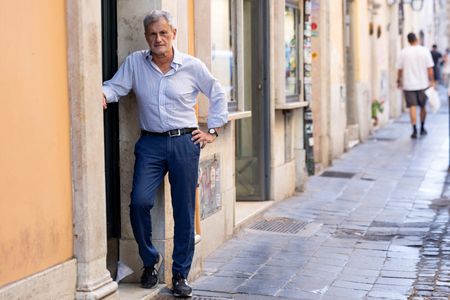

He’s far-right, freshly released from prison, and now partnering with a man who believes serious criminals should “rot” behind bars — yet Italy’s Gianni Alemanno has become one of the country’s most surprising advocates for prisoners’ rights, trying to strike a balance between a hard line on crime and a genuine concern for human dignity.
The 68-year-old has spent decades on the right side of Italian politics. He got his start in the youth wing of the post-fascist MSI party, later served as agriculture minister under the late Prime Minister Silvio Berlusconi, and held the office of Rome’s mayor from 2008 to 2013.
On June 24, Alemanno walked free from Rebibbia prison in Rome — one of Italy’s largest and most run-down facilities — after 18 months of incarceration following a conviction for influence-peddling and abuse of office, charges he had denied.
During his time inside, Alemanno kept a detailed social media diary of what he witnessed, shining new attention on Italy’s neglected prison system. The country’s prisons rank among the most crowded in all of Europe, with an occupancy rate approaching 140%.
“Only those who have spent time inside, or have relatives inside, understand the issue with prisons. Others do not understand it, they don’t see it at all,” Alemanno said in an interview with Reuters.
Alemanno also recalled a much earlier stay at Rebibbia — a 10-month sentence in 1982 for throwing a Molotov cocktail at the Soviet embassy during a far-right protest. Remarkably, he ended up in the very same cell when he returned on December 31, 2024. “From that cell, I watched Italy win the football World Cup in 1982,” he reflected.
Upon his release, Alemanno aligned himself politically with Roberto Vannacci, a former army general and vocal anti-woke campaigner whose new far-right party has been climbing in opinion polls. Vannacci, however, holds views on punishment that are anything but lenient.
On the night Alemanno was freed, Vannacci met him and made his position crystal clear, drawing on the Biblical story of Cain and Abel — in which Cain murders his brother. “Between Abel and Cain, I’m with Abel, and Cain should rot in prison,” Vannacci told reporters. “For serious crimes, people definitely deserve a rigorous, serious, and prolonged sentence.”
While locked up, Alemanno built a reputation by co-authoring a Facebook diary with a fellow inmate serving time for complicity in murder, documenting what he described as abuses and failures within the prison system. The two plan to turn those posts into a book.
Alemanno spoke out about filthy living conditions, understaffing in the judiciary, suffocating red tape, petty regulations, and the near-total absence of educational or vocational opportunities for inmates who genuinely want to change their lives. He argued the system is essentially designed to keep criminals criminal.
“Those who want to misbehave have a wide-open path and can do whatever they please; those trying to find a different way, on the other hand, face a multitude of difficulties,” he said.
Last July, Prime Minister Giorgia Meloni’s right-wing government promised to add up to 15,000 new prison spaces and make it easier to transfer inmates with addiction issues to treatment facilities in order to reduce overcrowding. So far, no new spaces have materialized, and a proposed law addressing inmate transfers remains stalled in parliament, at risk of dying if it isn’t passed before the current legislative term concludes in 2027.
With polling showing Meloni’s coalition running even with the center-left opposition, and facing pressure from Vannacci on crime and public safety, it remains unclear whether the prime minister will choose to spend political energy on prison reform.
Still, Alemanno expressed cautious optimism — even without Vannacci’s backing on this particular issue. “It is a bipartisan battle, which must bring together left and right,” he said.