
Your daily cup of coffee could get even more expensive, depending on how Washington responds to a major political move by Nicaragua’s leader — and traders and analysts say the threat is real.
American consumers are already paying some of the steepest coffee prices in at least a decade. Now, the political situation in Nicaragua is adding a new layer of uncertainty to that market. Nicaraguan President Daniel Ortega announced that his country will no longer hold elections, prompting a sharp response from Washington.
On Tuesday, U.S. Secretary of State Marco Rubio declared that Nicaragua should not expect “business as usual” with the United States following Ortega’s announcement the day before.
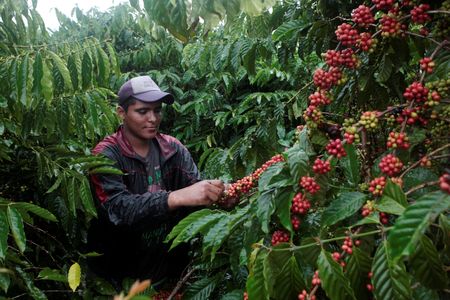
Coffee is one of Nicaragua’s most significant exports, and the U.S. is by far its biggest customer. According to the U.S. Department of Agriculture, the United States purchases 35% of all coffee Nicaragua sends abroad. Altogether, Nicaragua brings in about half a billion dollars annually from coffee exports to all countries combined.
Senior U.S. coffee trader and advisor Mike Nugent said he wouldn’t rule out the possibility of trade restrictions. “I wouldn’t be surprised,” he said when asked whether the administration might limit coffee purchases from Nicaragua or impose heavy tariffs on that trade.
Coffee analyst and consultant Marc Schonland, who advises several U.S. coffee companies, warned of the potential fallout. “Should the U.S. choose to get involved, it risks that Nicaragua could become the target for future trade sanctions,” he said.
The U.S. is the world’s largest coffee market. Retail prices there are currently averaging $9.45 per pound — near the highest levels recorded since at least 2016, according to the U.S. Bureau of Labor Statistics.
Any significant U.S. restriction on Nicaraguan coffee would deliver a blow to small farmers in that country and damage its economy. It would also further tighten a U.S. coffee market that has already been under strain for four years, worsened by production shortfalls among major suppliers and the ongoing effects of President Donald Trump’s tariffs.
Soft commodities analyst Judith Ganes noted that policymakers will have to weigh the broader impact. “There will be certainly the consideration of the coffee community and the economic toll that would take,” she said.
The National Coffee Association, the main industry group representing U.S. coffee businesses, has been actively pushing to keep coffee out of trade restrictions. The group recently succeeded in getting instant coffee added to a list of tariff exemptions — building on an existing exemption that already covered green coffee beans.
With roughly two-thirds of Americans reporting that they drink coffee every day, the issue is drawing attention from Republican lawmakers who are watching consumer costs closely ahead of midterm elections. The party is working to hold onto its narrow majority in Congress.
Ortega has spent recent years tightening his grip on power in Nicaragua, severely limiting political opposition and rewriting the country’s Constitution last year to establish a one-party system.