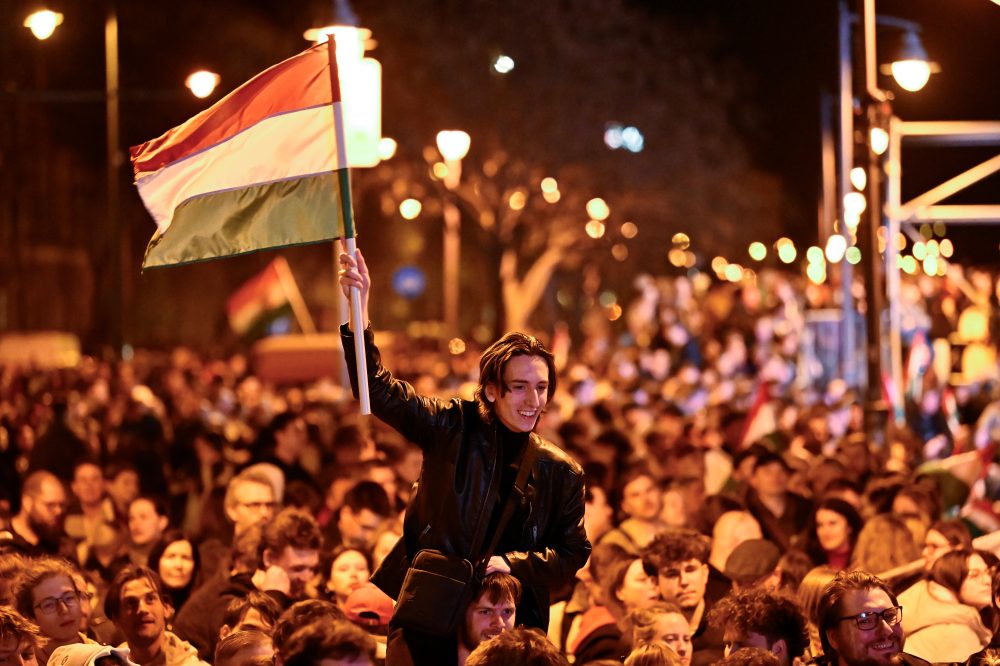

BUDAPEST, Hungary (AP) — The young generation that spent their entire adult lives under Prime Minister Viktor Orbán’s administration became the driving force behind Sunday’s stunning electoral upset that removed him from power after 16 years of rule.
Massive crowds flooded Budapest’s streets to mark the historic victory of pro-European Union candidate Péter Magyar, with music from Hungary’s leading anti-government artists echoing throughout the celebrations. Young people climbed the famous Chain Bridge while playing rebellious songs from musicians who had voiced their generation’s anger toward the administration.
Throughout Budapest’s public transportation system, youth activists organized protest songs and performed computer-generated tribute music honoring Magyar.
Outside Hungary’s ornate parliament complex, an organization named “More Techno to Parliament!” threw a dance party to mark Orbán’s electoral loss.
These demonstrations highlighted how crucial younger voters were in the movement to overthrow Orbán’s authoritarian government.
Pre-election research from 21 Research Center revealed that 65% of voters younger than 30 chose Magyar’s Tisza party, compared to just 14% who supported the 62-year-old Orbán.
Marcell Szabó-Temple, a 26-year-old architect, was raised in Budapest’s suburbs by family members who avoided political discussions around children. During the 2018 election — his first opportunity to vote, which Orbán won decisively — he remained indifferent toward the electoral system.
However, Szabó-Temple’s perspective shifted dramatically during his college years. Despite attending Hungary’s premier engineering institution, he became dismayed by the educational system’s condition. Learning through what he called an obsolete program in deteriorating facilities led him to question: “Was this really all they could achieve in 12 years of governance? If so, we need something better.”
Additional challenges followed. During 2022, over 20 Hungarian institutions lost their eligibility for the European Union’s Erasmus student exchange initiative due to Orbán’s policy transferring university oversight to government-appointed foundation leaders.
Opposition voices argued Orbán’s restructuring aimed to dominate academic institutions and suppress independent thinking. Despite widespread protests from students and administrators, the changes proceeded as planned.
Unable to participate in international study programs and discouraged by Orbán’s dominant 2022 re-election, Szabó-Temple described feeling “like the world went silent for the next few years.”
“I stopped caring about politics, again,” he explained. “It was like being back in high school: I didn’t even want to hear the news.”
When the 45-year-old Magyar emerged as a political figure in 2024, Szabó-Temple experienced unprecedented optimism about potential reform.
Magyar, a former member of Orbán’s Fidesz party, focused his campaign on rebuilding Hungary’s European Union ties and returning to Western partnerships after years of growing Russian influence under Orbán’s leadership.
Throughout hundreds of campaign events nationwide, he regularly spoke directly to young audiences, encouraging them to shape their nation’s destiny.
During this period, a fresh wave of musical performers, many who gained popularity through online platforms, started creating more politically charged content. As young people faced worsening economic conditions and deepening societal rifts, their music became increasingly critical of Orbán’s administration.
Concert-goers began spontaneous anti-government demonstrations during summer music festivals. Government representatives criticized young people for these displays of opposition.
This musical resistance culminated two days before the election when more than 100,000 people filled a massive Budapest plaza for a “system-breaking” performance. More than 50 performers took the stage, encouraging young voters to support political transformation.
Following Orbán’s defeat, Szabó-Temple announced plans to return to Hungary from Portugal, where he currently works on an exchange program.
“There was a growing sense among young people that if we can’t change the regime now, we might not want to live in Hungary for the rest of our lives. I certainly felt like that,” he stated.
Similar to many Hungarian youth, he maintains high hopes for the Tisza party.
“We put our faith in them and we expect them to deliver,” he said. “If they do, I will settle down and build a family in Hungary.”