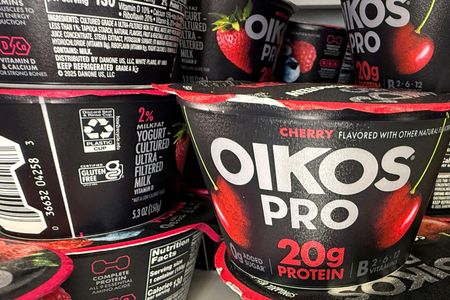

A legal fight has broken out between two of the biggest names in yogurt, as French dairy giant Danone filed suit against Chobani in Manhattan federal court, accusing the New York-based company of overstating the protein content on labels for its Chobani 20G Protein product.
Danone claims the multi-serving tubs of Chobani’s product use an inflated serving size to make protein numbers appear higher than they should be, which it says prevents shoppers from making a fair comparison with its own Oikos Pro yogurt in the ultra-high-protein category. Danone also alleged that Chobani copied its product and used these methods to undercut Danone’s Oikos brand — valued at €1 billion — on price.
Chobani pushed back forcefully. CEO Hamdi Ulukaya, who founded the privately held company in 2007, dismissed the allegations and suggested Danone was simply trying to generate damaging headlines. “In a way, I am kind of laughing at it,” Ulukaya told Reuters. “We never add external protein to our products. We will never mislead anybody.”
For its part, Danone said in a statement that consumers deserve “clear, accurate and consistent nutrition information” and that Chobani’s labeling approach makes it impossible for shoppers to make “an accurate comparison between products.”
The dispute comes at a critical moment in the yogurt industry. Growing numbers of Americans using GLP-1 weight-loss drugs are seeking out protein-rich foods to prevent muscle loss, and yogurt has emerged as one of the few food categories seeing a lasting benefit from that trend. A consumer study by Boston Consulting Group found that yogurt, unlike products such as protein shakes, experiences a more permanent sales boost tied to GLP-1 use.
“High-protein foods like yoghurt or meat seem to increase in frequency during and even more after stopping GLP-1s,” said Lauren Taylor, managing director and senior partner at BCG.
The competition between the two companies has intensified as Danone has struggled to keep up with consumer demand for high-protein yogurts. Analysts at Barclays noted in May that investors are growing uneasy about what they see as a slow response from Danone in rebuilding its U.S. dairy business. “Competitors, notably Chobani, (are) doing a much better job and growing currently at more than 20%,” Barclays wrote. “There is a feeling that Danone has been too slow to add capacity and perhaps it needs to spend more to compete with aggressive competitors such as Chobani.”
Danone’s stock has dropped 15% so far this year, while the MSCI World Index has risen 11% over the same period. Meanwhile, NielsenIQ data shared by Chobani shows the company’s U.S. market share climbed to 26% in the first quarter of this year, up from 21% three years ago. Danone’s share fell to 25.8% from 30.7% during that same stretch. Danone’s dairy division did report 3% like-for-like sales growth in the Americas in the first quarter.
This is not the first time Danone has taken Chobani to court. The Paris-based company has sued its rival at least four times since 2016, including a recent case over coffee packaging slogans. Ulukaya said those previous lawsuits were thrown out.
Brad Charron, a former Chobani marketing executive who now leads plant-based protein brand ALOHA, was blunt in his assessment. “Danone sues Chobani four or five times a year for everything,” he said. “If you can’t compete with them, sue them.” Charron did acknowledge that many large consumer food companies adjust serving sizes to present nutritional figures — including protein — in a favorable light, but added that “at the end of the day, I think the consumer is smart enough to figure out whether they’re being misled one way or the other.”