
KANSAS CITY, Mo. — When World Cup fans show up to cheer on their national teams, they’re not just carrying flags, jerseys, and team songs — many are also toting cups and metal straws to share a round of yerba mate.
The energizing beverage, a staple in many South American countries, has grown in popularity alongside the global reach of soccer. In the United States, it has even become a go-to drink for elite athletes both on and off the field.
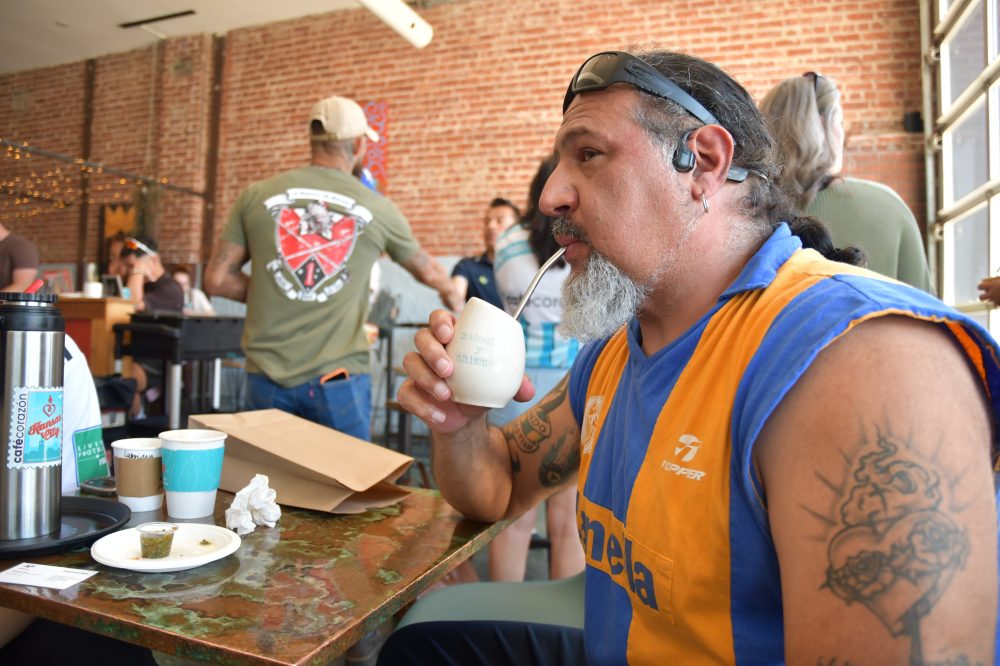
When reigning World Cup champions Argentina arrived at their Kansas City hotel, supporters gathered outside sharing yerba mate from gourd-shaped cups, sipping through metal bombillas — a special filtered straw designed for the steeped leaves. At Cafe Corazon, considered one of the largest yerba mate importers in the Midwest, a crowd of fans dressed in Argentina’s signature sky blue-and-white jerseys stretched nearly to the door on Monday — the day before Argentina’s opening World Cup match.
“Our mate has been flying off the shelves,” said Dulcinea Herrera, a co-owner of Cafe Corazon. “So a lot of people have been coming in to try it. People who aren’t Argentinian want to just have that experience. And we have a lot of Argentinians coming in saying, ‘Oh, this reminds me of home.’”
Several of the World Cup’s most recognizable players are well-known mate enthusiasts, including Uruguay’s Luis Suarez and Argentina’s Lionel Messi. After Argentina’s 2022 World Cup victory, Messi famously shared a photo of himself holding a mate cup in one hand and the championship trophy in the other — a moment that firmly placed the drink among the most iconic images in sports history.
The beverage traces its origins to Indigenous peoples and gauchos — the traditional cowboys of South America — and has since traveled the globe. Christine Folch, a cultural anthropologist at Duke University and author of “The Book of Yerba Mate,” notes that different cultures around the world have put their own unique spin on the drink.
Mate drinkers from Paraguay, Uruguay, Argentina, and Brazil each have distinct preferences for how the drink is prepared and what vessel it’s served in, which can serve as a cultural marker when fans from those regions cross paths at a match. Folch herself owns an extensive collection of mate cups, ranging from those crafted from cow hooves and horns to hand-stitched, leather-wrapped metal containers and traditional gourds.
Folch also explained that in the early 1900s, mate gained a strong following in Syria and Lebanon — which is why Middle Eastern grocery stores in the United States remain one of the primary places to find the dried leaves. In the American market, mate is frequently sold in refrigerated cans and promoted as a natural energy drink, often blended with fruit flavors. Some Cuban Americans enjoy a sweetened, carbonated version, while in Berlin, a sparkling mate drink called Club Mate is widely popular and frequently mixed with alcohol.
In its traditional form, the leaves are smoked during preparation, giving mate a slightly smoky quality along with a bold, earthy, grassy taste. Many drinkers say it provides an energy boost without the jittery feeling associated with coffee.
And for those new to ordering it — the correct pronunciation is MAH-teh, not like the word for a teammate on the soccer field.
Folch describes mate as a naturally social drink, well-suited for gatherings like sporting events, where it’s customary to share a single cup or bring enough for everyone around you.
“When somebody offers you mate and you accept, what you have done is you have stepped into a relationship. So it’s a way of bonding with people,” Folch said.
Sebastian Cufre and his father Rene, who was born in Argentina, made the drive from Albuquerque to Kansas City hoping to land last-minute tickets to Argentina’s match. At Cafe Corazon, they connected with fellow Argentina fans and passed a cup of mate around the table.
“It’s like something that you pass around during the games,” Cufre said.
While he has sampled the canned American version of the drink, he’s not impressed by it.
“Honestly, I don’t even consider that to be mate,” Cufre said. “That’s like a completely different class of beverage.”
Regardless of how someone prefers their mate, fans of the drink are encouraging North Americans to give it a try if they spot a cup being passed around at a cafe, restaurant, or watch party.
“It’s not only a drink, but a social thing,” said Fernando Villagran, originally from Salta, Argentina, who traveled from California to support his country’s team. “It is about friendship.”