
WASHINGTON — Indiana has joined a small but growing list of states gaining new freedom over how they spend federal education money, becoming the third state to receive special exemptions from the U.S. Education Department under the Trump administration’s effort to “return education to the states.”
Under the approved plan, Indiana will combine $50 million in federal funding from five different funding streams into a single pool with fewer rules about how the money must be spent. State officials say the arrangement will cut compliance and paperwork costs by roughly $20 million. Iowa and Louisiana received similar exemptions earlier this year.
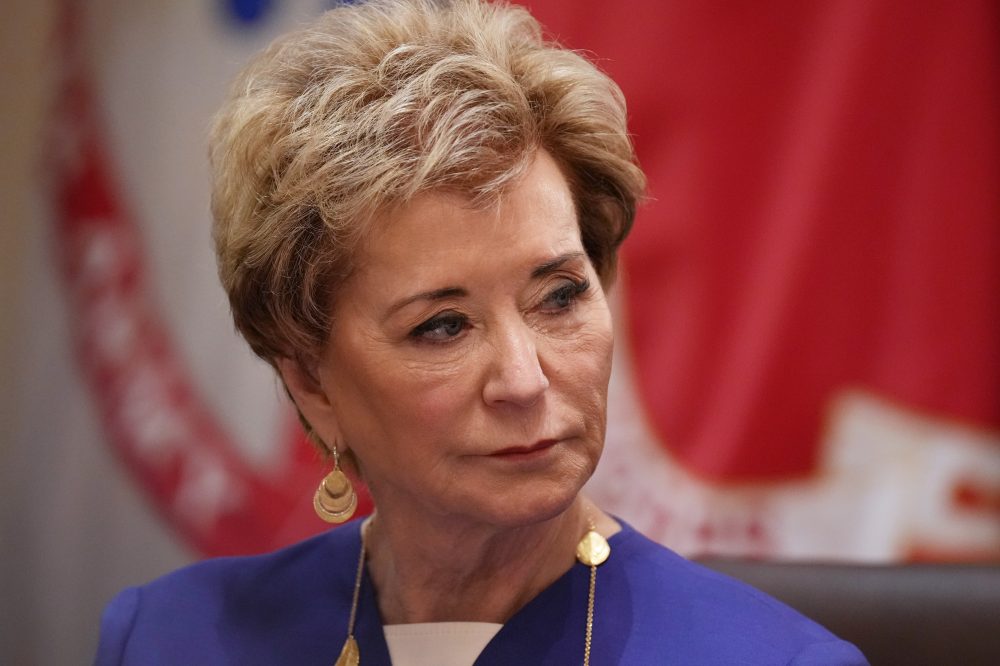
Education Secretary Linda McMahon traveled to Indiana on Tuesday to formally approve the plan alongside state Secretary of Education Katie Jenner and Gov. Mike Braun, a Republican.
Jenner expressed enthusiasm about the increased authority over federal dollars, saying states have long had control over standards, curriculum, and assessments — but not over how federal funding is used.
“As states, we have significant control over education in that we set the standards, we can choose our curriculum, we can design our assessments,” Jenner said. “But when it comes to federal funding, our hands have always been tied. Until now.”
Each year, the federal government sends billions of dollars to schools across the country, with funding levels determined by Congress. That money arrives through dozens of separate grants, each designated for specific purposes, and while it represents only a portion of most school budgets, it plays a critical role for many districts.
Federal waivers have existed for years and were heavily used during the pandemic. Under the current administration — which has pledged to dramatically reduce the federal government’s role in education — these waivers have taken on new significance as a tool for scaling back federal oversight of local school decisions.
Indiana’s waiver is also notable as the first approved by the Trump administration that touches the accountability system, permitting the state to reduce how much weight academic performance indicators carry in school ratings.
However, there are limits to what the federal government can approve. Indiana had asked to redirect money meant for struggling schools toward higher-performing schools that accept transfer students — essentially creating a school choice program — but that portion of the request was denied. An Education Department official explained that the proposal would have changed how funds are distributed to recipients, which falls outside the secretary’s legal authority to waive.
Iowa’s experience was similar. The state originally sought flexibility over major funding streams including Title I — which delivers more than $100 million to Iowa schools with large numbers of low-income students — and wanted to merge 10 funding streams into one. The department approved a much narrower waiver, combining just four funding streams worth a total of $9.8 million, covering teacher training, English learner programs, after-school activities, and academic enrichment.
Additional waivers are expected in the coming months, as several conservative-led states have either signaled interest or already submitted their own proposals seeking greater spending flexibility.
The Trump administration has framed the waivers as a way to empower state leaders and cut down on administrative red tape. The administration has also been a strong supporter of the school choice movement, in which taxpayer dollars are used to help families pay for private school or homeschooling. A federally run school choice program is set to launch next year.
Many of the funding streams being consolidated were originally set aside to help disadvantaged groups, including students in rural and low-income schools and those still learning English. Critics argue that without those specific designations, money intended for the most vulnerable students could get absorbed into broader spending that doesn’t directly address their needs. All three waivers approved so far roll English-language learner funding into a general spending pool.
The Education Department also signed off on Indiana’s request to overhaul its school accountability system using state-developed benchmarks, with a stronger emphasis on college and career readiness.
Denise Forte, CEO of EdTrust, an organization that advocates for educational equity, criticized both the waiver and the new accountability framework, arguing they reduce transparency and downplay reading and math performance.
“The Department of Education will allow Indiana to rewrite its accountability system in a way that will mask student performance and move millions of dollars in dedicated funding away from students who need it most,” Forte said in a written statement.