
SAN FRANCISCO (AP) — Once-dominant internet company Yahoo has launched Scout, an artificial intelligence-powered answer engine, as it attempts to reclaim its position in online search technology. When The Associated Press tested Scout by asking why one of Silicon Valley’s former giants lost its prominence ten years ago, the AI tool provided a thoughtful response.
“Yahoo’s journey illustrates how a company with an early advantage can disappear without continuous innovation,” Scout responded, while providing hyperlinks to additional websites that supported its analysis.
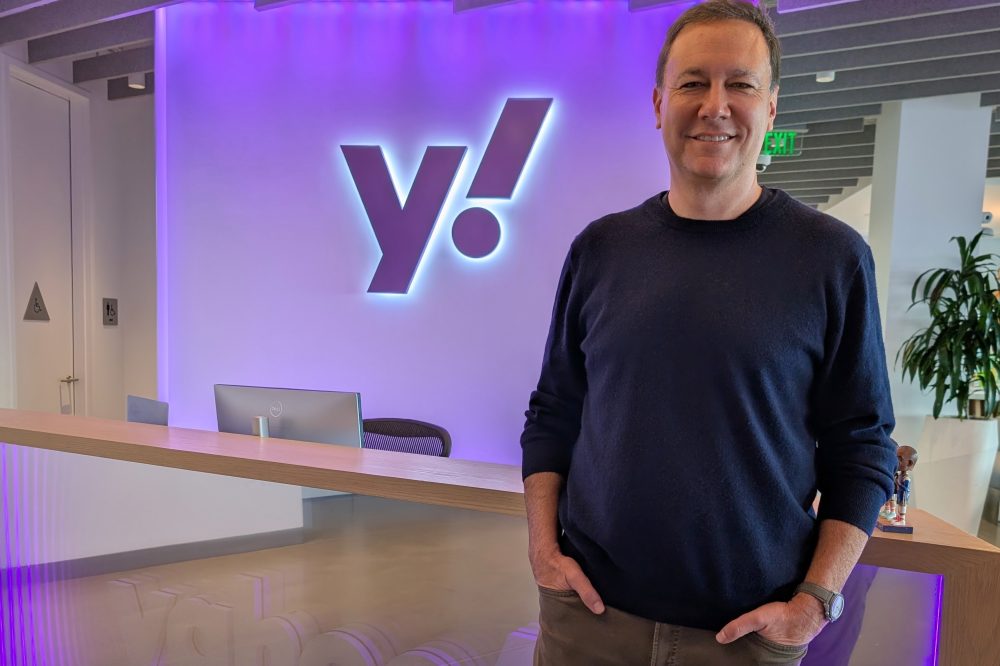
That assessment might need revision if Yahoo CEO Jim Lanzone successfully uses artificial intelligence to grow the company’s global base of 700 million users who continue using Yahoo’s financial, sports, news, fantasy and email platforms, despite a troubled history that almost eliminated a brand once considered synonymous with the internet.
“Always been the white whale of turnarounds for me,” Lanzone stated, noting his experience in reviving struggling internet companies. “I always thought I could do something with this thing.”
The 55-year-old executive received his opportunity when private equity company Apollo Global Management purchased Yahoo for $5 billion in September 2021 — far below its highest market valuation of $125 billion during the dot-com surge in early 2000. Apollo’s purchase followed Verizon Communications’ 2017 acquisition of Yahoo’s digital services and subsequent failed effort to merge them with AOL, another internet pioneer.
Verizon’s opportunity to acquire Yahoo’s online services only arose due to the company’s consistent poor decisions under seven different chief executives over 16 years.
While Yahoo’s troubled history didn’t eliminate the company entirely, it created a negative perception that makes it doubtful the company will ever return to its former status, according to Jeremy Ring, one of Yahoo’s earliest employees who started selling advertisements for the service from his New York apartment in 1996.
“Even though Yahoo isn’t what it once was, it hasn’t turned into a Blockbuster or Radio Shack story either,” Ring commented, who explored the company’s rise and fall in his 2018 book, “We Were Yahoo!” “What is going to enable them to compete against all the bigger companies using AI? I am not convinced all the best engineers in the world are suddenly going to come work at Yahoo.”
Lanzone’s rebuilding strategy initially concentrated on eliminating Yahoo’s problematic divisions. The restructuring involved removing some of Yahoo’s advertising technology, selling publications like TechCrunch and Rivals, and shutting down AOL’s dial-up internet service, which disconnected its remaining 500 customers. Currently, Yahoo is “very profitable” and generating billions in revenue, Lanzone reported, though he declined to provide exact figures.
After completing the cleanup phase, Lanzone started rebuilding what remained — work that included improving Yahoo’s successful fantasy sports section and completely redesigning its email service, which still holds the second-largest market share behind Google’s Gmail.
By introducing Scout to its 250 million American users, Yahoo is embracing the AI revolution with hopes the technology will make online searching easier and deliver more customized results based on individual user preferences. Lanzone also expects Scout to create a cycle that continuously directs traffic to Yahoo’s other services.
Yahoo faces competition from longtime rival Google, which remains the powerful competitor that contributed to the company’s downfall two decades ago and continues integrating more AI into its search platform through Gemini technology. Adding to the challenge, Yahoo must also compete against popular AI chatbots like OpenAI’s ChatGPT and Anthropic’s Claude, plus answer engines such as Perplexity.
Acknowledging it’s playing catch-up, Yahoo operates Scout using AI technology licensed from Anthropic.
Unlike other AI chatbots and answer engines, Scout avoids mimicking human conversations so users can’t “have a fake personal relationship with it,” Lanzone explained. “The product is very unique, even though we didn’t invent AI in the first place.”
Yahoo’s efforts to capture more online search traffic have mostly failed since the late 1990s, a decline that began just years after Stanford University students Jerry Yang and David Filo established the company as the internet’s first comprehensive website directory.
However, as the internet became more important for entertainment and business, Yahoo changed its strategy from directing traffic to other sites to creating an all-inclusive website that would keep visitors engaged. This strategic change allowed two other Stanford students, Larry Page and Sergey Brin, to develop a search engine called Google.
After rejecting an opportunity to purchase Google for only $1 million in 1998, Yahoo invested more heavily in becoming a complete destination while neglecting search so much that it outsourced that function to another company in 2000. Yahoo not only contracted Google as its search provider but also advertised Google’s brand on its website. By 2002, Yahoo offered to purchase Google for $3 billion, but Page and Brin demanded $5 billion. The failed negotiations set Google on a path toward building an internet empire now worth $3.7 trillion under parent company Alphabet Inc.
Yahoo cycled through seven CEOs, including former Google executive Marissa Mayer, in an unsuccessful attempt to compete in search before ending its 21-year run as a public company with its problematic sale to Verizon for $4.5 billion. During this period, Yahoo turned down a $44.6 billion acquisition offer from Microsoft in 2008 before eventually agreeing to use the software company’s Bing search engine.
Should Yahoo’s investment in Scout succeed, Lanzone admits it might result in the company returning to public trading more than 30 years after its 1996 initial public offering that heightened the dot-com excitement among investors at the time. Lanzone thinks another Yahoo IPO could still generate enthusiasm.
“We still have one of the biggest audiences on the internet, and that audience has been pretty loyal through a lot of ups and downs,” he stated. “If we just ‘super-serve’ them, good things will happen.”