
DALLAS — World Cup fans arriving in the Dallas-Fort Worth area are walking into a heat danger that won’t show up on any weather app — and experts say it could put their health at serious risk.
Weather forecasts may show a relatively manageable 90 degrees Fahrenheit (32 degrees Celsius), but the pavement fans are walking on could be reaching temperatures closer to 122 F (50 C). That’s a dangerous gap between what visitors expect and what they actually encounter on the long walks from parking lots, train stations, and open plazas to the stadium.
Every stretch of asphalt, every metal security gate, and every shadeless fan zone creates what experts call a “heat trap” — and it’s one that smartphone weather apps simply don’t account for.
“Concrete can actually absorb some of that heat, especially if you come across blacktop or that kind of colored surface that you’re walking on,” said Jennifer Dunn, a meteorologist with the National Weather Service. “That will absorb and reflect that, and that can raise the temperature even more on those surfaces.”
Dunn stressed that fans need to pay close attention to how their bodies feel during those walks. “So it’s really important to pay attention to how you are feeling as you are walking across those surfaces, especially on some of these farther distances. If you need to stop and sit down and take a break, or if you need to find medical attention, don’t hesitate to do that,” she said.
A study of Dallas’s urban heat island, conducted in August 2023 by CAPA Strategies — a team of analysts who evaluate climate action — found that temperatures can vary by as much as 10 F (5.6 C) depending on the surrounding environment. The study was designed to track how different conditions shape urban heating, and it found that the real-world experience on the ground can swing dramatically between comfort and danger regardless of the overall air temperature and humidity.
Commercial areas including parking lots and industrial zones tend to trap and hold heat throughout the day, while shaded residential streets and preserved natural areas help keep temperatures lower, the study found.
Fans already in Dallas have noticed the difference. “It’s hot,” said Mathias Milane from Argentina. “When you walk, you don’t feel anything, but here, if you just don’t move, it’s hot, really hot. A lot of buildings, a lot of cars, everything, concrete. Everything is concrete here.”
Dunn echoed that observation. “There’s a lot of concrete within Dallas. So it can be difficult to find shelter areas within an urbanized area like this. So you do want to maybe look for those grassy areas or those AC buildings. Some of Dallas may feel a little bit hotter because of the amount of infrastructure and because of the amount of concrete in it. But that hot feeling is going to be uniform across the entire region here because we are highly urbanized,” she said.
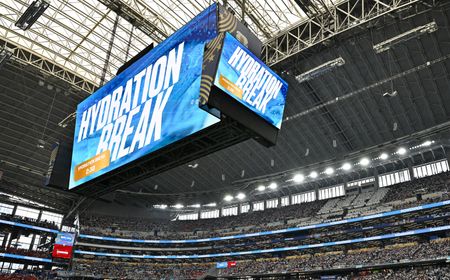
The hottest window of the day in northern Texas falls between 2 p.m. and 7 p.m. — precisely the hours when fans will be traveling to and from Dallas Stadium. One silver lining: matches are played indoors, shielding spectators from the worst of the heat once they’re inside.
Swedish fan Victor Blomdahl described the experience bluntly. “It’s crazy. I’m not getting used to it. I’m just like enduring it, surviving, trying to find my ways.”
Meteorologist Dunn offered practical advice for anyone heading to a match. “If you can, wearing lightweight, light-colored, loose-fitting clothing, taking those breaks, and taking advantage of water, cooling towels, misters, or any of our heat mitigation accessories that might be out there. That’s really going to be the best,” she said.
She also cautioned fans not to underestimate how quickly the heat can take a toll. “If you think you’re feeling fine, you can easily get kind of run over with impacts from heat within a few minutes. So if you start to feel rundown, start to feel warm, start to feel sunburned even, it’s time to find a place to take shelter and get out of that direct sun,” Dunn warned.