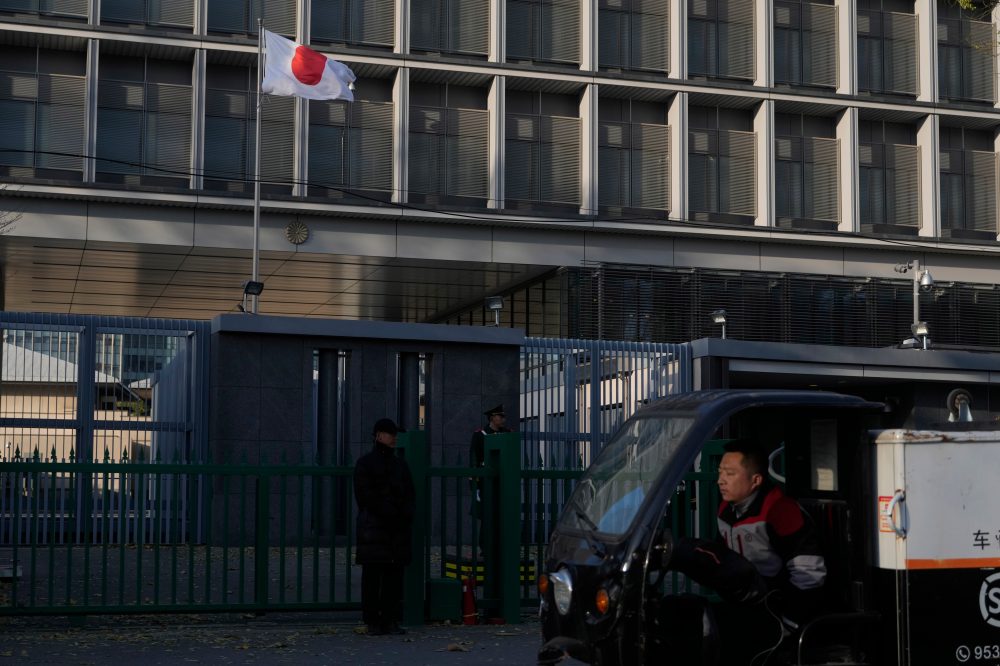

TAIPEI, Taiwan — China announced new export control measures Monday targeting 40 Japanese companies, accusing them of contributing to what Beijing calls Japan’s “remilitarization.”
According to China’s Commerce Ministry, 20 of those companies — including Mitsui E&S, a manufacturer of ship engines and related equipment — have been added to a watch list covering dual-use items, meaning products that can serve both civilian and military functions.
Chinese companies that wish to export goods to those firms will now be required to obtain special licenses, provide risk assessment reports on the Japanese businesses, and submit written commitments that any dual-use items will not be used for military purposes.
Separately, 20 additional Japanese companies that were placed on a watch list back in February have now been moved to a stricter control list. Under that designation, both Chinese and foreign exporters are prohibited from selling them any dual-use products manufactured in China. Among those on the control list are several divisions of Mitsubishi Corporation.
In its official statement, China’s Commerce Ministry defended the actions: “China’s measures are entirely justified, reasonable and lawful. They are aimed at firmly deterring Japan’s reckless pursuit of ‘new militarism.’”
The statement went further, adding: “We hope Japan will recognize its mistakes, reverse its wrongful course, genuinely reflect on its past and return to the right track.”
The friction between the two nations has been building since Japanese Prime Minister Sanae Takaichi suggested last year that Japan could step in militarily if China moved against Taiwan — a self-governing island democracy that Beijing claims as its own territory.
Takaichi’s government has also been expanding Japan’s military capacity, including placing longer-range missiles on remote islands and opening the door to lethal weapons exports under a newly adopted policy. Japan is also expected to revise its defense and security documents by December, a move that could push its defense budget even higher.
On Monday, Japan’s Ground Self-Defense Force announced the deployment of a Type-12 missile launcher on Minamitorishima, the country’s southernmost remote island — a move widely seen as a response to China’s growing military presence in the Pacific.
China’s latest actions mirror steps it took in February, when it placed 20 Japanese companies on an export control list and another 20 on a watch list.
Beijing has been steadily increasing military pressure on Taiwan, viewing the island as territory that must eventually be reunified with the mainland, by force if needed.
Earlier this month, China’s Coast Guard conducted patrols east of Taiwan, which state media described as a “pointed warning” to Japan and the Philippines following a joint announcement that the two countries would discuss their shared maritime boundaries in waters Beijing considers its own.
Last week, the United Kingdom, Germany, and France issued an unusual joint statement condemning Chinese actions in the waters east of Taiwan and declaring their opposition to any change in the current status quo between China and Taiwan.