
LOS ANGELES — In a city built around the car, something unusual is happening: soccer fans are willingly hopping on buses and trains to get to World Cup matches.
On every match day, tens of thousands of fans — both American and international — are flooding into Union Station in downtown Los Angeles to board special buses headed directly to the Inglewood stadium. Thousands more are gathering in the Fan Zone set up inside and outside the station’s historic Art Deco building to watch games on big screens.
The moment fans step inside, they’re greeted by “ambassadors” ready to point them toward the buses, the Fan Zone, or — if the heat and noise become too much — toward “calming pods” and hydration stations.
“We’ve had folks come in who are overwhelmed by all the sounds and the activity happening at the station,” said Armando Roman, a manager in LA Metro’s civil rights, racial equity and inclusion and accessibility group. “We’ve also had folks who have come in and used it to pray, we’ve also had folks come in and breast-feed, all types of different reasons.”
LA Metro, the region’s public transit authority, isn’t exactly cashing in on the World Cup. A round trip to the stadium runs just $3.50, and the agency has spent heavily — hiring hundreds of extra staff, wrapping buses in World Cup branding, and managing the complicated traffic and security situation around the stadium. But the agency sees its investment as part of a larger goal of building what it calls “the most ambitious transportation infrastructure program in the United States.”
For fans who’ve done their homework, choosing transit over driving in car-obsessed Los Angeles was an easy call.
“We didn’t want to sit in traffic and this was a lot less expensive,” said Crystal Gristina, 46, from New Orleans, who was heading to Thursday’s U.S.-Turkey match along with her children, husband, and friends. Renting a car and shelling out around $200 for stadium parking was simply not something they were willing to do.
Brandon Luna, 29, of San Diego, and his uncle Brian Stanton, 51, from Maryland, showed up draped in American flags, stars-and-stripes bandanas, and U.S. soccer shirts. The two had just stepped off an Amtrak train from San Diego and were waiting in line for a World Cup bus.
“On the Amtrak you chill, you just sit, you can have a drink, watch the ocean go by,” Luna said. “I saw all the World Cup buses around the county and said ‘Yup, that’s what I’m going to do.’”
Stanton admitted he had doubts about riding public transit in Southern California, but came around quickly. “The train was fun,” he said, noting that some U.S. fans aboard were dressed as historical figures like George Washington.
The numbers back up the enthusiasm. More than 20,000 people have ridden the special World Cup buses to each match, with many thousands more arriving via regular bus and train routes. The June 18 Switzerland-Bosnia and Herzegovina match drew more than 52,000 transit riders — exceeding half the stadium’s capacity. LA Metro reports that ridership has continued to grow as the tournament progresses.
Back inside Union Station, hundreds of Colombia and Germany supporters were cheering loudly in front of a giant TV screen in the Fan Zone, even though they weren’t heading to the stadium that day. For many, the communal experience was the whole point.
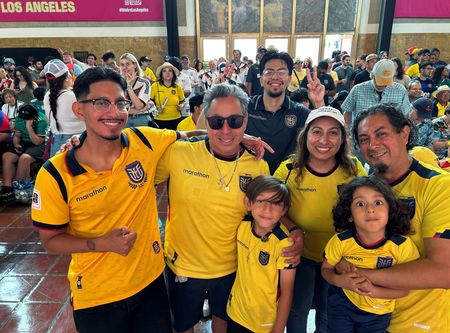
“We just wanted the World Cup feeling, the fan-fest, to be part of it, and just feel the excitement,” said Jorge Yunda, 45, an Ecuadorean American who brought his wife, sons, a grandson, his sister-in-law, and her family to the station. “We love it. As South Americans we feel the passion.”