
MADISON, Wis. — Democratic socialists have been racking up wins recently in liberal strongholds like New York City, Washington, D.C., and Denver. Now the movement is setting its sights on Wisconsin — a very different kind of political battlefield.
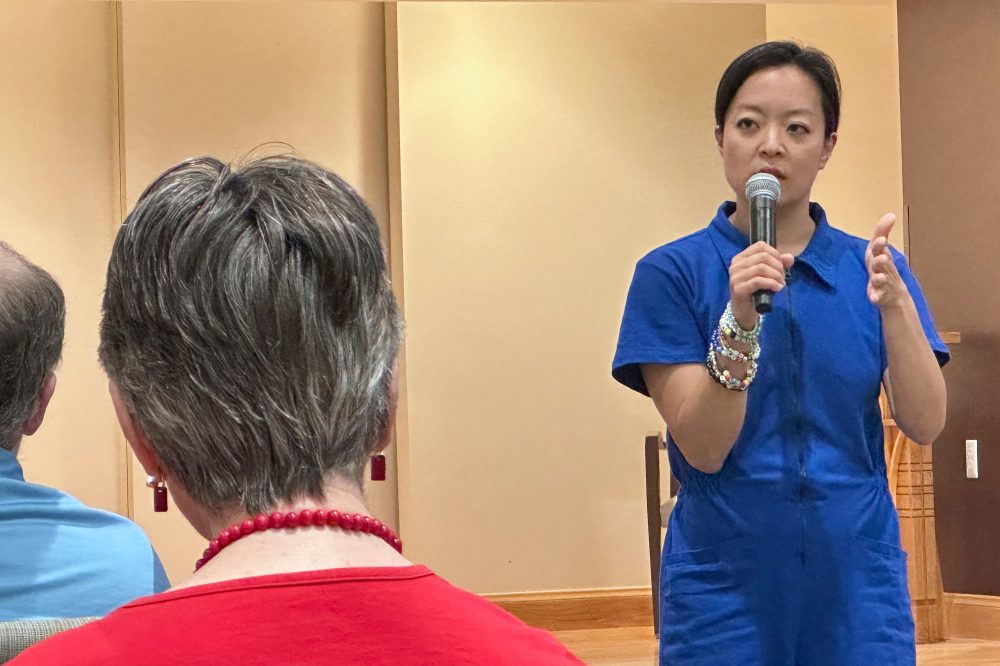
Francesca Hong, a 37-year-old single mother who has worked as a dishwasher and line cook, is running for governor in Wisconsin, a swing state where elections are frequently decided by razor-thin margins and moderate, independent voters carry enormous weight.
Her candidacy has transformed the Democratic primary on August 11 into a real-world test of how far to the left voters are willing to move heading into the November general election.
“We do this in Wisconsin, we’re going to change politics across the country,” Hong said as she entered the final month of her campaign. “People who are frustrated and have a lot more to lose — and I’m one of those people — are ready to coalesce around someone they can believe in.”
At a retirement home where he lives, undecided independent voter John Ravdabaugh heard Hong speak and came away with a positive impression. Despite having reservations about the democratic socialist label, he said he would consider casting a vote for her.
“Every system reaches a point where change is necessary,” Ravdabaugh said.
The winner of the Democratic primary will almost certainly go on to face Republican U.S. Rep. Tom Tiffany in November. Tiffany, considered one of the most conservative members of the House and backed by President Donald Trump, faces only minimal opposition in his own primary.
The governor’s race matters enormously for Democrats, who are hoping to gain full control of Wisconsin state government for the first time since 2010. The outcome could also send a broader signal about the direction of American politics in a state that plays a pivotal role in presidential elections.
Tiffany has directed much of his criticism at Hong and fellow Democratic candidate and former Lt. Gov. Mandela Barnes. “This November, the choice is common sense or crazy,” Tiffany wrote on social media in June, sharing screenshots of Barnes expressing support for cutting prison populations in half and Hong’s posts calling for defunding and abolishing the police.
Hong has not walked back those positions. She also supports raising taxes on wealthy individuals, establishing a state-owned bank to help fund free health care and child care, setting a $20 minimum wage, and placing a moratorium on data center construction.
She pushes back against the idea that her politics are too extreme to attract independent voters in a state Trump carried twice and narrowly lost a third time.
“I worry that’s a miscalculation of where voters are at in our state, that we’re underestimating what people want,” Hong said.
Recent democratic socialist victories have been encouraging for the movement. Last month, Janeese Lewis George won the Democratic primary for mayor of Washington, D.C., positioning herself to win the office in November. Three congressional candidates supported by New York Mayor Zohran Mamdani, also a democratic socialist, defeated establishment-backed opponents. And just last week, Melat Kiros — a 29-year-old first-time candidate — pulled off a stunning upset over U.S. Rep. Diana DeGette in the Colorado primary, defeating an incumbent who had been in office longer than Kiros has been alive.
But those wins came in congressional or mayoral contests in major urban areas — a very different environment from Wisconsin’s statewide political landscape.
Wisconsin actually has deep historical ties to socialist politics. In 1910, during the height of socialism’s influence in the United States, Milwaukee sent the nation’s first socialist to Congress and became the first major American city to elect a socialist mayor. The city went on to elect two more socialist mayors before 1960.
Vermont Sen. Bernie Sanders, arguably the most prominent democratic socialist in the country, carried all but one county in Wisconsin during the 2016 Democratic primary. In 2023, two state lawmakers from Milwaukee revived the Legislature’s socialist caucus, which had been inactive since 1935. Hong — the first Asian American elected to the state Assembly, in 2020 — is among the four members of that caucus.
Also running in the Democratic primary is Mandela Barnes, 39, who spent four years in the state Assembly before serving four years as lieutenant governor under Democratic Gov. Tony Evers. In 2022, Barnes came within 27,000 votes of defeating Republican U.S. Sen. Ron Johnson. Barnes, who grew up in Milwaukee, is seeking to become Wisconsin’s first Black governor.
“I’ve been around longer than anybody fighting these fights,” Barnes said. He downplayed the idea of a democratic socialist surge, adding: “People aren’t looking for labels, necessarily. People are looking for bold solutions.”
Veteran Democratic strategist Joe Zepecki, who is not affiliated with any of the campaigns this cycle, sees Barnes as the frontrunner. “I have believed from the day since Mandela Barnes got into the race, he’s the favorite,” Zepecki said. “It is his race to lose.”
Lt. Gov. Sara Rodriguez, a former nurse and health care executive also seeking the Democratic nomination, argues she would have the broadest appeal in a general election. She points to her private sector background, her success flipping a state Assembly seat in a conservative Milwaukee suburb, and her focus on reducing costs for working families.
“I’m not worried about other candidates in this race,” Rodriguez said. “What I’m worried about is making my argument to Wisconsinites about why I’m the best person to lead the state, how I am going to fight for them.” She launched a $1 million television ad campaign this week showing her in nursing scrubs and focusing on taking on Tiffany and lowering health care costs.
Other Democrats in the race include state Sen. Kelda Roys, who has the backing of the statewide teachers union, and Joel Brennan, a former senior aide to Evers. Missy Hughes, the state’s former economic development director, exited the race in June and threw her support behind Rodriguez. David Crowley, the top elected official in Milwaukee County, dropped out this week without endorsing anyone.
Some moderate Democrats are concerned that nominating Hong could backfire in November, particularly given Wisconsin’s history of tight statewide races where independent voters are decisive.
Neera Tanden, who leads the Center for American Progress, said “it’s especially important in the age of Trump” to field candidates who can actually win. “In Wisconsin, whoever wins the general election will be the person overseeing elections in 2028 and whether people are seated in 2029,” she said.
The numbers underscore just how competitive Wisconsin is: Evers won his two gubernatorial races by just over one percentage point in 2018 and just over three points in 2022. Trump carried the state by less than a point in 2024 and lost it by less than a point in 2020.
Dave Smith, a 72-year-old retired doctor from Madison who attended a Hong event Tuesday, said the democratic socialist label will be a hard sell for voters of his generation. “The platform, much of that resonates well,” said Smith, who remains undecided in the primary. “My vote will likely go to who is the most electable in the fall.”