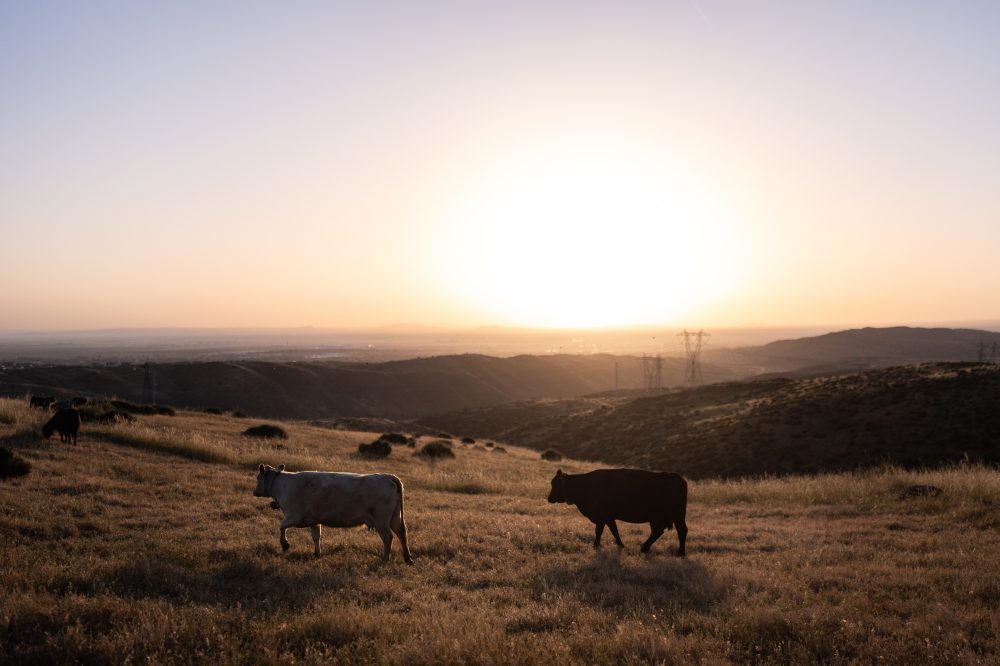

Americans have never paid more for steaks and hamburgers, but bringing down those costs would require cattle producers like Stephanie Hatzenbuhler to expand their operations — a challenge that’s far from simple.
Multiple factors are making Hatzenbuhler and ranchers nationwide hesitant to expand the country’s cattle population, which has shrunk to its smallest size in over seven decades. Until herd numbers increase, consumer demand will continue exceeding available supply, keeping beef costs elevated.
While expanding operations makes financial sense for some producers, others are barely managing with their current livestock numbers, according to Hatzenbuhler.
“They’re good times, and they’re bad times,” she said. “It’s a combination of both.”
This spring, Hatzenbuhler faces critical decisions as approximately 700 calves are born on her family’s Diamond J Angus operation, spanning over 2,000 wind-swept acres near Mandan, North Dakota. She must choose between expanding her herd or maintaining current numbers by selling an equivalent amount of cattle for processing.
While herd size isn’t the sole determinant of grocery store beef costs, the declining cattle population significantly contributes to current pricing. Federal data shows uncooked ground beef averaged $6.86 per pound nationally in March, just 3 cents below February’s record peak. This represents a nearly 48% increase from March 2021 levels.
According to the U.S. Department of Agriculture, America’s cattle population peaked at 132 million head in 1975, then gradually declined to 86 million this year.
Despite the dramatically smaller herd, improved genetics and feeding methods have enabled ranchers to produce significantly more meat per animal. This efficiency helped the nation achieve record beef production of 28.4 billion pounds in 2022, explained Tim Petry, a livestock marketing specialist at North Dakota State University. Production is projected to reach about 26 billion pounds by 2026.
Approximately 2.5 billion pounds of beef were shipped overseas in 2025, creating tight domestic supply that, combined with strong consumer demand, has driven prices to record levels.
While ranchers recognize the elevated prices, they confront numerous obstacles to herd expansion, particularly drought conditions.
Dry weather has affected much of cattle-producing regions, with roughly 63% of the U.S. cattle herd located in drought-stricken areas, USDA data shows. Some regions have also experienced massive wildfires that destroyed grazing grass.
“You’ve got to have rain. You’ve got to have grass to keep cows on because they’re out on pastures for over half the year, and so that’s been the dilemma, is we had forced liquidation of cows,” Petry said.
During calving season, producers must decide whether to keep young female cattle called heifers and calves for breeding purposes, with pasture conditions serving as a major consideration, said Bernt Nelson, an American Farm Bureau Federation economist.
Feed represents ranchers’ largest expense, and drought in states like Texas and Oklahoma has forced them to transport supplies from distant locations. These additional expenses make herd expansion financially challenging.
“When these pasture conditions deteriorate, and water becomes an issue, some of these states have to go as far as to haul hay, haul water from other regions of the country that have grass and easy access to water, and that adds a significant cost to operations,” Nelson said.
Even if ranchers decided to increase cattle numbers, calves require 15 to 24 months to mature before processing.
Producers frequently point to concentrated meat processing — dominated by four major companies — as responsible for high beef prices, though the situation involves multiple factors.
The Meat Institute, representing processing companies, stated that retailers and food service businesses, not processors, determine consumer prices. The organization noted that livestock producers were “earning record profits” while processors faced losses.
The trade group also contended that industry concentration levels haven’t “changed appreciably” over three decades.
“Rhetoric about beef industry concentration implies that consolidation in the beef packing sector is ongoing and that market power is becoming increasingly concentrated. That is not the case,” the organization stated.
John Robinson, representing the National Cattlemen’s Beef Association, acknowledged multiple price factors, sometimes including processor responsibility, but emphasized that “it’s far more complicated than most people will give it credit for.”
Price increases also stem from U.S.-Mexico border restrictions on livestock imports, implemented to prevent spread of the New World screwworm, a flesh-eating parasite. These restrictions, beginning in late 2024, have blocked approximately 1 million cattle from entering the U.S. from Mexico, according to Warren Rusche, an extension feedlot specialist at South Dakota State University.
The border restrictions particularly impact feedlot operations and ranchers who graze cattle in southern plains states.
While President Donald Trump has proposed increasing beef imports from Argentina, the expanded quota would represent only a minimal fraction of U.S. beef production, Rusche noted.
Hatzenbuhler, the North Dakota producer, isn’t becoming wealthy, but for ranchers who own their land and equipment, current conditions favor cattle operations. The situation is less favorable for newcomers, given high costs for everything from machinery to fertilizer and worker shortage challenges.
“If you’re a young guy and want to get in, it’s probably not the time to do it, but if you’re kind of established and been doing this for a while, you’re doing good,” she said.
California rancher Mike Williams said he wouldn’t discourage newcomers from entering the business but would advise caution about overextending financially.
“I would say that we’re finally maybe getting a fair price,” Williams said. “I think people are starting to realize the value of beef, and they’re finding that they’re willing to pay maybe a little more than they have in the past for the quality of the product that they’re getting.”