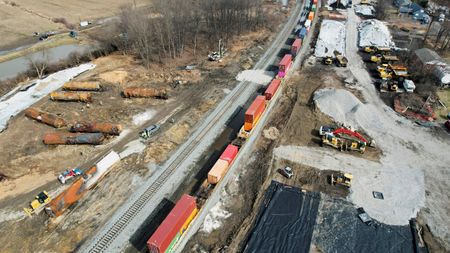

The White House is pressing Congress to approve railroad safety legislation that has been stalled for months, following a devastating 2023 train derailment in Ohio that resulted in a fire and the release of more than a million gallons of dangerous chemicals and pollutants.
The proposed legislation has backing from President Donald Trump and numerous Democrats, but its future remains uncertain due to strong resistance from railroad companies and many Republican lawmakers.
On Thursday, the U.S. House Transportation and Infrastructure Committee was reviewing a five-year, $580 billion highway funding package while considering whether to include rail safety provisions that would strengthen safety protocols for trains transporting hazardous cargo and impose stricter regulations on railcar wheel bearings.
Representative Troy Nehls, a Texas Republican, argued the legislation is essential because the derailment “exposed serious weaknesses in the freight rail industry safety practices, particularly when it comes to transporting hazardous materials.”
However, Representative Sam Graves, the Republican committee chair, warned the proposal would increase rail shipping expenses by billions of dollars over a decade. “It’s going to ripple across the entire supply chain,” Graves stated.
The 2023 accident occurred when a railcar wheel bearing overheated and failed catastrophically. Norfolk Southern reached a $310 million settlement with the Justice Department in 2024, which included commitments to install additional equipment for early detection of overheated wheel bearings to prevent future derailments.
National Transportation Safety Board chair Jennifer Homendy noted that numerous safety recommendations issued after the 2023 East Palestine, Ohio derailment have not been implemented more than three years later.
“People living in the community of East Palestine and all Americans deserve no less than a comprehensive approach that addresses critical rail safety issues,” Homendy stated.
The proposed legislation would mandate improved safety protocols for hazardous material transport, require wayside defect detection systems, establish minimum two-person train crews, and increase penalties for violations.
The Association of American Railroads, representing major railway companies, opposed the measure, claiming it has “increasingly become a vehicle for longstanding labor and operational mandates that would raise costs throughout the supply chain while doing little to measurably improve safety outcomes.”