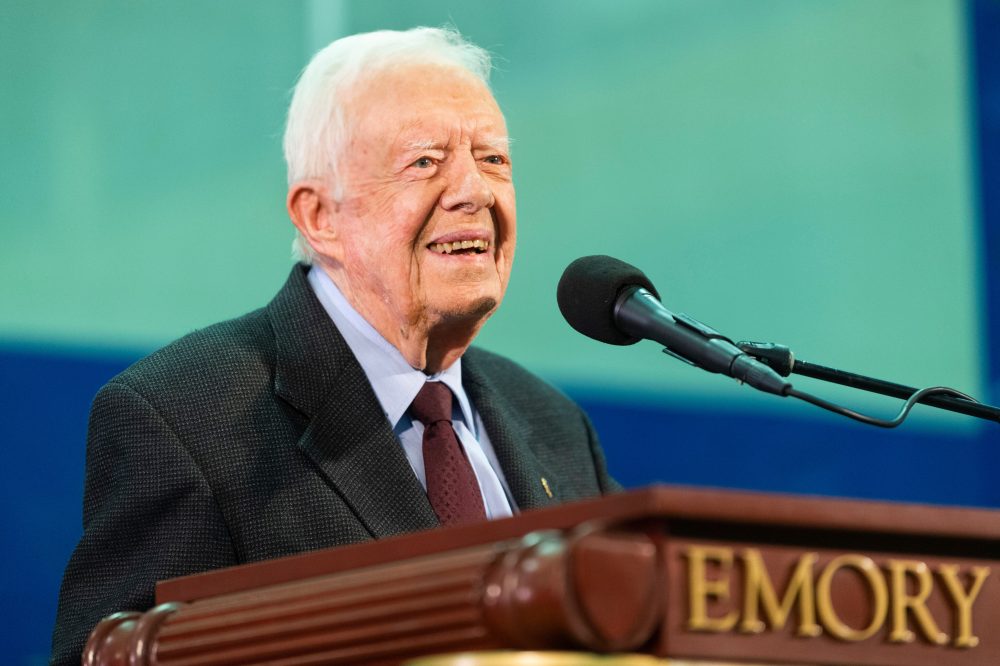

The current White House is incorrectly characterizing former President Jimmy Carter’s position on mail-in voting by twisting findings from a two-decade-old election study, as officials promote new federal voting legislation requiring stricter citizenship verification and photo identification before the upcoming midterm elections.
During consecutive days this week, President Donald Trump and White House press secretary Karoline Leavitt referenced the 2005 Commission on Federal Election Reform study while supporting the Safeguard American Voter Eligibility Act, known as the SAVE America Act. The bipartisan commission was jointly led by Carter, a Democrat, and former Secretary of State James Baker, who served under three Republican presidents: Gerald Ford, Ronald Reagan, and George H.W. Bush.
Both Trump and Leavitt incorrectly suggested that Carter opposed mail-in and absentee voting due to fraud concerns, which distorts what the commission actually concluded.
During Monday’s Republican Members Issues Conference, Trump stated: “Jimmy Carter, the best thing he ever did, he headed a commission after he was president. It was the single best thing. And he did a thing on mail-in ballots. He said mail-in ballots should not be allowed because they are inherently dishonest.”
At Tuesday’s White House press briefing, Leavitt said: “The bipartisan 2005 report of the Commission on Federal Election Reform, shared by, of all people, former President Jimmy Carter and former Secretary of State James Baker, concluded that, quote, ‘absentee ballots remain the largest source of potential voter fraud.’”
However, evidence shows Carter actually endorsed mail-in voting and absentee ballots throughout his life, based on his own public statements, comments from his grandson Jason Carter, and official positions from The Carter Center. While the 2005 study acknowledged that absentee and mail-in ballots could create fraud opportunities, it also provided recommendations to minimize those risks and called for additional research on the matter. Election security specialists maintain there’s no proof that mail-in and absentee voting generates widespread fraud, either currently or twenty years ago.
Jason Carter, who chairs The Carter Center’s board of trustees, told The Associated Press Wednesday: “My grandfather supported mail-in voting — so much so that he used it himself. Any claim to the contrary unnecessarily sows doubt in election integrity and undermines voter confidence in a consequential election year.”
The late president publicly backed mail-in voting and absentee ballots in 2020, maintaining this position until his death in 2024.
In May 2020, during COVID-19 pandemic concerns about election safety, Carter declared: “I urge political leaders across the country to take immediate steps to expand vote-by-mail and other measures to help protect the core of American democracy — the right of our citizens the vote.”
Four months afterward, responding to media coverage about his absentee ballot opinions, Carter clarified: “I approve the use of absentee ballots and have been using them for more than five years.”
Mail-in voting continues to attract support from voters in both major political parties. In the 2024 election, which Trump won, approximately 30% of voters submitted mailed ballots, according to the U.S. Election Assistance Commission. This exceeded pre-pandemic numbers, when roughly 25% of voters used mailed ballots. Among the four states where mailed ballot usage increased compared to 2020, three are under Republican control: Indiana, South Dakota, and Utah.
Trump has personally voted by mail in Florida, his home state.
The Commission on Federal Election Reform, established by American University’s Center for Democracy and Election Management with funding from various philanthropic organizations, released “Building Confidence in U.S. Elections” in 2005. The study concluded that “absentee ballots remain the largest source of potential voter fraud” and that mail-in voting “is likely to increase the risks of fraud and of contested elections” in some states.
Nevertheless, the report didn’t discourage mail-in and absentee ballot usage. Instead, it provided recommendations for reducing fraud risks.
The commission made three specific suggestions regarding absentee ballots and voter registration fraud: limiting ballot handling to designated individuals while prohibiting candidates or party workers from collecting and delivering absentee ballots; encouraging states to enact laws preventing fraud from payments related to voter registration, absentee ballot collection, or signature gathering; and ensuring states don’t discourage legitimate voter registration or get-out-the-vote activities.
The report also recommended stronger ballot security measures and additional research into mail-in and early voting advantages and disadvantages. Notably, it observed that Oregon, which had implemented vote-by-mail for seven years, showed “little evidence of fraud.”
“The administration’s claims about President Carter’s views on mail-in voting are not true,” The Carter Center stated to The Associated Press this week.
The organization noted the claims ignore “the rest of the report’s findings or President Carter’s acknowledgment of the safeguards that have emerged in the 20+ years since this report came out.”
Election experts confirm that mail-in and absentee voting doesn’t create widespread election fraud, despite increased usage over the past twenty years, growing from approximately 13% of voters in 2004 to nearly one-third of all ballots cast in the most recent election.
Mark Lindeman, policy and strategy director at Verified Voting, a nonpartisan election technology organization, explained: “There’s no evidence that mail-in voting fraud was rampant then, and it’s not rampant now. Mail voting has become more common and more mature. So, over that period of time, states have learned from each other — best practices for not only avoiding fraud, but just generally administering mail balloting well.”
Improvements include better ballot tracking systems, processes for correcting initially rejected ballots, and enhanced capabilities for identifying and resolving duplicate voter registrations.
Trump’s position on mail-in voting has shifted repeatedly over time. He preemptively criticized mail balloting months before the 2020 election began, while simultaneously encouraging Florida voters to use mail-in ballots in a state he ultimately won. Following his 2020 loss, Trump and other Republicans blamed mail-in voting for the results.
Republicans, including Trump at times, promoted mail-in voting to their supporters before the 2024 election when it was viewed as strategically necessary during a competitive race.
When asked about Trump and Leavitt’s statements, White House spokeswoman Abigail Jackson responded: “President Trump and Karoline are completely right — and Karoline read a direct quote from the report during her briefing.”
She added that The Carter Center’s May 2020 press release containing Carter’s mail-in voting endorsement “does not invalidate the findings” of the 2005 commission report.