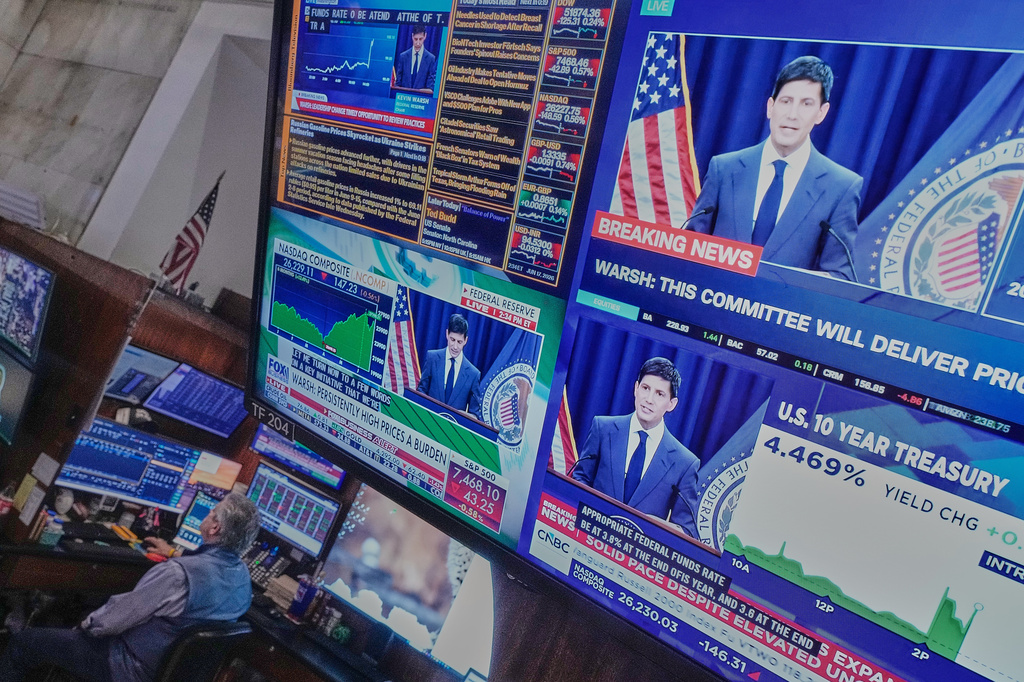

NEW YORK (AP) — American stock markets took a significant hit Wednesday as investors grew anxious over the possibility that the Federal Reserve could raise interest rates before the year is out. Higher interest rates are a tool used to slow rising prices, but they also put the brakes on economic growth and can drag down investment values.
The S&P 500 index lost 1.2%, wiping out an earlier small gain after the Fed published projections showing that nine of its 18 policymakers believe the central bank’s main interest rate should be raised at least once this year. The Dow Jones Industrial Average swung dramatically — from a morning gain of 280 points to an afternoon decline of 507 points, or 1%. The Nasdaq composite fell 1.3%.
Notably absent from the Fed’s rate projections was Chairman Kevin Warsh himself, who did not submit a forecast for where the federal funds rate might stand by the end of 2026. In his first press conference leading the nation’s central bank, Warsh also signaled he is weighing changes to how the Fed shares information with financial markets, households, and businesses.
Among his early actions, Warsh has already eliminated what’s known as “forward guidance” — the practice of including hints in Fed statements about the likely direction of interest rates down the road.
Warsh expressed a desire for Wall Street to respond to economic reports on inflation, employment, and other data based on what those figures actually mean for stocks, bonds, and other investments — rather than simply guessing how the Fed will respond to that data.
Along those same lines, Warsh indicated the Fed may revisit its practice of releasing quarterly projections that outline where officials expect interest rates, inflation, and the broader economy to head.
Markets reacted with uncertainty to the latest batch of projections, even as Warsh cautioned that he “didn’t hear tons of conviction” behind them. Stock prices zigzagged repeatedly after the projections were released. The Fed also announced it would leave the federal funds rate unchanged at this meeting, consistent with its stance throughout the year so far.
In the bond market, yields moved higher. The 10-year Treasury yield — which shapes mortgage rates and other borrowing costs for households and businesses — climbed to 4.49% from 4.43% the prior day. The two-year Treasury yield, which tends to reflect expectations for Fed policy, jumped more sharply, rising to 4.21% from 4.05%.
Traders significantly raised their bets on a rate hike happening this year, with the probability now sitting at 84%, up from 59.5% just one day earlier, according to data from CME Group.
Elevated bond yields worldwide — driven by persistent inflation fears — have already been putting pressure on economies and weighing on investment values across the board.
In individual stock moves, SpaceX gave back an early gain and ended the day down 4.9%, marking its first loss since making its highly anticipated debut on U.S. stock markets last week. Microsoft fell 3.8%, Amazon dropped 3.5%, and Nvidia slipped 1.3% — three of the biggest drags on the S&P 500.
Those declines overshadowed a strong day for La-Z-Boy, whose shares surged 14.8% after the company reported better-than-expected profit and revenue for its most recent quarter. The furniture maker credited newly opened stores for a boost in revenue, though Chief Financial Officer Taylor Luebke noted the company still holds “a measured view” of the overall sales environment.
When the closing bell rang, the S&P 500 had fallen 91.25 points to finish at 7,420.10. The Dow Jones Industrial Average closed down 507.12 points at 51,492.55, and the Nasdaq composite dropped 354.69 points to 26,021.66.
A report out Wednesday showed that retail sales across the country grew faster than economists anticipated in May, offering a positive sign that consumer spending could help prop up the economy. However, persistent inflation continues to weigh on shoppers’ confidence in their own financial situations.
Oil prices stabilized Wednesday after falling earlier in the week, buoyed by optimism surrounding a tentative agreement between the U.S. and Iran. Under the deal, Iran is expected to reopen the Strait of Hormuz after the agreement is signed, which would allow oil tankers to resume deliveries of crude from the Persian Gulf and potentially ease inflationary pressure on energy costs. A barrel of Brent crude rose 0.7% to $79.55 — still above the roughly $70 price seen before the conflict began, but well below the $100-plus levels reached just weeks ago.
Overseas, stock markets showed mixed results across Europe and Asia. South Korea’s Kospi index gained 1.6%, while Hong Kong’s Hang Seng fell 0.7%, among the larger moves seen globally.