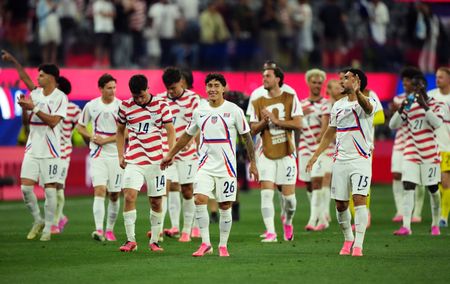

SEATTLE — When the United States men’s national soccer team takes the field against Australia this Friday, the match will carry meaning well beyond a spot in the World Cup knockout round. The game falls on Juneteenth, a federal holiday since 2021 that commemorates the emancipation of enslaved Black Americans, and co-host city Seattle is planning a series of events to mark the occasion.
Girmay Zahilay, the executive of King County, where Seattle is located, said Wednesday that the timing of the match and the arrival of fans from around the world create “a rare opportunity to celebrate a really deeply important part of our nation’s history.” He added, “This wouldn’t be the first time that sports and social justice or social awareness have combined.”
Marcus Green, a member of Seattle’s Juneteenth Matchday Advisory Committee, offered historical context for the holiday. He explained that Juneteenth marks the day in 1865 — more than two years after the Emancipation Proclamation — when a group of enslaved African Americans finally learned they were free.
“That gap between the word and the world is what Juneteenth asks us to hold,” Green said. “This is the uncomfortable, essential American truth: that freedom is not a single moment. It is a practice, a project and unfinished and that is why Juneteenth matters.”
The match takes place as the current U.S. presidential administration pushes to eliminate diversity, equity and inclusion programs — efforts that are currently being contested in court. Still, former U.S. men’s national team player Tony Sanneh, who was part of the squad’s memorable run to the quarterfinals at the 2002 World Cup, said the current roster’s diversity is something to be proud of.
“For me personally, it’s heartwarming,” Sanneh told Reuters. “If you look at the players on the team, very international, very representative of our country, so we can celebrate the team and celebrate this holiday together.”
Sanneh went on to say the team’s makeup sends a broader message about American identity. “I think it could be representative of what we hope that every community and city is like in America: it doesn’t really matter where you were born, it doesn’t really matter where your parents were born. It matters where you are and you joining up with your teammates to make it better so that you all win together.”