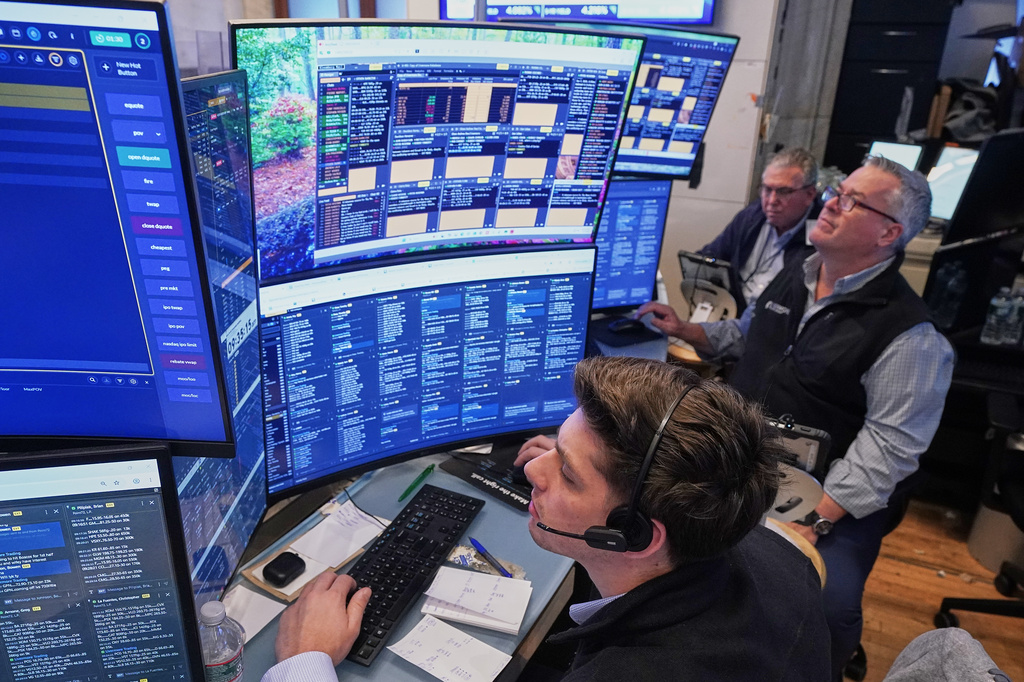

NEW YORK — Wall Street experienced its most impressive surge in two months Thursday, while petroleum prices tumbled after President Donald Trump withdrew his threat to launch military strikes against Iran. The development sparked optimism about a possible agreement that could restore normal global petroleum distribution.
The S&P 500 climbed 1.8%, recovering from consecutive declines that had pulled the index back to early May levels. The Dow Jones Industrial Average surged 929 points, gaining 1.9%, while the Nasdaq composite advanced 2.5%.
Markets shifted dramatically upward during midday sessions following Trump’s announcement on his social media platform that “discussions with the Islamic Republic of Iran have been brought to the highest level of Iranian leadership and approved” and that the timing and location of a signing will “be announced shortly.”
An agreement to conclude the conflict with Iran might reopen the Strait of Hormuz and restore petroleum tanker shipments from the Persian Gulf to global markets. Benchmark U.S. crude prices dropped 2.6% to $87.71 per barrel. Brent crude, the global benchmark, declined 2.9% to $90.38, although it remains elevated from its approximately $70 pre-war level.
Concerns had intensified as the United States and Iran conducted strikes in recent days, jeopardizing a fragile ceasefire that had lasted over a month.
Elevated petroleum costs from the Iran conflict have driven inflation sharply higher, and Thursday’s data revealed that U.S. wholesale prices rose more significantly in May than economists had projected. The impact extends globally, with the European Central Bank on Thursday becoming the first major central bank to increase interest rates in response.
Elevated rates can control inflation but also decelerate economic growth and reduce values for various investments, including equities and digital currencies. They particularly affect investments considered overpriced, with some analysts labeling the artificial-intelligence sector a bubble where investment expanded excessively.
Major fluctuations in AI company shares have driven U.S. market volatility over recent days, as these stocks moved from achieving new highs to suddenly declining. The primary concern involves whether such securities rose too rapidly due to AI enthusiasm, with their volatile movements sometimes reversing direction hourly.
AI securities had already begun recovering Thursday morning before Trump’s Iran announcement.
Marvell Technology gained 11.1% after a turbulent period that included a 16.7% plunge, a 9.6% surge, then consecutive daily drops exceeding 5%. Previously, it had achieved a historic single-day jump of 32.5% when Nvidia CEO Jensen Huang suggested it could become “the next trillion-dollar company.” Its valuation exceeded $190 billion at that time.
Semiconductor manufacturing companies posted some of the market’s largest gains. Lam Research jumped 12.7%, while KLA advanced 12.9%.
These gains helped counterbalance Oracle’s 8.5% decline. The company reported quarterly profits exceeding analyst expectations but announced plans to raise $40 billion this fiscal year through debt and equity sales. This follows last year’s $48 billion fundraising effort to finance AI investments.
Other corporations have recently faced stock penalties for announcing substantial AI spending, as questions persist about whether such investments will generate the profits and productivity improvements that AI supporters promise.
Overall, the S&P 500 gained 127.31 points to 7,394.30. The Dow Jones Industrial Average increased 929.97 to 50,848.75, and the Nasdaq composite added 640.16 to 25,809.66.
In bond markets, Treasury yields fell substantially as declining petroleum prices reduced inflationary pressures. The 10-year Treasury yield dropped to 4.45% from Wednesday’s 4.55%, representing a notable bond market movement.
Sustained petroleum price declines could enable the Federal Reserve to maintain current interest rates this year rather than implementing increases that many traders anticipated due to high inflation and a robust U.S. job market. Following Trump’s announcement, traders reduced expectations for potential federal funds rate increases this year, according to CME Group data.
The Fed might even resume rate reductions under its new chair, Kevin Warsh, if inflation pressures diminish sufficiently. Trump appointed Warsh, and Trump has consistently advocated for lower interest rates.
Smaller company stocks can benefit most from easier interest rates since many require borrowing for growth, and the Russell 2000 index of smallest U.S. stocks led markets with a 3% gain.
International markets showed modest gains in Europe following mixed Asian results.
London’s FTSE 100 rose 0.5%, while Hong Kong’s Hang Seng fell 0.7%, representing two of the day’s more significant global movements.