
President Donald Trump announced Thursday that he has canceled planned military action against Iran, claiming that diplomatic negotiations have achieved meaningful progress just hours after threatening to escalate military action by taking control of Iran’s petroleum sector.
In a social media statement, Trump indicated he made this decision following a diplomatic breakthrough, noting that key negotiating points “have been brought to the highest level of Iranian leadership and approved.”
This development follows two days of military exchanges between the United States and Iran that brought the Middle East dangerously close to renewed large-scale warfare.
Earlier Thursday, Trump had warned of further military escalation, declaring on social media that America would strike Iran “VERY HARD TONIGHT” and assume “total control” of its petroleum and natural gas sectors.
Hours later, Trump posted that “discussions and final points have been, in both concept and great detail,” approved by the United States, Israel, and other regional partners. He provided no additional specifics.
In recent weeks, Trump has repeatedly suggested that warring nations were close to reaching an agreement, though no deals have materialized. Iranian officials and mediators have not yet responded to Trump’s latest claims about negotiating progress.
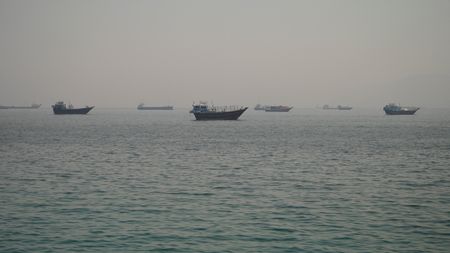
Diplomatic efforts remain stalled over Iran’s nuclear development program, which Washington and Israel worry could produce nuclear weapons, though Tehran maintains it serves peaceful purposes. Another significant dispute involves Iran’s control over the Strait of Hormuz, a vital shipping corridor for petroleum and natural gas transport.
President’s Pattern: From Threats to Diplomacy
Trump’s swift Thursday transition from severe military threats to promoting peaceful negotiations highlighted his unpredictable approach to the conflict. Earlier this week, he suggested a peace agreement could be finalized within days.
However, military strikes then shook the Middle East throughout the week. Initial exchanges occurred between Iran and Israel, followed by two rounds of attacks between America and Iran, targeting nations hosting U.S. military personnel. American strikes commenced after Trump accused Iran of shooting down an American attack helicopter near the Strait of Hormuz. Both crew members were successfully rescued.
U.S. forces said they struck Iran’s military monitoring systems, communication networks and air defense installations. Iran’s paramilitary Revolutionary Guard reported hits on a manufacturing facility, military barracks and a Guard installation near Tehran.
Tehran responded by launching strikes at Kuwait, Jordan and Bahrain, with Bahrain reporting an 11-year-old girl injured and property damage from debris of intercepted Iranian missiles.
Iran’s Foreign Ministry declared that American attacks had “effectively rendered the ceasefire … meaningless,” while stopping short of formally abandoning it.
Following Trump’s Thursday threats of additional attacks, Iran’s parliamentary speaker, Mohammad Bagher Qalibaf, warned on social media that “wrong strategies and impulsive decisions” would devastate energy markets and “create an endless quagmire that you will be stuck in for years.”
This mirrors Trump’s previous pattern from April, when he warned Iran that “a whole civilization will die tonight, never to be brought back again” unless it accepted his conditions, before subsequently extending a ceasefire.
Oil Terminal Seizure Threats
Iran’s extended disruption of Strait of Hormuz shipping has restricted global energy supplies, increased fuel costs and made food and essential goods more expensive far beyond the region.
Trump had threatened Thursday to capture Kharg Island, Iran’s petroleum industry hub, which handles 90% of the country’s oil exports.
However, Trump quickly expressed uncertainty about seizing the oil facility, telling Fox News: “I don’t know that America has the stomach for it, to be honest.”
Treasury Secretary Scott Bessent announced on social media that America would use frozen Iranian assets to cover damage costs to American allies and any fees Iran charges for ships passing through the Strait of Hormuz.
Beyond disputes over the strait and Iran’s nuclear program, Tehran demands that any war-ending agreement must also halt fighting in Lebanon between its allied militia Hezbollah and Israel.
But Israeli Prime Minister Benjamin Netanyahu appears determined to pursue his objective of eliminating the militant organization, further complicating Tehran negotiations.
International Criticism Over Sailor Deaths
America faced international condemnation Thursday following a U.S. military strike that killed three Indian sailors aboard an oil tanker near the Strait of Hormuz.
U.S. forces said they fired Tuesday to disable the Palau-flagged vessel M/T Settebello as it tried to break through an American blockade of Iranian ports while transporting Iranian petroleum. Three Indian crew members died, India’s ports and shipping minister confirmed Thursday on X.
The International Maritime Organization leader, a United Nations agency, denounced the attack. India’s foreign ministry called in a senior American diplomat to express its “deepest concerns” and formally protest the strike, spokesperson Randhir Jaiswal said.
The State Department confirmed it was “in direct contact” with India’s government about the strike, but provided no additional information.
U.S. Central Command stated American forces issued warnings before attacking the vessel. This marks one of nine commercial ships the U.S. military has disabled while enforcing the blockade.
Iranian Citizens Fear Escalating Crisis
A 25-year-old student in northern Iran reports that Iranians fear “chaos” amid ongoing warfare and mounting domestic problems.
The student from Babol said many Iranians cannot afford basic groceries due to widespread unemployment and triple-digit food price increases. He requested anonymity for security reasons.
“Everything is going wrong and there is no hope among the people,” the student said.
The student previously spoke to The Associated Press before the war during widespread anti-government demonstrations. He now says his primary concern is that Iran “maintain territorial integrity and deterrence” against attacks from the U.S. and Israel.