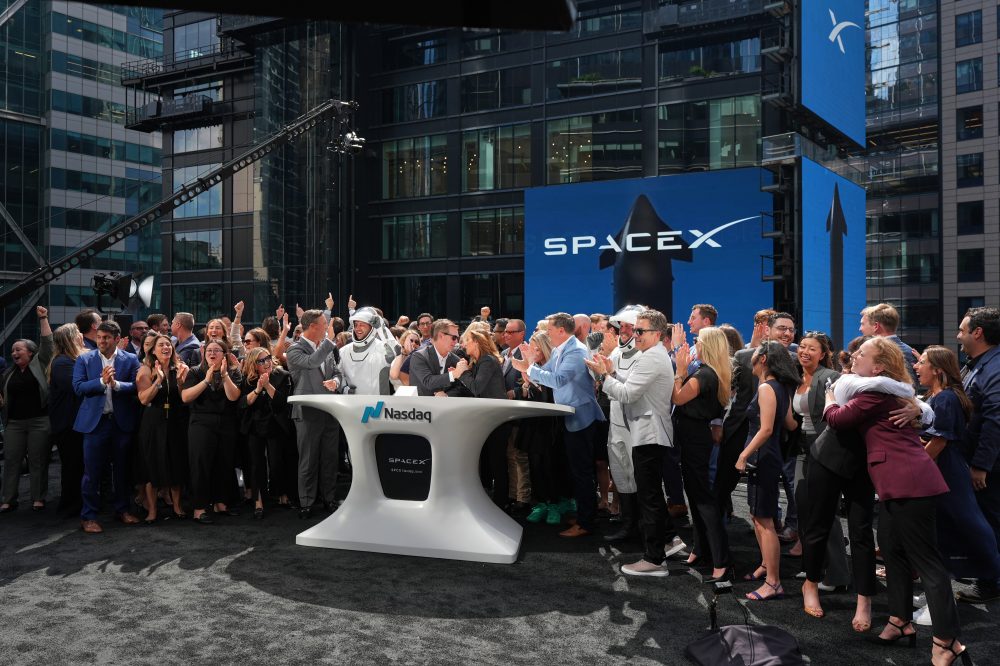

NEW YORK (AP) — The biggest names on Wall Street are expressing strong confidence in SpaceX, yet shares of Elon Musk’s rocket company are struggling to gain altitude in the market.
Following SpaceX’s initial public offering, the major investment firms that helped bring the company public released their first formal research reports on Tuesday. Nearly every one of those firms advised clients to purchase the stock and projected the share price would climb past $200 within the next 12 to 18 months.
Despite briefly surpassing $200 during its opening week of trading, SpaceX shares have since drifted back to roughly $152 — barely above the price at which they debuted on June 12, the company’s IPO day. Many investors appear to be approaching the stock with caution, even while examining the same factors that have Wall Street analysts so energized.
Much of the enthusiasm centers on SpaceX’s position to dominate the space transportation and infrastructure market. The company uses reusable rockets to carry both people and cargo into Earth’s orbit and has set its sights on deeper exploration of the solar system. At present, the bulk of SpaceX’s income comes from its Starlink satellite network, and analysts expect advances in artificial intelligence to further strengthen that business.
Analysts at J.P. Morgan captured the broader sentiment in their research report, writing: “SpaceX’s ambitions, and potential impact on humanity, are bigger than any company’s we’ve ever seen.”
J.P. Morgan is forecasting the stock will hit $225 by the close of 2027. The bank pointed to SpaceX’s commanding edge in space transportation, noting approximately 670 orbital launches and a success rate of nearly 99% with its Falcon rockets. The company has handled the majority of all payloads sent into orbit since 2023.
SpaceX has already established itself as the dominant force in reusable rocket technology through its Falcon 9. Now, attention is turning to its massive Starship rocket, which is designed to carry larger payloads — potentially including data centers — into space.
Among the most optimistic voices is investment bank Raymond James, whose analysts believe the stock could eventually reach $800 per share. They view SpaceX as a foundational industrial company for the current century. “Just as railroads, electric grids, and the Internet reshaped prior economic eras, we believe SpaceX is building the foundational platform for the next generation of industrial capacity,” the analysts wrote.
SpaceX founder Elon Musk chose to take the company public in order to raise the capital needed to fund its sweeping ambitions — including deploying more satellites, eventually placing data centers in orbit, and, further down the road, establishing a human colony on Mars.
For now, the Starship rocket remains in the testing phase, and no technology currently exists to place data centers in space or transport humans to Mars. Analysts openly acknowledge that a setback or prolonged delay in establishing a consistent Starship launch schedule represents a serious risk that could undermine their projections.
SpaceX wrapped up its first day of public trading in June with a market valuation exceeding $2 trillion, a figure that remains roughly the same today. That milestone briefly made Musk the world’s first trillionaire, though his personal net worth has since slipped back below $1 trillion, according to Forbes.
Not everyone on Wall Street shares the same level of enthusiasm. Equity research firm MoffettNathanson acknowledged the company’s potential but assigned it a “neutral” rating, with a price target of $131 per share. The firm cited a range of unknowns, including regulatory hurdles, unproven technology, and uncertain demand. “It is, in short, a bet on any and all things made possible by a virtual lock on rocket manufacturing and launch,” MoffettNathanson wrote in its report.