
A sexual assault allegation against Democratic Senate candidate Graham Platner has upended the race in Maine and raised serious new questions about whether Democrats can win enough seats to take control of the U.S. Senate.
Republicans currently hold a 53-47 edge in the chamber, and Democrats need to pick up at least four seats to flip the majority. Maine has been considered an essential piece of that puzzle — but the Platner allegation has thrown that calculation into doubt.
Platner, who has denied the accusation, now faces pressure from within his own party over whether he should stay in the race. If he withdraws before July 13, Maine Democrats would have the opportunity to place a replacement candidate on the ballot. If he stays in without national party backing, he would face a very difficult road against five-term Republican Sen. Susan Collins.
Should Platner step aside, his replacement would face a challenge similar to what presidential candidate Kamala Harris encountered in 2024 — entering a general election campaign late, without the benefit of a competitive primary to build name recognition and appeal to a broad electorate.
Collins, for her part, has won elections for 30 consecutive years, even as no Republican presidential nominee — including President Donald Trump — has carried Maine since 1988.
Here is a breakdown of the key Senate races Democrats are watching closely:
ALASKA: Former Democratic Rep. Mary Peltola is running against Republican incumbent Sen. Dan Sullivan, and her candidacy has given her party a boost. Peltola was the first Alaska Native to serve in Congress, having won both a special election and a regular election in 2022 for the state’s sole House seat — making her one of a small number of Democrats to win in a Republican-leaning state.
The state’s Aug. 18 primary has been complicated by a separate candidate who shares the same name and party affiliation as Sullivan. Alaska’s supreme court has ruled that this challenger is eligible to appear on the ballot. Peltola’s campaign and state Democrats have rejected Sullivan’s claim that they are coordinating with the challenger to create voter confusion.
MAINE: Platner secured the Democratic nomination despite earlier controversies. Senate Democratic Leader Chuck Schumer had initially supported sitting Gov. Janet Mills but ultimately lined up behind Platner — until Monday’s bombshell allegation changed the picture entirely. Schumer and a growing number of Democrats are now calling on Platner to step down.
NORTH CAROLINA: Democrats scored a major recruit in former Gov. Roy Cooper, who has never lost a statewide race across four terms as attorney general and two terms as governor. Republicans countered with Michael Whatley, Trump’s personally chosen candidate, who previously led both the state Republican Party and the Republican National Committee.
Whatley was seen as a strong fundraiser and a natural advocate for Trump in a state the president has won three times. History also favors Republicans — the party has won all but two U.S. Senate contests in North Carolina over the past 30 years, along with all but one presidential race.
Still, Cooper won governor’s races during two of Trump’s three presidential election cycles and is leaning into his moderate image at a moment when independent voters have grown skeptical of Trump. That puts Whatley in the difficult position of energizing Trump’s core base while also appealing to voters who have repeatedly supported Cooper.
OHIO: Democrats are relying on former Sen. Sherrod Brown to knock off Republican incumbent Jon Husted in what is shaping up to be yet another costly Ohio Senate battle — the third in four years. The Senate Leadership Fund, a GOP super PAC, has committed $79 million to protect Husted’s seat.
Brown served three terms in the Senate before losing a tough reelection fight in 2024. While Ohio has been shifting increasingly Republican, Brown built his career as a champion of unions and working-class voters, and Democrats believe he can win over some of the same voters who have backed Trump three times. Husted, a former lieutenant governor, was appointed to fill the seat after JD Vance became vice president.
IOWA: With two-term Republican Sen. Joni Ernst retiring, Democrats see a chance to flip a seat in a state Trump has won three times. Democratic state Rep. Josh Turek faces Republican U.S. Rep. Ashley Hinson, who carries Trump’s endorsement.
Turek is relatively new to elected office but has pointed to his success in a Trump-leaning state House district as evidence he can attract independent and moderate Republican voters statewide. Hinson, a three-term House incumbent from northeastern Iowa, has argued that Trump needs someone who will “always have his back.”
TEXAS: State Rep. James Talarico, a 37-year-old seminarian, has emerged as a national fundraising standout. He faces Republican nominee Ken Paxton, the state’s attorney general, who has survived an impeachment attempt by members of his own party, a lengthy corruption investigation, and the very public airing of his personal troubles — yet has continued winning elections.
Democrats were encouraged when their primary drew roughly 2.3 million voters, edging out Republicans’ 2.2 million — something that has not happened since Texas shifted to Republican dominance in the 1990s. The challenge for Talarico is converting that energy into a broad, diverse coalition come November.
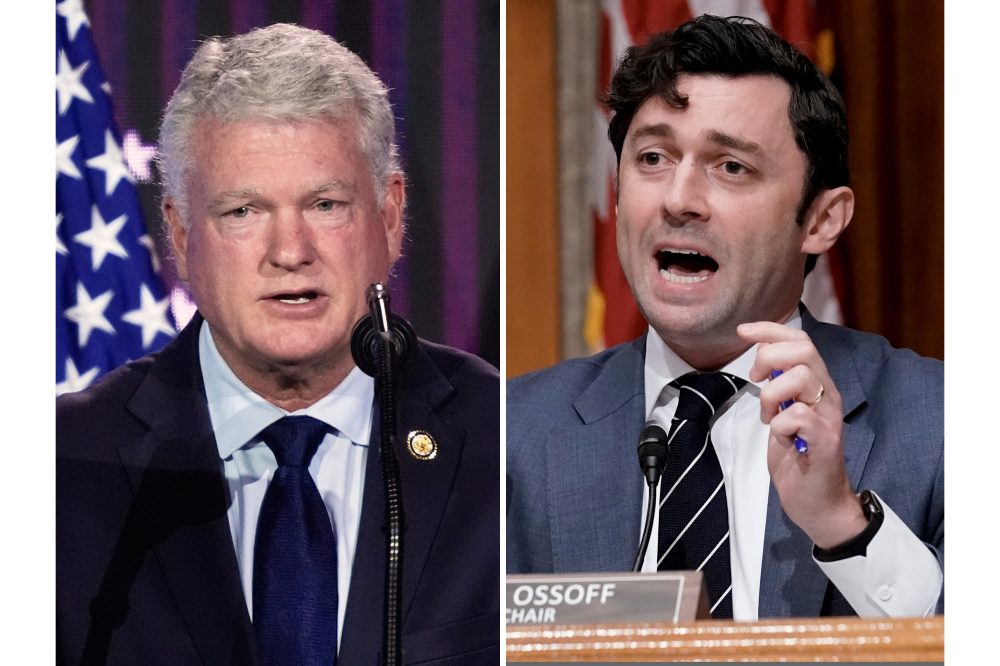
GEORGIA: Sen. Jon Ossoff is the only Democratic senator seeking reelection this cycle in a state Trump carried in 2024. He ran unopposed in the primary and entered the general election with more than $30 million in cash on hand. Ossoff has drawn national attention for his pointed and direct criticism of Trump.
His Republican opponent, Rep. Mike Collins, is playing catch-up after a hard-fought primary runoff. Collins must win over skeptical Republicans who view him as too conservative or too controversial for a competitive state. He has repeated Trump’s false claims that the 2020 election was stolen, and he is also dealing with a House ethics inquiry into allegations that he misused taxpayer funds to pay the girlfriend of a former senior aide.
Collins’ most potent line of attack against Ossoff centers on immigration. Collins sponsored the Laken Riley Act — named after a Georgia nursing student killed by a Venezuelan man in the country illegally — which requires immigrants accused of certain crimes to be held without bond. Ossoff initially voted against the measure before switching his vote after Trump returned to the White House.
MICHIGAN: The retirement of Democratic Sen. Gary Peters opens up a seat the party must hold in a state that has been closely contested — Trump won it twice, while former President Joe Biden carried it in 2020.
The Aug. 4 Democratic primary is now a two-person contest between moderate Haley Stevens and progressive Abdul El-Sayed, after a third candidate, Mallory McMorrow, suspended her campaign. Stevens has the backing of Minority Leader Chuck Schumer, while El-Sayed has the support of Sen. Bernie Sanders and other progressives. Stevens has also benefited from significant outside spending, including nearly $8 million from a super PAC connected to the American Israel Public Affairs Committee.
El-Sayed, a former Wayne County health director, has campaigned on issues including Medicare for All and stopping all U.S. weapons transfers to Israel. He has appeared alongside online streamer Hasan Piker, who has millions of followers but has made controversial statements, including that “America deserved 9/11.”
The Democratic nominee is expected to face Republican Mike Rogers, who lost to now-Sen. Elissa Slotkin, a Democrat, in 2024.