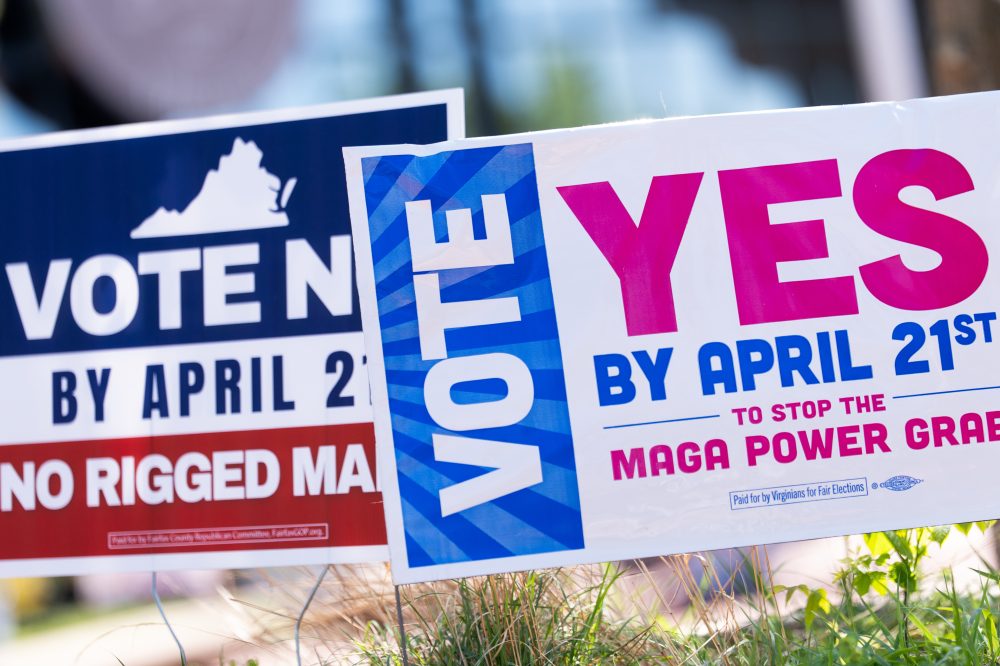

Virginia’s highest court will examine arguments Monday regarding a GOP legal challenge to a newly approved congressional redistricting plan that voters endorsed last week, potentially delivering Democrats four extra seats in the U.S. House.
The Republican lawsuit argues that the Democrat-controlled General Assembly broke procedural rules when they put the constitutional amendment on the ballot to allow redistricting in the middle of the decade. Should the justices determine that legislators violated proper procedures, they might nullify the amendment and make last week’s statewide electoral decision void.
These Virginia court hearings represent another development in a nationwide redistricting fight between the two major parties as they compete for control in November’s election, which will decide if Republicans keep their slim House majority.
Former President Donald Trump encouraged Texas Republicans to redraw their districts for partisan gain last year, hoping to secure multiple House seats. This action triggered comparable efforts across the nation, culminating in Virginia voters endorsing their state’s revised map last week.
Florida comes next, where Republican Governor Ron DeSantis has put congressional redistricting on the schedule for a special legislative session starting Tuesday with the GOP-controlled state legislature.
During a Sunday appearance, Trump expressed support for Florida’s redistricting effort while condemning Virginia’s Democratic-backed amendment.
“It’s a very bad thing for our country. Very, very bad,” he told Fox News Channel’s “The Sunday Briefing.”
The partisan redistricting battle has resulted in roughly equal gains so far. Republican strategists believe they might capture up to nine additional seats through redrawn districts in Texas, Missouri, North Carolina and Ohio. Democratic analysts estimate they could secure as many as 10 extra seats through revised maps in California, Utah and Virginia. However, court battles continue in both Virginia and Missouri.
Virginia’s current House delegation includes six Democrats and five Republicans who won election from districts created by judicial order after a bipartisan redistricting commission couldn’t reach consensus following the 2020 census. The recently approved districts, which barely passed with voter support last Tuesday, might improve Democratic prospects in 10 congressional races.
The state Supreme Court must decide whether these districts should be thrown out due to flawed legislative procedures.
Since Virginia’s redistricting commission was created through a voter-approved constitutional change, legislators needed to propose another constitutional amendment to handle redistricting themselves. This process demanded approval of a resolution during two different legislative sessions, with a state election occurring between them, before placing the amendment before voters.
In January, Judge Jack Hurley Jr. of rural Tazewell County in southwestern Virginia determined that lawmakers didn’t follow proper procedures when adding the redistricting amendment to last fall’s special session. The Circuit Court judge also found that legislators failed to approve the amendment initially before voters began casting ballots in last year’s general election, and that the state didn’t publish the amendment three months before the election as legally mandated. Based on these findings, he declared the amendment invalid and void.
Virginia’s Supreme Court suspended Hurley’s ruling and permitted the redistricting vote to move forward before scheduling arguments on the matter. Republicans have initiated at least two more legal challenges that are also moving through the court system.