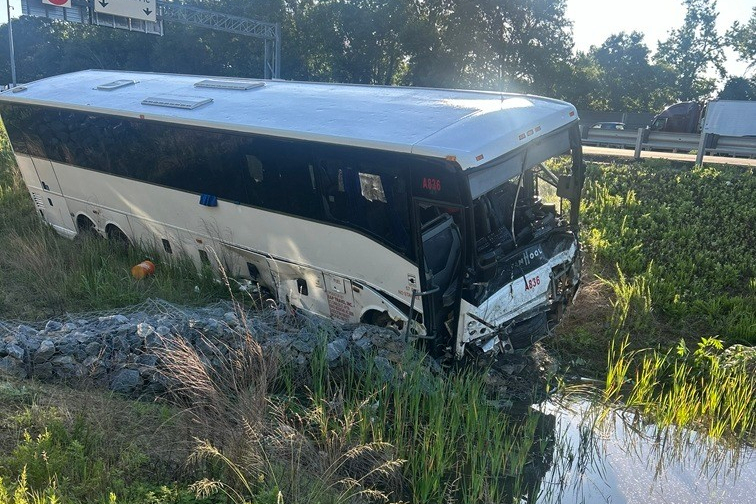

A devastating bus accident in Virginia that claimed five lives and left dozens injured has brought renewed attention to safety issues plaguing the commercial transportation industry.
Although the National Transportation Safety Board investigation into last week’s tragedy is in its early stages, the incident underscores the severe consequences when large commercial vehicles collide with other traffic — despite buses being statistically safer than personal vehicles.
Many passenger cars now come equipped with collision-prevention technology and automatic emergency braking as standard features, yet commercial buses continue to operate without these systems — despite long-standing NTSB recommendations and proposed federal regulations calling for their installation.
The timing of the accident, which occurred early Friday morning, has prompted questions about whether driver exhaustion played a role. Additionally, court documents reveal that the E&P Travel Inc. operator, who now faces manslaughter charges, had been cited previously for excessive speed violations, as had other drivers employed by the same company.
Although these infractions may not have been sufficient to automatically suspend the individual’s commercial driving privileges, transportation industry professionals indicate that even a single comparable offense would typically result in termination under normal circumstances.
“The fact that there was one conviction and another citation and this driver is still on the road goes against industry norms and best practices in a pretty significant way,” said Fred Ferguson, who leads the American Bus Association trade group.
The lack of enforcement authority for NTSB crash investigators contributes to why numerous safety recommendations remain unimplemented for years, as the industry and regulatory agencies frequently prioritize potential financial impacts.
“Everybody walks a walk in talking safety at the industry level, at the congressional level. And then at the end of the day, it’s the same old excuses,” said Jim Hall, who was chairman of the NTSB during the 1990s. “And if it costs money, there’s going to be a strong resistance.”
Federal regulations stipulate that drivers convicted twice within a three-year period for exceeding speed limits by more than 15 mph should face a 60-day disqualification.
The operator involved in last week’s accident, Jing Sheng Dong of Staten Island, New York, had previously been convicted of traveling 73 mph in a 55 mph zone in Virginia in 2024, and received another citation in March in Annapolis, Maryland, for allegedly driving a motorcoach 72 mph in a 50 mph zone. The 48-year-old now faces five involuntary manslaughter charges and one reckless driving count.
However, Ned Einstein, an expert witness in approximately 700 transportation lawsuits, expressed doubt that the criminal charges filed following the crash will effectively improve road safety because Dong didn’t establish the conditions that likely contributed to the incident.
“They never hit the heart of the problem and never go after the person who’s responsible, and the person that’s responsible for these things is the person that runs the company,” Einstein said, explaining that drivers have to take the shifts they are given while company owners set the schedules and run the businesses.
Friday’s collision occurred around 2:30 a.m. ET — approximately five hours into a journey from New York to North Carolina. This timing has led former state trooper Jeremy Disbrow, who helps train law enforcement with the Commercial Vehicle Safety Alliance, to question whether fatigue may have been a contributing factor.
Federal regulations prohibit bus operators from driving more than 10 hours or working more than 15 hours without taking at least eight hours of rest. Electronic logging systems have improved enforcement of these rules compared to paper logbooks, though instances of tampering with electronic records have occurred.
Documentation shows that another E&P Travel driver was involved in a comparable accident in North Carolina in 2024 that injured nine people after the bus failed to reduce speed for a traffic control vehicle performing a moving lane closure. The bus struck that vehicle, and a third vehicle then rear-ended the bus. The bus operator, Pei Jie Lu, subsequently pleaded guilty to failure to reduce speed. That crash happened three months after Lu was ticketed in Maryland for negligent driving and unsafe lane changes, according to court records. He pleaded guilty in that case in September 2024.
Transportation Secretary Sean Duffy has stated federal investigators are examining Dong’s background along with the company that employed him and the school that provided his training. The Federal Motor Carrier Safety Administration is also working to verify that New York properly followed regulations when issuing Dong a commercial driver’s license. Duffy has worked to strengthen and enforce standards for CDL holders, but that effort has focused on truck drivers.
Even when the National Highway Traffic Safety Administration endorses safety improvements like automatic braking, finalizing requirements often takes years. Commercial buses, for instance, have only been mandated to have seat belts since 2016.
Many NTSB recommendations for buses and other commercial vehicles remain unimplemented, including stricter standards to reduce driver fatigue and ensure adequate rest periods between trips. A regulation requiring collision-avoidance technology in commercial buses and trucks was proposed in 2023, but it remains under review.
Implementation ultimately depends on regulators, Congress and the industry to adopt these measures. Unlike regulatory agencies that must perform cost-benefit analyses, the NTSB isn’t required to consider the practicality of its recommendations. It simply advocates for safety improvements to prevent future tragedies.
The Transportation Department didn’t immediately respond this week to questions about why so many recommendations go unfulfilled.
The American Bus Association trade group works to promote safety measures and Ferguson said driver-monitoring technology, such as inward-facing video cameras and advanced telematics systems similar to those used by major auto insurers, has become common. Some of those systems can even send alerts about driver behavior to a bus company.
Ferguson also said some companies have installed collision-avoidance technology on their buses because “the difference between catastrophic accidents and not having catastrophic accidents is you keeping your company.”
However, cost remains a consideration — a new motorcoach previously cost roughly $650,000, and the industry is now dealing with the impact of 10% tariffs. Ferguson said newer buses have the most safety features, but increasing costs will slow upgrades.
“Operating safely not only is morally and ethically what they believe in, but it’s good business,” said Ferguson, whose group represents about 40% of the 1,800 companies that operate about 50,000 motorcoaches across the United States and Canada.