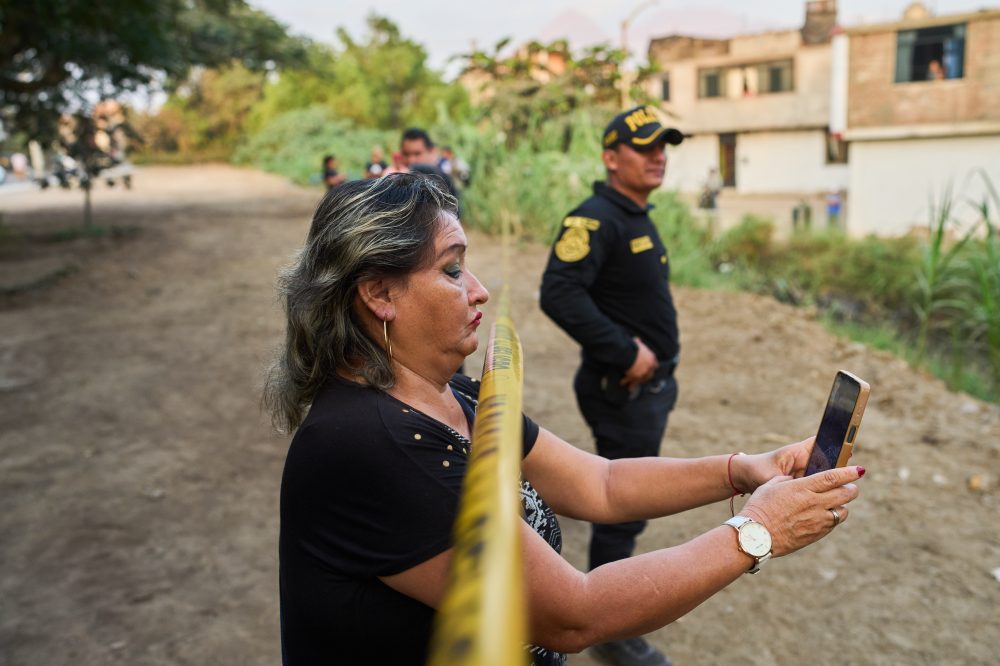

TRUJILLO, Peru — Along Peru’s northwestern Pacific coastline, market vendor Gladys Saavedra watches warily as unfamiliar faces approach the small marketplace where she and other women workers face a grim reality: collectively pay $300 monthly to criminal extortionists or face devastating consequences.
When the women at the Trujillo market refused the demands last June, criminals torched their workplace. The vendors protested and demanded government protection in the following days, but received no help. This lack of response came as no shock to Saavedra, whose home was bombed with explosives during another extortion scheme in August 2024.
As Peruvians prepare to choose their next president in Sunday’s runoff election, this escalating gang violence has become voters’ primary concern. Many citizens will venture to polling locations with deep anxiety about becoming crime targets during their journey.
“You can’t even stick your head out for fear of being shot,” Saavedra, 49, said.
While extortion first appeared in Trujillo over two decades ago, the criminal activity has exploded across Peru during the past five years. Government statistics show extortion reports jumped fivefold to 28,948 cases in the previous year, while homicides doubled to reach 2,226 in 2025.
Law enforcement officials and security analysts link the criminal organizations’ growth in Trujillo to their connection with unlawful gold mining operations. These groups initially earned money by offering protection services to illegal miners in nearby areas, then invested those profits in hiring assassins, purchasing firearms, and expanding their urban influence.
Government figures reveal that illegal mining produces roughly $7 billion each year, significantly exceeding the approximately $1.2 billion generated annually through drug trafficking.
Transportation companies became the initial extortion targets, with drivers facing death if payments weren’t made. These workers remain prime victims, as at least 239 drivers were murdered nationwide last year, according to the independent Observatory of Crime and Violence.
More than half of those killed operated motorcycle taxis, commonly used in city outskirts where paved roads are scarce. However, bus driver murders have sparked transportation strikes and public demonstrations.
Security specialists connect organized crime’s growing influence in Peru to profits that long-established criminal organizations earn from illegal gold extraction in the Andes and Amazon regions. Peru exported 100 tons of illegally extracted gold in 2025, nearly equaling the 109 tons of legally mined gold it exported.
In a Trujillo district that produces one-fourth of the nation’s footwear, union representative Máximo Varas reported that approximately 1,500 small business operators in the shoe industry make payments to extortionists to continue operating.
“Everyone pays — even I get extorted. No one is safe,” he said.
Throughout Trujillo, numerous buses, restaurants, corner shops, nightclubs, and educational institutions display stickers on their building fronts. These markers include puma images, crosses, and Batman symbols. Law enforcement officials explained that these stickers signal businesses have made extortion payments. Authorities sometimes patrol Trujillo removing these markers and replacing them with police stickers.
Business owner Iván Díaz, 58, believes violence has grown “unreasonably” in Trujillo. Criminals disguised as law enforcement officers abducted him from his workplace in 2023, holding him captive for 11 days. To secure a $250,000 ransom, his kidnappers severed portions of two fingers on his right hand and transmitted torture videos to his relatives to “advance the payment.”
“I had to adapt to reality and keep a cool head,” Díaz said.
Courts sentenced four members of the criminal organization Los Pulpos to life imprisonment in May for Díaz’s kidnapping. This group originated in Trujillo during the 1990s and later spread operations into neighboring Chile.
The Ministry of Economy calculated in July that criminal activity costs Peruvians approximately $5 billion annually. This amount encompasses government investment in police operations plus private expenditures on surveillance equipment and security personnel.
Peru’s peripheral neighborhoods lack paved streets, clean water, and electrical service, but most critically, they lack police presence. By comparison, affluent municipalities like the capital’s San Borja, where both presidential candidates — conservative Keiko Fujimori and progressive Roberto Sánchez — reside, maintain large numbers of uniformed officers plus additional private security forces patrolling their areas.
Security professionals argue that fighting crime requires eliminating corruption within the national police force, which employs approximately 130,000 officers, plus substantial funding for investigations.
An investigator working on organized crime cases, who requested anonymity because he lacks authorization to speak with media, told The Associated Press that technology limitations prevent police from tracking phones linked to digital payment systems that criminals use for collecting extortion money.
Congressman-elect and former police officer Harvey Colchado stated that each of the nation’s 70 police investigative divisions received $29,000 monthly budgets five years ago, but currently operate without funding as the government redirected money to other purposes. He noted this problem worsens due to recent legislation supported by both Fujimori’s and Sánchez’s parties that complicates criminal prosecutions.
The legislation Colchado mentioned removed preliminary detention in specific situations and increased requirements for seizing criminal property and conducting searches.
“This is a cancer,” Saavedra said. “(Police) don’t have the resources to trace the calls, to know where the messages are coming from. That’s the only way to stop it.”