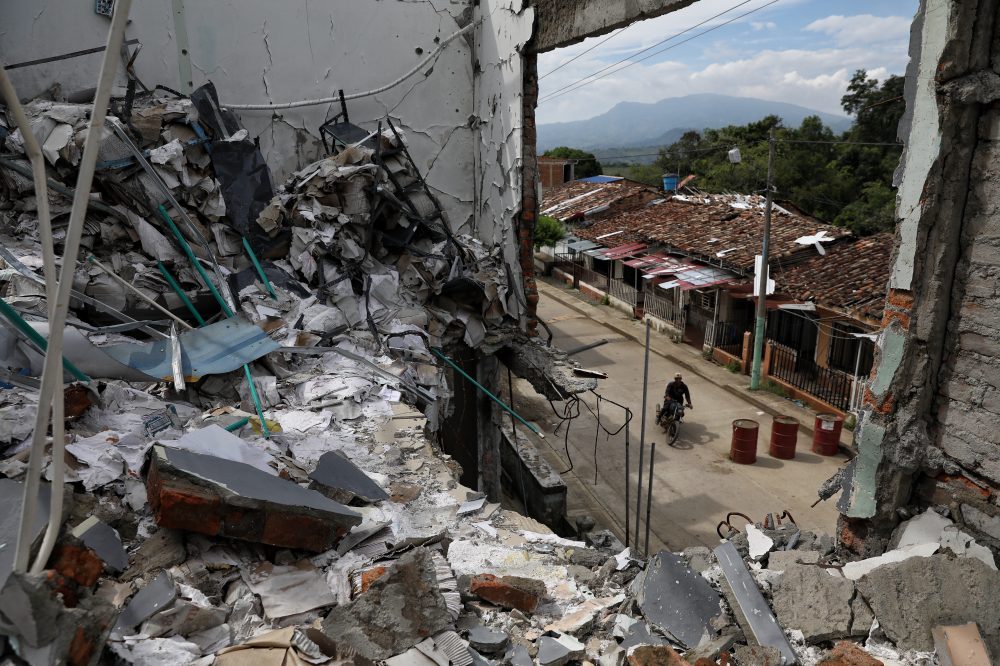

JAMUNDI, Colombia — Gladys Marín faces a difficult decision this Sunday. Though the polling station sits just across the street from her home in the small Colombian town of Potrerito, safety concerns may prevent her from casting her ballot in the country’s presidential election.
Marín’s residence sits within 100 meters of the local police station, which has repeatedly been targeted by explosive devices dropped from drones. Government officials attribute these assaults to rebel fighters who refused to accept a peace deal negotiated with the Colombian government ten years ago.
“You have to stay alert to what is happening, because we live very close to the police station,” Marín explained while speaking from her porch in the town located approximately 470 kilometers from Bogotá, the nation’s capital.
The South American nation will select its next president and vice president on May 31 in elections widely viewed as a judgment on President Gustavo Petro’s administration, particularly his divisive “total peace” program designed to establish negotiations with remaining insurgent organizations.
Most observers agree that violence from armed factions has intensified during Petro’s presidency.
Data from Colombia’s Electoral Observation Mission shows that 386 municipalities — roughly one-third of all local governments — face threats from illegal military organizations. Research from the Ideas for Peace Foundation indicates approximately 27,000 individuals remain armed across the nation.
In the nearby community of Robles within Jamundi municipality, makeshift barriers block roads approaching the police headquarters. Law enforcement personnel have fortified their positions behind sandbag and black fabric shelters, constantly monitoring the skies for incoming drone threats.
“You pass by the police station with this sense of dread, looking up, hoping you won’t run into a nasty surprise,” explained Eucaris Zamora, who was forced to abandon her residence after a cylinder bomb damaged it in October, leaving the structure partially demolished.
Guillermo Londoño, a regional security administrator in Valle del Cauca where Jamundi is situated, noted that criminal armed organizations have adopted coordinated “swarm-style” drone operations to increase destruction. This represents a change from earlier methods where attackers used single drones, reloaded them, and continued their offensive.
Explosive-carrying drones have transformed Colombia’s internal conflict dynamics since 2024, creating significant dangers for both civilians and military personnel, especially near the Venezuelan frontier, in northern Bolivar province, and along southwestern coastal regions.
The Defense Ministry documented 333 drone strikes in 2025, a sharp increase from 61 incidents in 2024. Military forces have logged 107 drone assaults this year alone, resulting in two soldier fatalities.
Regional authorities believe their area has suffered consequences from Petro’s “total peace” approach, which seeks to end one of the globe’s most enduring conflicts.
Petro admits the program has not succeeded in dismantling illegal networks as intended, and his willingness to engage with all groups has become more restrictive. He has suspended talks with certain organizations due to ongoing violence while maintaining communication with others.
A sharp division exists among presidential candidates. Some support continued negotiations with illegal groups, including Sen. Iván Cepeda from Petro’s political coalition. Others advocate abandoning such efforts in favor of military action, such as opposition Democratic Center Sen. Paloma Valencia and Abelardo de la Espriella, who describes himself as an admirer of Salvadoran President Nayib Bukele and promises aggressive action against armed groups.
Elizabeth Dickinson, a senior analyst at the International Crisis Group, warns violence could escalate if an aggressive candidate wins office.
“Right-wing candidates propose a ‘hard-line’ response that could exacerbate the violence, because the armed groups will respond to pressure from security forces with terror-style attacks, as they lack the means to respond symmetrically, army-to-army,” Dickinson stated.
Last December, gunmen terrorized the small southern community of Buenos Aires, attacking the police facility and injuring multiple officers while destroying a local bank and surrounding residences.
The destruction included the home of 89-year-old Celimo Enrique Aguilar.
“I haven’t lost faith that, someday, one might be able to live in peace,” he said.