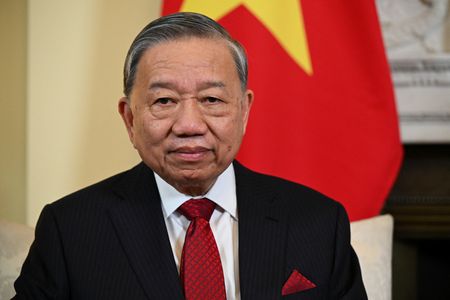

Vietnam’s National Assembly unanimously approved Communist Party chief To Lam for the position of state president on Tuesday, granting him dual leadership authority that political analysts say represents the most significant concentration of power in the Southeast Asian nation in decades.
The parliamentary approval, which was widely expected, formally breaks with Vietnam’s longstanding tradition of shared leadership among multiple officials. This shift toward centralized control mirrors developments in neighboring China and could fundamentally alter how the single-party state operates moving forward.
Lawmakers endorsed the Communist Party’s selection of Lam, a decision that party officials confirmed was reached during closed-door discussions in late March. The 68-year-old former security chief now holds both the general secretary and presidential positions simultaneously for a five-year term, after securing his second stint as party leader this past January.
Following the legislative vote, Lam addressed parliament members in remarks broadcast on television, expressing gratitude for the dual appointment. He outlined his vision for the country, promising “a new growth model with science, technology, innovation, and digital transformation as the primary driving forces.” Lam also emphasized his commitment to strengthening national defense capabilities through domestic resources.
Singapore-based political expert Le Hong Hiep from the ISEAS Yusof Ishak Institute warned about potential consequences of this power consolidation. “Concentrating greater power in To Lam’s hands could pose risks to Vietnam’s political system, such as increased authoritarianism,” Hiep noted. However, he acknowledged that streamlined leadership “could enable Vietnam to formulate and implement policies more quickly and effectively,” potentially boosting economic development.
Alexander Vuving from the Asia-Pacific Center for Security Studies in the United States described the change as transformative. The dual role arrangement “will shift Vietnam’s domestic politics to a new normal where most of the old assumptions about Vietnam’s politics, including those about collective leadership, are no longer valid,” Vuving explained.
This marks Lam’s second time holding both positions simultaneously. He previously served in both capacities for several months in 2024 following the death of former General Secretary Nguyen Phu Trong. Even after temporarily stepping back from the presidency in favor of military leader Luong Cuong, Lam continued conducting presidential duties, including extensive international travel and diplomatic meetings with foreign officials.
Throughout his initial tenure as party leader, Lam has pursued ambitious economic restructuring aimed at enhancing Vietnam’s global competitiveness, though his initiatives have generated mixed reactions. He has committed to achieving double-digit economic growth by moving away from the low-wage manufacturing model that has traditionally powered Vietnam’s export economy under foreign corporate leadership.
While Lam’s reform agenda has sometimes created uncertainty within government circles and the business community, he has demonstrated adaptability in his approach. He supports expanding private sector conglomerates but has also issued guidance reinforcing the importance of state-owned companies, apparently to maintain support from party conservatives.
International businesses, which play a crucial role in Vietnam’s export-focused economy, generally view the country’s political consistency favorably and regard Lam as business-friendly. Nevertheless, his promotion of domestic corporate champions and aggressive growth targets have sparked concerns among some observers about potential favoritism, corruption vulnerabilities, speculative bubbles, and inefficient resource allocation.
In international relations, Lam has maintained a balanced approach. He continues Vietnam’s established “Bamboo Diplomacy” strategy, working to maintain equilibrium among major global powers while pursuing broader international cooperation.
Boston College visiting scholar Khang Vu believes the leadership consolidation will not alter Vietnam’s foreign policy direction. “Lam’s double-hat would not signal any changes in Vietnam’s foreign policy, even if there are concerns that Vietnam is concentrating more power in a single individual,” Vu stated.