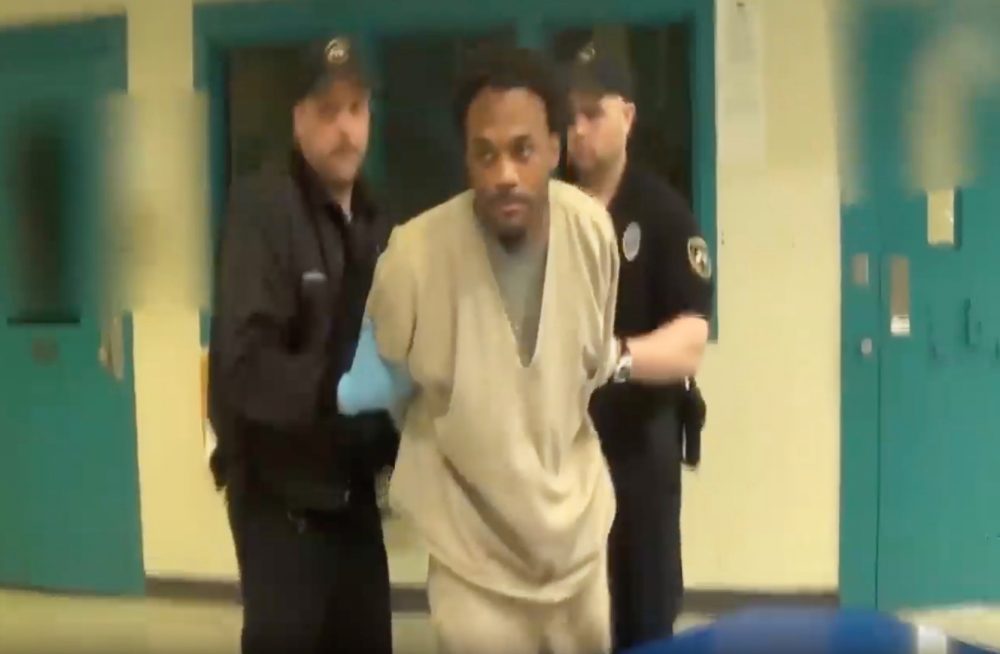

HARTFORD, Conn. — A Connecticut judge has released video footage from 2018 showing correctional officers repeatedly striking inmate J’Allen Jones, who was in the middle of a mental health crisis, shortly before his death at a state prison.
The footage was made public Friday by a Hartford state judge overseeing a lawsuit filed by Jones’ family against eight officers and a prison nurse. Both sides agreed to certain portions of the video being edited out before its release, following years of legal proceedings.
The Department of Correction had fought to keep the video sealed since 2019, arguing its release could create security risks by revealing the prison’s physical layout and staffing patterns. However, Jones’ family, the American Civil Liberties Union of Connecticut, and local NAACP officials pushed for the video to be made public, arguing that transparency was essential in understanding how Jones died.
Ron Murphy, an attorney representing Jones’ family, drew a stark comparison in court documents, writing: “The events in the video are as disturbing as the events in the video of George Floyd’s death” — referring to the man killed by a Minneapolis police officer in 2020. “But in some ways, the video of J’Allen’s death is worse.”
Jones, 31, originally from Atlanta, was serving a 10-year sentence for robbery at Garner Correctional Institution in Newtown — approximately 25 miles west of New Haven — when he died on March 25, 2018. At the time, correctional officers were attempting to escort him to the prison’s medical unit for mental health treatment.
Segments of the 52-minute recording show Jones handcuffed behind his back, and later with his legs restrained, as officers struck his legs and torso with their knees and fists after he refused a strip search. At one point, an officer pins Jones face-down on a bed with a knee on his back while other officers hold him in place.
Court documents indicate Jones was experiencing a schizophrenic episode at the time. He can be heard yelling in the video, much of it difficult to understand. He repeatedly shouts, “In the blood of Jesus Christ!” and at one point tells officers, “I command you … to uncuff me now!”
Throughout the video, officers repeatedly instruct Jones to stop resisting and calm down, with one officer telling him they are only trying to help.
Roughly 17 minutes into the footage, Jones appears to begin struggling to breathe after the spit bag is placed over his head and pepper spray is directed at his face. Nearly five minutes later, he appears to lose consciousness as officers struggle to hold him upright and place him in a wheelchair. At approximately the 24-minute mark, an officer asks for a nurse to come check on Jones.
“Right now he’s just being dead weight, and I just want to make sure he’s OK,” the officer says, speaking toward a camera being held by another officer.
Around 28 minutes into the video, a nurse begins performing CPR and an officer radios for someone to call 911. An ambulance does not appear until more than 43 minutes into the recording. Jones was later pronounced dead at a nearby hospital.
In the hours following Jones’ death, the Department of Correction released a brief statement saying Jones had become “non-compliant and combative with staff and then became non-responsive.” The statement made no mention of officers striking Jones and noted there were no immediate signs that excessive force had been used. It said life-saving measures were taken and Jones was transported to a hospital.
The medical examiner’s office concluded that Jones died from “sudden death during struggle and restraint with chest compression and pepper spray exposure in person with hypertensive and atherosclerotic cardiovascular disease.” His death was ruled a homicide, though that classification does not automatically mean a crime took place.
In January 2019, a state prosecutor concluded that no crimes were committed in connection with Jones’ death.
An internal Correction Department review also found that excessive force was not used. However, it determined that the eight officers and the nurse violated department policy by failing to recognize for more than seven minutes that Jones was in medical distress — though the report noted this was not intentional.
Department records show all nine staff members received one-day suspensions without pay as punishment. The correctional officers’ union did not respond to a request for comment.
Jones was Black. His attorney noted that eight of the nine defendants are white, and one is Black. In court filings seeking the video’s release, Murphy stated it was important for the public to view the footage and consider “whether his race or schizophrenia played any role in how his cries for help and gasps for air were perceived and handled.”
“I hope everyone who chooses to watch the video does so with an open heart, remembering that J’Allen Jones was a father and a son and that his family grieves every day,” Murphy said in a statement released Friday afternoon, adding that he hoped the footage would lead to improvements within the prison system.
Murphy also urged viewers to be cautious: “I found the video very difficult to watch as it depicts the painful death of another human being. So please take care of yourself while watching and if you experience overwhelming feelings, consider taking a break or reaching out to someone for support. Thank you.”
The Correction Department’s interim commissioner, Sharonda Carlos, responded to questions from The Associated Press about the video and how officers handled the situation. In a statement, she said the agency is continuously working to improve the services it provides to inmates dealing with mental health issues.
“Any loss of life in our facilities is a tragedy that we feel deeply, and our sympathy remains with Mr. Jones’ family and loved ones,” she said.
Carlos added that she appointed a psychiatrist to lead the department’s inmate medical services in May, and that the agency is rolling out significant improvements to its mental health training for staff.
“Behind every individual in our care is a family hoping for their well-being, and we do not take that responsibility lightly,” she said.