
MILAN (AP) — Days before the world’s most prestigious contemporary art exhibition was set to open, the entire international jury for the Venice Biennale stepped down Thursday amid controversy over Russia’s participation in the event.
The arts organization announced that jury president Solange Farkas along with members Zoe Butt, Elvira Dyangani Ose, Marta Kuzma, and Giovanna Zapperi had all resigned, though officials provided no official explanation for the unprecedented decision.
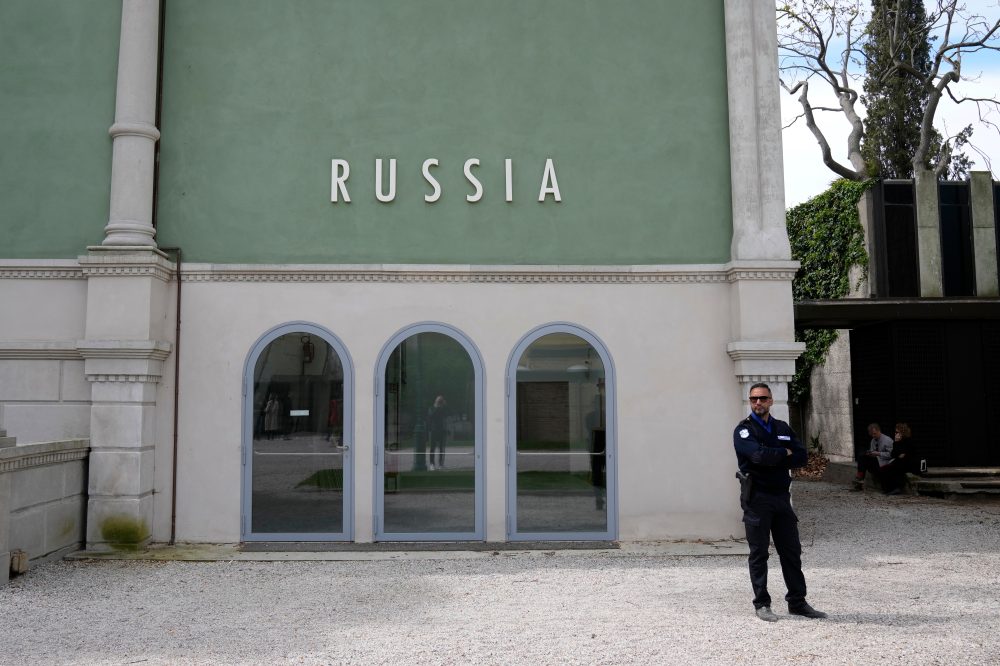
The resignations occurred after Italian Cultural Ministry representatives visited the Biennale on Wednesday to investigate the reopening of Russia’s pavilion. Italy’s leadership has publicly criticized the exhibition’s choice to welcome Russian participation.
Originally, the jury was scheduled to announce winners of the coveted Golden Lion award and other honors when the exhibition officially launches May 9. With the jury’s departure, organizers announced that attendees will now vote for two recognition categories: Best Participant in the 61st curated Exhibition “In Minor Keys” and Best National Participation among the 100 country pavilions. Winners will be revealed on the final day, November 22.
When questioned about the resignations, Prime Minister Giorgia Meloni restated her administration’s disagreement with allowing Russian involvement while recognizing the Biennale’s independence. She indicated uncertainty about whether the resignations were linked to her Culture Ministry’s inspection decision.
Cabinet Minister Matteo Salvini praised the shift to public voting, calling it “a great idea” by Biennale leadership. “So it will be an autonomous and democratic Biennale,” he said. “It doesn’t get any better than that.”
Last week, the European Union reduced its financial support to the Venice Biennale by 2 million euros ($2.3 million) due to Russia’s return to the exhibition for the first time since Moscow’s 2022 Ukraine invasion.
Russian artists pulled out of the 2022 event, and Russia didn’t mount an exhibition in 2024 for its permanent pavilion space, instead lending it to Bolivia. Russia’s last participation in the International Art Exhibition occurred in 2019.
In a statement, the Biennale explained it “does not have the authority to prevent a country from participating. Any country recognized by the Italian Republic may request to participate.”
Because Russia owns its pavilion constructed in 1914 within the historic Giardini grounds, it needed only to notify organizers of its intention to participate, according to Biennale officials.
“La Biennale di Venezia rejects any form of exclusion or censorship of culture and art. The Biennale, like the city of Venice, continues to be a place of dialogue, openness and artistic freedom, encouraging connections between peoples and cultures, with the constant hope for an end to conflicts and suffering,” the organization stated.
The Venice Biennale contemporary art showcase stands as the globe’s oldest and most significant exhibition of its kind, featuring a central exhibition alongside individual country pavilions that participating nations curate independently.
Historically, the Biennale has resisted external pressure to ban countries from participating, including previous calls to exclude Iran and Israel.