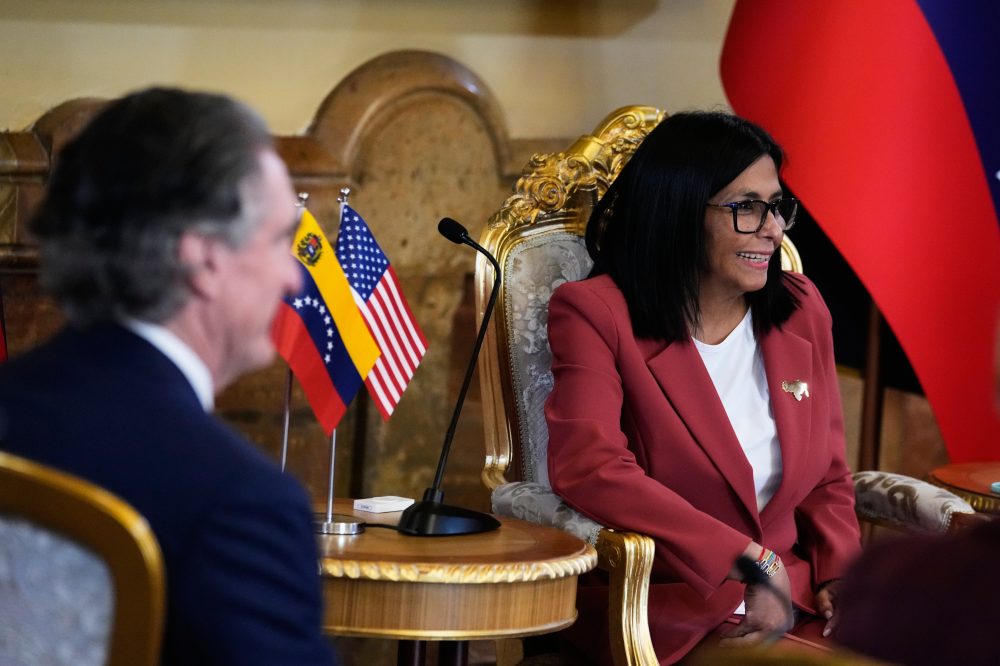

CARACAS, Venezuela — At a Saudi-sponsored investment conference in Miami on Wednesday, Venezuela’s acting President Delcy Rodríguez made a compelling case for long-term investment opportunities in her nation’s energy sector, highlighting recent reforms designed to attract foreign capital to the country’s oil industry.
Speaking virtually to the Miami conference from Venezuela, Rodríguez outlined an overhauled petroleum sector that now welcomes private investment, international dispute resolution, and external oversight—changes implemented in the roughly three months since U.S. forces apprehended her predecessor Nicolás Maduro and Washington began executing a staged recovery plan for the struggling nation. Notably absent from her remarks was any reference to Maduro, as she concentrated on convincing prospective investors that Venezuela now offers secure investment opportunities due to recent industry restructuring.
Rodríguez forecasted that the nation would experience double-digit economic expansion this year and through the next two years, establishing conditions “where investors know that, regardless of political changes or restrictive circumstances, there is security, that Venezuela has laws that allow for the safe return of their investments.”
“We are in a process of stabilization, implementing the reforms needed for a productive environment and to attract investments that will diversify the engines of the Venezuelan economy,” she stated during her presentation, which was delivered completely in Spanish.
The South American nation possesses the globe’s most extensive oil reserves and previously leveraged them to fuel what was formerly Latin America’s most robust economy. However, widespread corruption, poor management, and U.S. economic penalties caused output to drop dramatically from the 3.5 million barrels daily produced in 1999, when Maduro’s political mentor Hugo Chávez assumed leadership, to fewer than 400,000 barrels daily by 2020.
During 2019, the U.S. Treasury Department under the initial Trump presidency effectively banned Venezuela from international oil markets by imposing sanctions on the government-controlled Petróleos de Venezuela S.A., or PDVSA, as part of measures targeting Maduro’s administration for corrupt practices. This action compelled the government to market its remaining petroleum production at reduced prices—approximately 40% under market value—to purchasers including China. Venezuela even began accepting payment in Russian rubles, trade goods, or digital currencies.
The nation presently generates roughly one million barrels daily.
During Wednesday’s presentation, Rodríguez emphasized Venezuela’s minimal production expenses and flexibility in negotiations.
“When we consider a barrel of oil, its production cost, 64% of that barrel has room for negotiation with the investor regarding royalty reductions, income tax reductions, and most importantly, the dividends the investor receives,” she explained. “If there is a large investment, obviously the return will be higher on that 64%.”
Rodríguez assumed office following Maduro’s and his wife’s apprehension on January 3 in Venezuela’s capital city, Caracas, before being transported to New York to face drug trafficking allegations. Both individuals have entered not guilty pleas and are scheduled for a court appearance Thursday.
Upon taking leadership, Rodríguez, facing Trump administration pressure, rapidly restructured petroleum industry regulations. New legislation now permits private enterprises to control oil production and marketing, eliminating PDVSA’s exclusive authority over these operations and pricing decisions. The law also establishes independent arbitration for conflicts, replacing the previous requirement that disputes be resolved exclusively through Venezuelan courts, which remain under ruling party influence.
In response, the U.S. Treasury Department has relaxed sanctions. Last week, it issued comprehensive authorization permitting PDVSA to directly market Venezuelan oil to American companies and international markets, representing a dramatic policy reversal after years of largely prohibiting transactions with Venezuela’s government and energy sector.