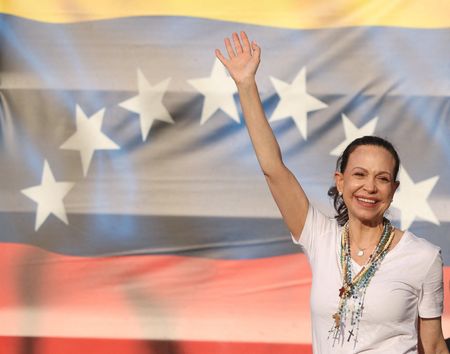

Venezuelan opposition figure Maria Corina Machado announced her intention to return to her homeland before 2026 concludes, while pressing the United States to expedite electoral preparations in the South American nation.
In a recent Reuters interview conducted Sunday evening, the Nobel Peace Prize recipient stated she “absolutely” anticipated being back in Venezuela in the near future. She cautioned that postponing elections could increase the likelihood of domestic turmoil.
“We believe that in order to (manage) the anxiety and expectations and the urgency of the Venezuelan people in an orderly, civic way, it is very important to start taking steps towards what the whole country requires and demands, which is free and fair elections,” she said.
Following President Nicolas Maduro’s capture by U.S. forces in January, some opposition members hoped Machado, age 58, would assume a leadership position in governing Venezuela. However, President Donald Trump appointed Delcy Rodriguez, Maduro’s former deputy, to lead instead, citing Machado’s insufficient support for immediate governance.
Machado departed Venezuela in December, breaking a decade-old travel restriction to accept her Nobel Prize, after spending over a year primarily in concealment following the controversial 2024 elections.
Those elections saw Maduro declared victorious over opposition contender Edmundo Gonzalez, sparking nationwide demonstrations. Machado, who has an industrial engineering background, was prohibited from seeking office.
While Rodriguez has earned commendation from the U.S. administration for her work, Machado dismissed this as evidence of Trump’s long-term support for Rodriguez.
“What I heard was President Trump praising how she follows his instructions,” she said.
“They (the Rodriguez government) have never been as weak as they are right now… they are starting to realize that things have changed and this is a totally different moment.”
Machado emphasized that Venezuelans anticipate significant governmental and economic reforms following Maduro’s detention, and these expectations must be addressed quickly to avoid potential “anarchy.”
“It’s like a huge dam that’s been (gathering) more and more and more energy, frustration, and courage, and expectations,” she said.
“My challenge, our challenge, is to channel those energies peacefully, civically, with one objective, which is an electoral process. If people feel that this is not the purpose of all that’s going on, these forces could get out of hand.”
She indicated that voter registration systems require updating to include previously disenfranchised citizens and new electoral council members must be chosen, processes that could be completed “in eight or nine months.”
Machado avoided directly criticizing Trump’s pace, noting she had presented him with her Nobel Prize medal.
“We wouldn’t be where we are right now, moving ahead, if it wasn’t for the U.S. administration and President Trump’s decision to bring Nicolas Maduro to justice.”
“But certainly I understand the urgency and demands of my people and I think we should move ahead in the democratic and electoral process.”
During her Madrid visit, Machado organized a Saturday gathering for Venezuelan exiles, attracting thousands to a plaza in Spain’s capital where she promised their eventual homecoming.
Approximately 25% of Venezuela’s population has dispersed throughout Latin America, the Caribbean, Spain, and the United States since 2014, escaping an oil-reliant economy damaged by poor governance.
While meeting with Spain’s conservative opposition politicians, she refused to see Prime Minister Pedro Sanchez, criticizing the Spanish government’s inadequate response to the Maduro administration.
“We expected Spain to be perhaps the main voice in highlighting the horrible situation of our country, the crimes against humanity that have been committed, the terrorism of state that has been deployed. Unfortunately, it didn’t happen.”
“Fortunately there are other voices – and I’ve met with some of them this week – and we certainly feel that we do have in Europe an ally to Western values and to build back in Venezuela institutions that will last for centuries.”
Since her Venezuelan departure, Machado has primarily resided in the United States and expressed joy at reconnecting with her three grown children.
“As a mom I’ve always felt very guilty in terms of the consequences my family, especially my children, have suffered because of my decisions,” she said.
“I tell myself every day that I do it for them, for every single young Venezuelan and those that have not been born yet, that they will have a country that they feel proud about and they can live as free citizens.”
For security purposes, Machado had requested her children relocate abroad after she became a legislator.
She has also appreciated discovering technological advances from the past two decades that hadn’t reached Venezuela, particularly finding Uber transportation services remarkable.
“On the other hand, I am used to my country. I feel I should be back with my people and I’m counting the days.”