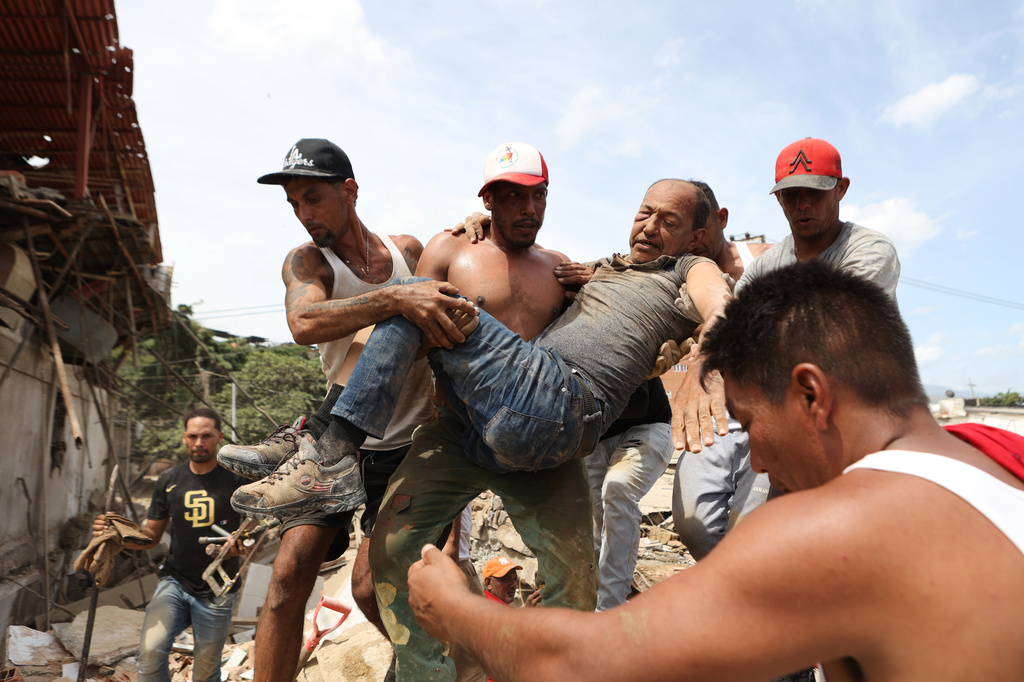

LA GUAIRA, Venezuela — Ordinary citizens worked side by side to claw through collapsed buildings in search of missing family members across northern Venezuela Friday, following two devastating earthquakes that have now claimed at least 589 lives and left thousands more hurt.
Acting President Delcy Rodríguez announced the updated death toll early Friday morning, speaking alongside government and military officials as she greeted international rescue teams arriving from around the globe.
“We are going to rescue the people who are trapped,” she said. “We are working tirelessly on this task.”
Rodríguez said the state of La Guaira has suffered the worst damage from the 7.2 and 7.5 magnitude earthquakes that struck Wednesday evening. She noted the area has been placed under military control as crews continue searching for survivors and distributing food and water to those in need.
The death toll is expected to rise further, with thousands of people still reported missing and rescue efforts ongoing around the clock.
The International Organization for Migration estimates that as many as 6.76 million people across Venezuela may be affected by the quakes, including roughly 2 million in the capital city of Caracas alone. Loyce Pace, the International Red Cross’ regional director for the Americas, noted that “people are still terrified to reenter what were their homes.”
Survivors were pulled from wreckage covered in dust and blood — among them children. Venezuelan state television broadcast dramatic footage of rescues, including one woman who had been pinned beneath a concrete slab with only her bare foot visible before crews managed to pull her out alive. However, government-organized search teams were largely absent outside of Caracas in the early hours following the disaster.
Many residents woke Thursday morning to a shocking scene — buildings reduced to bare frames, furniture dangling from broken windows, and helicopters circling overhead. Entire structures had been flattened and roads split open.
Families posted flyers with photographs of missing loved ones, while others passed around handwritten lists of names. Venezuelans living abroad struggled to reach relatives as phone service across the country was disrupted.
In downtown Caracas, hundreds of people spent the night gathered in parks, parking lots, and other open areas rather than risk returning to damaged buildings.
Dayana Delgado, a mother of three, demanded to know where the heavy machinery that government officials had promised was located, saying it was ordinary residents doing the digging through collapsed structures.
“I want to know where my child is, if he’s trapped or in a shelter,” she said, referring to her missing 8-year-old son.
One mother broke down and collapsed in grief as the bodies of her 3- and 10-year-old children were wrapped in blankets and carried away. Others cried out the names of those they were searching for. Some stood in complete silence, too shocked to react.
Venezuelan authorities said they were redirecting rescue teams from other parts of the country to La Guaira — a region no stranger to tragedy. A devastating mudslide in 1999 killed thousands there and remains one of the country’s worst natural disasters on record.
In La Guaira, resident Cristian Carreño stood staring at his scorched apartment building, which was leaning dangerously to one side.
“I lost everything,” he said. “There are people still inside, I imagine, that couldn’t get out. It’s incredibly devastating.”
Retired schoolteacher Juan Alberto Mendaño made his way through the wreckage in La Guaira, stepping past a body, when he spotted a woman who was trapped and waving her hand for help.
“May God rescue her as quickly as possible,” Mendaño said. “When we heard the scream, there was nothing we could do.”
Among the stories of hope emerging from the destruction, a young man was carried out on a stretcher in the San Bernardino neighborhood of Caracas to applause from bystanders, while his tearful mother cried out, “Leandro, I love you.”
Venezuelan public television also showed video of a young girl, covered in dust and wrapped in a dark sweatshirt, emerging from the rubble with the help of rescuers. Caracas metropolitan rescue team head José Luis Núñez said she was found inside a 10-story building in La Guaira that had collapsed and been crushed “like a pancake.”
“We want to highlight this girl’s strength, determination and will to live,” Núñez said.
The disaster presents a major challenge for Acting President Rodríguez, the former vice president who took office in January following the capture and removal of then-President Nicolás Maduro by the United States. Venezuela has been mired in economic turmoil for more than a decade, and many citizens do not recognize the legitimacy of the political movement Rodríguez leads.
Rodríguez declared a state of emergency in a national address late Wednesday and announced the creation of a $200 million reconstruction fund to help rebuild damaged hospitals and homes. On Thursday, she urged businesses to make heavy construction equipment available to support rescue operations.
“We hope to rescue as many living people as possible,” Rodríguez said.
While Venezuela lies near several fault lines, its location along the boundary of the South American and Caribbean tectonic plates makes major earthquakes relatively rare compared to other parts of Latin America.
The U.S. Geological Survey reported that both earthquakes were centered near Moron on the Caribbean coast, approximately 170 kilometers — or 105 miles — west of Caracas.
The combination of two back-to-back quakes and the shallow depth of the seismic activity intensified the destruction, according to Marcos Ferreira, a geophysicist and researcher at the Geological Survey of Brazil.
“It is as if I am screaming and then someone starts screaming, too. That amplifies the vibration and adds to the potential hazard,” Ferreira explained.
Shortly after United Nations officials in Venezuela urged the government to lift restrictions on social media so that survivors could access potentially life-saving information, Venezuelans found they were able to log onto X. The platform had been blocked since August 2024 under the Maduro government in an effort to limit the spread of information among those who disputed his claimed victory in the July presidential election.
Around 1,000 emergency responders organized into 25 search-and-rescue teams from countries around the world are being deployed to Venezuela, according to Jens Laerke, a spokesperson for the U.N. Office for the Coordination of Humanitarian Affairs.
U.S. Secretary of State Marco Rubio, who spoke directly with Rodríguez after the quakes struck, confirmed that the United States was moving quickly to send assistance.
“We have a whole-of-government response. It’ll be big; it’ll be fast; and it’ll be effective,” Rubio said, while acknowledging that the closure of Venezuela’s main airport near Caracas was creating logistical hurdles.
Venezuelan public television broadcast footage Friday showing the arrival of rescue workers with dogs and specialized equipment — including cameras and ground-penetrating radar — from Spain. Teams from Germany, Chile, and Switzerland also landed in the country. Turkey announced two flights would depart Istanbul on Friday carrying rescuers and search dogs. China said it would also provide assistance, and leaders from Qatar, Brazil, Portugal, and Canada pledged to send help as well.
Rescue teams from El Salvador and the Dominican Republic touched down in Venezuela on Thursday, along with rescuers and material aid from Mexico.
“No country is prepared to provide the response that’s needed. That’s what neighboring countries are there for,” said Dominican air force Maj. Carlos Olivares.