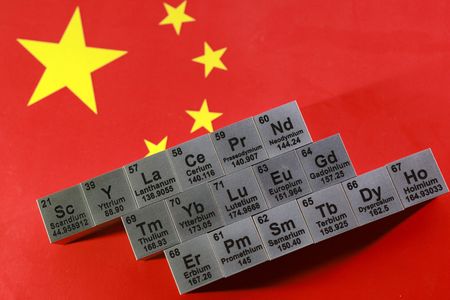

The White House announced Sunday that China has agreed to address American concerns regarding critical mineral shortages, following agreements reached during last week’s leadership summit. However, the announcement stops short of demanding the elimination of export restrictions that have caused significant disruptions to US aerospace and semiconductor production.
Beijing implemented these controls in April 2025 as a response to US President Donald Trump’s Liberation Day tariffs. The restrictions continue to severely limit exports of specific rare earth materials, despite an agreement reached at October’s Busan summit where the White House stated China had pledged to “effectively eliminate” all existing and planned critical mineral export controls.
Six months later, the White House’s most recent statement appears to quietly accept that China’s export control system will remain operational. The announcement also failed to address whether a temporary one-year suspension of broader Chinese rare earth restrictions, set to end in November, would be renewed.
According to Sunday’s fact sheet outlining major outcomes from the Beijing summit, China committed to addressing American concerns about shortages of essential minerals and rare earths, specifically yttrium, scandium and indium.
The document also indicated China would tackle US worries regarding export limitations on rare earth processing technology, which Beijing strictly protects to safeguard domestic manufacturers who handle nearly all global production.
In contrast to the White House announcement, China’s Ministry of Commerce did not reference rare earths in its own summary released Saturday.
“The gap in this case is not ideal, but fine,” stated Cory Combs, associate director at macro research firm Trivium China.
“What’s most important is that both sides have clearly, credibly indicated interest in stability and they are able to effectively market that message to their own domestic audiences.”
While export permits for rare earths are being processed for industries such as automotive and consumer electronics, companies operating in sensitive sectors where these materials have potential military uses continue facing significant delays.
Previous reporting revealed that persistent shortages of yttrium — a component in heat-resistant coatings for aircraft engines — and scandium utilized in semiconductor production have seriously affected American industry. Businesses have pressured Washington to negotiate with Beijing on their behalf.
Among the critical minerals the White House mentioned for the first time is indium, which serves an essential function in both upstream and downstream semiconductor supply chains and has appeared on China’s export control list since February 2025.
The compound indium phosphide is vital for producing advanced photonic chips that utilize light rather than electricity for data processing, along with high-speed optical lasers employed in fiber optic networks and 6G systems. Another compound, indium tin oxide, is necessary for manufacturing LED displays in consumer electronics.
Companies like Coherent are increasing production of photonic chips that are being rapidly incorporated into AI data center development worldwide.
Chinese indium exports have dropped substantially in the 14 months following February 2025 compared to the equivalent period previously, according to customs data. Global shipments have decreased by approximately two-thirds, with US shipments falling by 77%.
Coherent’s CEO joined the executive delegation that accompanied Trump during his visit, with all participating companies confronting regulatory or political challenges in China. Coherent controls a 40% global market share in indium phosphide optical components.
“If Chinese licensing remains slow or politically contingent, Coherent could face higher input costs, allocation problems, delayed capacity expansion, and difficulty meeting hyperscaler demand,” explained Paul Triolo, partner and China technology policy lead at DGA-Albright Stonebridge Group.